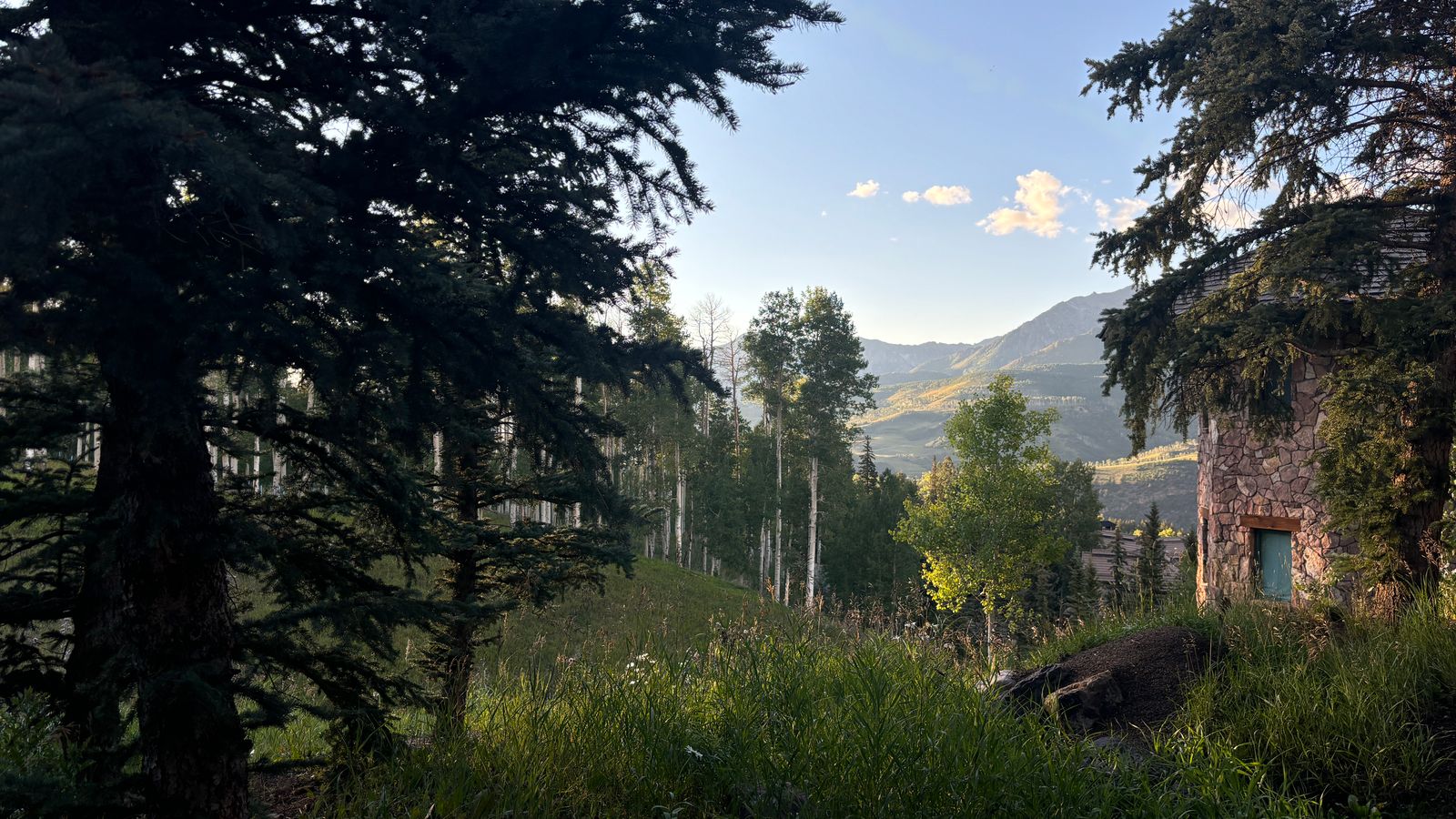
The San Juan Mountains. Southwest Colorado Territory. 1874. The Wild West.
An untamed wilderness stretched on for as far as the eye could see, with desolate peaks, surrounded on every side by thick, almost impassible forests of spruce and pine. No roads. No dirt footpaths. Nothing.
Just nature. On the edges of the mountain range, there were only a few permanent human settlements with miles and miles of rugged terrain in between them. For three centuries, the area had been inhabited by a nomadic Native American tribe, the Ute. But, like most places west of the Mississippi in the aftermath of the Civil War, more and more white men had travelled to the region in the hopes of panning and mining for gold.
Often at their extreme peril.
The San Juan mountain range has an elevation of around 14,000 feet above sea level. The peaks look like jagged arrowheads thrusting into the sky. The high elevation inflicted harsh winters on the region, often with layers of six feet of snow at a time, furious icy winds that cut to the bone, and temperatures dropping well below -20 degrees Celsius or -4 degrees Fahrenheit. And once the huge mounds of snow coated the landscape and animals concealed themselves from the cold, the only food you could rely upon were the provisions that you brought with you.
The risk of starvation in the endless icy wilderness was all too real. Even the Ute did not dare to traverse the San Juan Mountains in winter. They told travellers it guaranteed death. Yet, that winter, one of the worst in living memory, six white men, tempted by the prospect of gold, had tried to do exactly that.
It had not gone well. Or rather, it hadn’t gone well for five of them.
The Discovery at Dead Man Gulch
In stark contrast, on August 20th 1874, half a year after the six men had disappeared, summertime in the San Juan Mountains was tame and immensely beautiful. The peaks gleamed majestically in the sunlight, the dense forests were a verdant green, exhaling the unmistakable sweet scent of conifers. It was in this unspoiled paradise that John A. Randolph, artist for Harper’s Weekly, hiked and sketched, spending quiet nights under twinkling stars.
Harper’s Weekly had a circulation of several hundred thousand people back East. As a slogan, it vainly declared itself “the best family newspaper in the world.” The paper’s masthead at the time bore the words “A Journal of Civilization”, as Harper’s chronicled the progress of “Manifest Destiny” and regularly gave its readership a window into the wonders of the West.
That is why John Randolph was there, to visually document nature and frontier mining life for the curious inhabitants of the eastern states in their smog-laden cities. By any metric, Randolph was enjoying his assignment and basking in the warmth of summertime in the San Juan Mountains.
But then he stumbled upon a gruesome relic of the previous winter.
After struggling for hours through a dense forest grove, Randolph arrived at the banks of the Gunnison River, just two miles north of Lake San Cristobal. There he spotted, a little further upstream, at the bottom of a steep bluff, the mutilated and decaying bodies of five men. Randolph made his way toward the sprawled figures, accompanied by nothing but the sound of trickling water and the crunch of his own footsteps.
It was clear that the corpses had lain there for quite some time, but they had not yet fully decomposed. For months, a blanket of snow and frigid temperatures had preserved the bodies through the entire spring, until the unusual level of snowfall that year had finally melted away as unseasonably late as July. Then the bodies had thawed and started to rot.
Wildlife had gotten to two of the five corpses, stripping the bones of flesh and scattering them around the site of the massacre. A creature of some kind had carried the skull of one of the men into the forest and it was nowhere to be found. Scavenging wildlife had defleshed the other skull, and a long, jagged puncture wound stretched along its cranium, most likely inflicted by a hatchet.
The three other corpses were a different matter. The local wildlife had not yet gotten to them. Their discoloured faces were still intact, beards and all. Two of them had also been killed by a hatchet blow to the head.
They had defensive wounds on their arms. The murderer had likely crept up to the five men in the middle of the night, killed two of the men in their sleep with the hatchet, and killed two more as they awakened, while they helplessly raised their arms to shield themselves. The final victim had managed to get to his feet and put up a fight. He had been shot in the gut and then had his head bashed in with a rifle.
The gun lay nearby, broken in two from the violence of the impact with the man’s skull. The top of his head had been smashed open and his rotting brain was fully exposed.
Although the faces of three of the victims were still mostly intact, the flesh on their bodies was not. The men had been flayed from the neck down, the skin fully removed from their torsos exposing their internal organs, which now bloated and decayed in the Sun. The only skin that remained on their limbs was on their hands and feet. Most disturbingly of all, the killer had removed large chunks of muscle from the thighs, calves, arms, chest, and buttocks of the victims, butchering them like cattle for prime cuts of meat.
The killer did not remove any organs or try to extract any bone marrow. Apparently, being fussy and not lacking for choice, he had focused purely on harvesting muscle.
A little ways into the forest was a crude “lean-to” shelter created from spruce trees and held together with a few bits of twine. The killer must have slept there for several days after the murder, keeping away from the corpses. Within the shelter were a few strips of dried skin and what appeared to be the gristle of cooked human flesh. The killer had obviously fed upon his victims.
Also in the shelter was a bag of flour and a few cans of preserved fruit and vegetables - apples, peas, and corn. The murderer of the five men hadn’t even run out of provisions before cannibalising them.
Horrified and sickened, John Randolph fled down the Gunnison River until he came across the camp of a gold prospector, Hezekiah Musgrave, who demanded to see where the bodies were located. Randolph and Musgrave returned to the site of the murders, but did not linger. They headed off down-river to sound the alarm. A few hours later, in the afternoon, Randolph and Musgrave arrived at a gold mining encampment.
They told the miners there what they had seen. The group sent a runner to fetch the county coroner and law enforcement from the nearest settlement, while a posse of 20 men headed back to the murder site to secure the area, preserve the evidence from wildlife, and generally just to bear witness to what had happened.
One of the gold miners, John R. Pond, was so disgusted by what he saw that he could not bear to go near the human remains. But then, to his surprise, he noticed that John A. Randolph stood over the corpses, quietly sketching them.
He did not spare or censor his work - he drew a mass of broken bones and desiccated faces amid a pile of blankets and tattered rags. It looked as horrible as it sounds. Despite the grisly nature of John Randolph’s illustration, it was printed in Harper’s Weekly, “the best family newspaper in the world”, several weeks later. The place where the bodies were found quickly came to be known as “Dead Man Gulch.”
The coroner arrived and examined the bodies. Then they were taken from the gulch and buried in one-foot unmarked shallow graves on a small, treeless summit 8 miles away from the massacre site. The area was swiftly named “Cannibal Plateau.” Six men had ventured into the San Juan Mountains in February 1874, against the advice of the local Ute tribe. There were only five corpses. The sixth man was likely the killer. But where was he now?
The Arrival of a Stranger
A few months earlier, on April 16th 1874, a strange man arrived at the Los Pinos Indian Agency, approximately 70 miles east of Dead Man Gulch, on the other side of the San Juan Mountains. The Los Pinos Indian Agency was a US Government administrative hub to handle the supply of food and medicine to the recently subdued native tribes, who were now constrained to reservations. The Agency itself was a gaggle of hastily erected wooden shacks to house US bureaucrats and their families, along with a slow trickle of sundry travellers making their long journeys across the West.
Beyond that, there was a blacksmith, a stable, a communal mess hall, and a small schoolhouse for the camp children. All told, the Indian Agency harboured a few dozen inhabitants at any given time. Hardly the pinnacle of civilization.
But to the strange man emerging from the wilderness and crossing the frozen creek toward the cluster of wooden huts, it might as well have been Paris.
The strange man was first spotted by 24-year-old Alonzo Hartman, a cowboy who was wintering at the Agency before rejoining his coworkers at their cattle herd. As Hartman watched the strange man crossing the snow-covered ground, he noticed the man carried a Winchester rifle in one hand, and a coffee pot in the other. Hartman later learned that the coffee pot contained hot coals, which the strange man gathered from his last campfire and could use to light a new one – for he had no flint or matches with him. His clothes were tattered; his hair long, matted, and greasy.
His scraggly, unkempt beard gave signs that he had been in the wild for quite some time. But he walked at a leisurely pace.
The strange man approached and asked Hartman, “Is this the Agency?” The man was missing his two upper front teeth. He was approximately 5-foot-8, with high cheekbones and piercing blue eyes, spaced slightly too wide apart. Something about his eyes gave Hartman the impression the man was mentally unstable. Hartman replied that this was indeed the Agency, and then asked the strange man where he came from. The strange man simply replied, “The mountains.”
Assuming he was cold and hungry, Hartman guided the strange man to the communal mess hall. Four other men looked up from their breakfast as Hartman ushered the strange man inside. He asked for food, so they gave him a plate of beefsteak. The strange man tried to eat some of it and vomited. Once he recovered, the strange man asked for whiskey instead. He explained that his stomach must be unsettled from prolonged starvation in the mountains.
One of the other men in the mess hall, Agency Constable Herman Lauter, questioned the stranger, who claimed that he had departed the camp of Chief Ouray of the Ute tribe on the other side of the mountains, two months earlier in February. He had been with five companions. They were gold prospectors hoping to stake a claim at some mineral deposits near Breckenridge, on the other side of the mountain range, 200 miles northeast from Ouray’s camp, before anyone else could get there. And so, they had decided to cross the San Juan Mountains during winter.
Their plan was to travel 75 miles due east across unforgiving, rocky terrain to the Indian Agency, along the quickest route through the mountain range. There was no way their horses were going to make it through the thick forests and several feet of snow, so the six men intended to make the journey on foot. Once they reached the Indian Agency, their plan was to purchase some new horses and ride over 100 miles north, across the foothills, to Breckenridge and their potential gold claim.
The strange man explained that, not long after their departure, he had become snow-blind and could not keep up with the other men. So they had given him a rifle and a few cans of food and abandoned him in the mountains, promising to send help once they reached the Indian Agency. It was a journey that, in theory, was supposed to take 15 to 20 days, one-way. If he had stayed put, the strange man would probably have died from starvation or exposure before any help arrived.
The strange man said he recovered from his snow-blindness after a couple of days, after which he set out on his own and got lost in the wilderness. He had minimal ammunition and he couldn’t find any game to hunt anyway. The strange man claimed he had subsisted off of roots and rosebuds the entire time. Eventually, he had to boil and eat his leather shoes, and wrapped his feet in several layers of rags.
In total, he spent 65 days in the San Juan Mountains, braving subzero temperatures. Then, at long last, he had reached the foothills of the mountains and the Los Pinos Agency.
The strange man claimed that he didn’t have any money and sold his Winchester rifle for $10 ($276 in modern money) to one of the other men in the mess hall - a Major James Downer, a former Pennsylvania congressman and the camp’s Justice of the Peace. Then the strange man declared that he would head to the nearby supply town of Saguache, population 350, where he would recover from his ordeal. The strange man bought a pair of boots and caught a wagon for Saguache the very same day.
But something about the strange man’s story struck Constable Lauter and Justice Downer as rather odd. He had been starving in the wilderness for two months. And yet, the strange man did not look thin and malnourished. In fact, he looked rather well fed.
Meet Alfred Packer
Alfred Griner Packer was born in the Pennsylvania countryside on the outskirts of Pittsburgh on January 21st 1842 to parents James and Esther. He was one of eight children. His father was a carpenter and shortly after Alfred’s birth, he moved the family to the small town of La Grange, Indiana (not to be confused with the 20 other towns named “La Grange” in the United States). Nothing is known about Alfred Packer’s early childhood.
We do know that sometime during Packer’s teenage years, he fell out with his parents and moved to Minnesota to become an apprentice shoemaker. We also know that, by this time, Alfred Packer had developed epilepsy, and he regularly suffered from violent seizures.
In April 1862, when Packer was 20 years old, he joined the Union Army to fight in the Civil War. He was sent to Columbus, Ohio, for training. While there, Packer got a tattoo on his arm that read “Alferd Packer, Second Battalion 16th Infantry” with his first name misspelt. The permanent typo of A-L-F-E-R-D on his arm was not the fault of the tattooist. It was due to Packer being barely literate and unable to spell his own name. Such were the times.
Alfred did not last long in the Union Army. By Christmas 1862, he was discharged at Fort Ontario, New York State, for, quote “being incapable of performing his duties due to epilepsy.” Indeed, Packer’s seizures were frequent enough to impede basic tasks like marching, patrol, and guard duty. But Packer was not to be dissuaded.
He travelled west to Iowa and enlisted with the Union Cavalry, saying nothing about his previous dismissal. They were sent south to the front in Tennessee. In November 1863, Packer was fined by his commanding officer for looting and robbing people in the city of Nashville. In April 1864, Packer was again thrown out of the army, with the report saying he had a seizure, quote, “every 48 hours and sometimes two or three times every 48 hours.”
Packer then drifted around the West for a bit, working as a ranch-hand, saddler, trapper, teamster, hunter, and “wilderness guide” - though his qualifications for the last of these were often brought into question. Packer frequently got lost. Packer was also argumentative, arrogant, and his bad attitude ensured that he did not keep a job for very long. He was also rumoured to be a compulsive liar and to regularly engage in thievery. In general, Packer was not well liked.
In 1869, Packer was in Colorado working as a coal miner near Breckenridge until he blew off the tips of two of his fingers in a mining accident. Then he worked as a so-called “jack whacker”, leading mule teams through the San Juan Mountains to supply various mining operations. It was here that Packer supposedly should have developed a knowledge of the terrain that later made him fit as a guide.
By 1871, Packer was in Utah, where at some point he did 90 days behind bars after being caught by Mormon authorities in a brothel. There were also rumours that he had been forging banknotes. Packer began working in a copper mine, where he contracted lead poisoning.
After several months in a sickbed, he made a recovery and moved to the tiny town of Sandy, Utah, where he worked at a smelting operation and promptly got lead poisoning again. He again recovered by November 1873, despite his quack doctor prescribing nothing but laxatives, when he got word that there were fresh gold and silver strikes in his old stomping grounds in the San Juan Mountains of Colorado.
Packer headed to Salt Lake City, Utah, where he linked up with a man named Bob McGrue, who was leading a wagon train of 22 men to Colorado. The goal of the expedition was to claim a fresh gold strike in the San Juan Mountains. Each man who wanted to go along had to pay McGrue $50 (or $1311 in modern money) as a stake in the expedition, so they could gather the necessary supplies for the journey. Packer claimed he was broke and told McGrue that he would work hard as a dogsbody along the road, and that he knew the San Juan Mountains well.
Packer said he could guide McGrue’s expedition from Salt Lake, across 465 miles, all the way to Breckenridge, Colorado, in just 21 days. They’d be digging out gold by Christmas.
In reality, a simple wagon train in those days couldn’t possibly travel 465 miles in 21 days. Not even if it travelled at top speed, on flat terrain, and certainly not in winter with an enormous mountain range in between them and their destination. But McGrue was naive and an easy mark. Packer managed to sweet-talk him into covering his fifty bucks.
Although most people who met Packer seemed to loathe him, McGrue was an exception. Packer kissed his ass and McGrue enjoyed listening to Packer have theological debates with the Mormons while they were still in Utah. McGrue thought Packer was, quote, “smart and a fine talker.” There is also an unsubstantiated theory that McGrue was gay and that Packer had seduced him.
But, as mentioned, McGrue was very much an exception. When the wagon train departed in late November, it wasn’t long before the rest of the men in the expedition began to heartily dislike Packer. First of all, they had only been on the road a few days when it became clear that Packer had no idea where he was going.
He kept getting the wagon train lost. Second, Packer was whiny, irritating, and quarrelsome. Men on the expedition took note that Packer had a grating, high-pitched voice and he rarely ever shut up.
Packer grumbled constantly about the lack of provisions, even though he had not paid his fifty bucks, and he was the one who had assured McGrue they could reach Breckenridge in just 21 days, and he always ate more than his fair share. Several times, the men on the expedition caught Packer stealing food. Third, Packer kept interrogating people about how much money they brought with them and then turning around and attempting to gossip about it with others.
This was a red flag for many of the men that Packer might be planning to rob them somewhere along the road. But not for Bob McGrue, who continued to sleep with Packer in his wagon every single night.
Several days into the journey, about 40 miles south of Salt Lake, the expedition set up camp outside the town of Provo, still in Utah. They were already far behind schedule. Packer and a few other men were warming themselves around the campfire when Packer had an epileptic fit. He fell into the fire, knocking over a coffee pot in the process, sending jets of steam into his face while the flames licked his clothes and singed his hair.
The other men around the fire did not move a muscle. They just watched him flail and burn. Eventually, Bob McGrue had to come charging over from his wagon to rescue Packer from burning to death. We do not have a good idea of the extent of Packer’s injuries except that he was, quote, “in the fire for quite a while and was a bad sight.”
When Packer regained consciousness, he lied to McGrue that it was the first ever fit he had in his life. But from that point forward, Packer had a seizure every single day, sometimes multiple times a day. It was McGrue who invariably looked after him, holding him still during the fit, and tenderly caring for Packer as he lay exhausted and immobile. One night, when Packer had a seizure in the wagon he shared with McGrue, the latter woke up and shouted for help.
In reply, someone outside yelled, “Damn you! You wanted him along! Now take care of him!”
After that incident, Bob McGrue stopped asking for help.
Roasted Bicep
By the time the wagon train had reached the Colorado border, even McGrue had given up on Packer as a guide. He sent two other men on horseback to scout for the best route forward. By this point, it was mid-December and the snow lay so thick on the ground that you could not find any roads, trails, or footpaths. Not that many existed in the first place.
After a few days, the expedition encountered some Native Americans, whom they paid to show them the way for a few days before the natives departed, explaining that they were about to enter the territory of their tribal enemies and could go no further. The wagon train was left to wander again.
December gave way to January. It was at this point that the men began to starve. They had no more provisions and they could find no animals to hunt except for the occasional rabbit. Packer had boasted that he could guide the expedition from Salt Lake City to Breckenridge in just 21 days. But by the sixtieth day, the wagon train was still wandering the Colorado wilderness on the other side of the San Juan Mountains from their destination. The hardest part of the journey was yet to come.
On January 25th 1874, the expedition was surrounded on all sides by a Native American war party, whooping and yelling, but holding back from a full-on attack. These were the Utes led by Chief Ouray. A representative of the war party rode forward and declared to the starving and frightened men that they were trespassing on the Confederated Ute Reservation of Southwest Colorado.
With some difficulty, the men explained that they had no intention of settling on Ute land, but were travelling gold prospectors on their way to Breckenridge. At this point Chief Ouray rode forward and warned the men not to try and cross the San Juan Mountains during winter. To do so would mean death.
Instead, Ouray offered to let McGrue’s expedition stay with them at the Ute camp and await the spring thaw. The offer was accepted and they were led to a camp at the foot of the San Juan Mountains, next to a freshwater river. McGrue’s men put together some money to buy some supplies from the Ute and they settled in for the winter.
Relations between the two groups became cordial.
A week passed. Several men in McGrue’s expedition got restless. If they waited for the spring, odds were likely that other gold prospectors, coming along easier routes from the north and east, would beat them to the new strikes near Breckenridge, if they hadn’t already.
Chief Ouray again warned them that it was impossible to cross the mountains in winter. But a group of five men from the 22-man expedition decided to make the attempt anyway. The five were led by Oliver Loutsenhizer, former sheriff of Bozeman, Montana.
They decided to bypass the worst parts of the mountains and follow the Gunnison river 40 miles south to a cattle ranch maintained by the US government to supply the Ute tribe with livestock. From there, they’d swing northeast around the mountains to Los Pinos and finally Breckenridge. When Alfred Packer tried to join them, Loutsenhizer aimed a revolver at him and threatened to shoot Packer should he attempt to follow them any further.
Enraged, Packer returned to the Ute camp. Meanwhile, Loutsenhizer and his men thought they could reach the cattle ranch to the south in three or four days. It wound up taking them three weeks. Three of the five men nearly died in the cold. And that was the so-called “easy route” along the river.
Meanwhile, back at the Ute camp, Alfred Packer convinced five other men from the expedition to travel 75 miles on foot directly east across the San Juan Mountains to the Los Pinos Indian Agency, and then north to Breckenridge. Aside from Packer, the six man expedition was composed of 16-year-old George Noon, a young lad enticed by the promise of gold all the way from San Francisco; a former butcher in his 20s named Frank Miller; another young man named Shannon Bell who had come from Michigan in search of riches; a middle-aged veteran prospector named James Humphrey, originally from Philadelphia; and a 65-year-old man named Israel Swan who hoped not only to find his own gold claim, but to quickly buy up the claims of others.
To that end, Israel Swan was rumoured to have brought around $6000 cash with him on the expedition, or roughly $165,000 in modern money. It is unknown how much money the other men had with them, but it would likely have been a few hundred dollars apiece to buy further provisions, equipment, clothes, and, as planned, horses, once they arrived at Los Pinos. Even at a highly conservative estimate of $100 to $200 apiece, that still amounted to an additional $11,000 to $27,000 for the four younger men, bringing the total amount of cash the party carried with them to around $176,000 to $192,000 today.
Packer, who had regularly inquired about how much money all the men in the expedition were carrying, was not thought to possess any currency himself. But then again, Packer may have simply lied about being broke to get out of paying his fifty dollar stake. Either way, Packer seemed to take a keen interest in the contents of other people’s wallets.
The six man expedition departed the Ute camp on February 9th 1874. They carried with them two rifles, a pistol, two knives, a dozen matches, inadequate winter clothing, and a mere 14 days of food. There was no way this was enough to survive the 75-mile journey across the mountains.
But somehow Alfred Packer managed to convince them to make the journey, no doubt stressing his time as a “jack whacker” leading mule teams through the mountain passes. Still, having seen Packer’s abysmal performance as a guide thus far, greed must also have been a powerful motivator for the five men. The 11 men still at Ouray’s camp had given up on trying to reach Breckenridge in time to lay a claim, and were simply waiting out the winter before they’d seek new opportunities elsewhere.
Bob McGrue travelled with the six man party for a day and a half on horseback, until the horses could go no further in the snow. Then McGrue unloaded their meagre supplies, wished the men luck, and guided all their horses back to the Ute camp. Aside from Packer, McGrue was the last person to see the other five men alive.
Roughly two months later, either in late March or early April, a foraging party of several dozen Ute spotted a man camped in the San Juan Mountains. They cautiously observed him from a distance. He was sitting on a log, roasting a skewered chunk of meat over a fire. The strange man spotted the Ute.
Leaving the meat to sizzle on the coals, he got up, picked something off the ground, and hastily tossed it into the river. The Ute quietly departed. A few days later, they discovered an object washed up on the riverbank. It was a human arm.
There were tiny nicks made along the length of the humerus, radius, and ulna by a knife. The bones had been completely stripped of flesh.
A Whining Fraud
On April 16th 1874, Alfred Packer emerged alone from the mountains and walked leisurely into the Los Pinos Indian Agency. He was ushered by Alonzo Hartman into the mess hall where he told a harrowing story of being abandoned to die in the mountains by his travelling companions. Packer sold the Winchester rifle he carried with him (that was actually the property of Israel Swan) for $10. Then Packer left the mess hall to make arrangements to travel by wagon to the mining supply town of Saguache, 45 miles away, to recover from his ordeal.
While Packer was making his travel arrangements, three men from McGrue’s original expedition also arrived at the Los Pinos Indian Agency. They had heeded Chief Ouray’s advice and waited out the winter at the Ute camp. These three men were: a Scotsman who called himself “Dr. Cooper”, a prospector named Preston Nutter, and a man known only to history as “Italian Tom.” They had departed the Ute camp on April 2nd and arrived at Los Pinos in just two weeks, with minimal peril.
Preston Nutter spotted Packer walking among the wooden shacks of Los Pinos. Nutter approached Packer and asked where his five travelling companions were. Packer looked visibly agitated and replied that he didn’t know. Packer explained that he’d gone out to hunt, gotten his feet wet, and they froze.
Packer claimed that, being unable to walk, the five other men had abandoned him to die. Then Packer declared that he was sick of Colorado and planned to return home to his family and friends in Pennsylvania, after recuperating for a few days in Saguache. This was a lie. Packer was estranged from his family and hadn’t been to Pennsylvania since leaving for Minnesota as a teenager.
Nutter didn’t know any of this, but was suspicious of the story anyway, having already decided during their original journey out of Utah that Packer was, quote, “a whining fraud.”
That same day, Packer caught a wagon to Saguache. On an impulse, Nutter decided to go with him. Along the journey, Nutter discovered that Packer was in possession of a knife belonging to another one of the disappeared men - the former butcher Frank Miller. Packer claimed that Miller had stuck it in a tree and simply wandered off without it when the five other men had abandoned Packer to die. Again, Nutter doubted the story, but said nothing.
The wagon arrived in the supply town of Saguache on April 23rd. It was a classic Wild West town jam-packed with saloons, prostitutes, and drunken fighting-age men. Nutter and Packer both got rooms at the only boarding house in town.
Shortly after securing a room, Packer crossed the thoroughfare to one of the saloons, owned and operated by a man named Larry Dolan. There Packer drank, played poker, and repeated several versions of his harrowing story of survival. Larry Dolan estimated that Packer spent at least $100 in his saloon during the course of his stay in Saguache, or a minimum of $2760 in modern money.
Packer also bought a horse for $70 ($1930 today) and $78 of tobacco, clothes, food, and additional booze in the local general store (or $2150 today), for a total of nearly 7-grand in modern money blown after just a few days in town. Packer also drunkenly offered to loan Larry Dolan $300, which would have been an additional 8-grand, but Dolan refused.
As more and more men from Bob McGrue’s original expedition slowly trickled into town, they became increasingly suspicious of Packer’s spending habits. After all, the “whining fraud” had claimed that he was broke, to avoid paying the $50 stake for the expedition. Packer noticed their hostility and begged Larry Dolan to stay at the saloon instead. Dolan replied that the saloon was a loud, chaotic place to sleep, with drunkards and prostitutes coming and going at all hours.
Nevertheless, Packer insisted, and wound up sleeping on the floor of the saloon, eating canned oysters and peaches, and staying thoroughly lubricated on whiskey. Whenever Dolan had to run an errand, Packer tended bar for him.
On May 1st, the commanding officer of the Los Pinos Indian Agency, General Charles Adams, arrived in Saguache with his wife to stay with Otto Mears, Adams’ friend and the owner of the general store. Packer sought them out and regaled the General and his wife (mostly his wife) with the harrowing tale of his ordeal in the mountains. Then Packer returned to Dolan’s saloon. A few hours later, Preston Nutter came barging in while Packer was drinking.
He had heard a rumour that Packer was not only spending like a madman, but had several wallets in his possession. Nutter was almost certain at this point that Packer had robbed and murdered his five companions in the mountains. Nutter attacked him and the two men had to be separated by the other bar patrons.
Packer realized he’d better skip town or else risk getting lynched by the arriving members of McGrue’s expedition. That same day, former Montana sheriff Oliver Loutsenhizer arrived in Saguache, after recovering from his near-fatal trek to the southern cattle station back in February. Loutsenhizer also encountered General Adams, who said that earlier he’d spoken to Alfred Packer and learned his companions had abandoned him to die in the mountains.
Loutsenhizer was incensed by this and told General Adams that none of the five men in Packer’s party would be so craven as to abandon someone to die over a little frostbite on their feet. They were all good, upstanding men. Loutsenhizer then told Adams that Packer was an unscrupulous little liar and was not to be trusted.
General Adams went looking for Packer and found him in the thoroughfare, about to have the shit kicked out of him (or worse) by Preston Nutter and a few other men from the expedition. Adams stood between Packer and the potential lynch mob and said that he was arranging a search party for his five travel companions and he would like Packer to join it. Packer said he was broke and needed to find work. Adams said he would pay him for his trouble.
Packer then looked at Preston Nutter and the assembled group of angry men and, unsurprisingly, decided to join the search party.
Packer, General Adams, his wife, Loutsenhizer, and a few other men departed for Los Pinos the next morning. After a few days of travel, they encountered another one of McGrue’s expedition on the road, a man named George Tracy, who asked Packer what had happened to the others. Packer told Tracy almost the same story but altered a detail that Israel Swan had died of starvation before the other four men had abandoned him.
This was to cover up for the fact that Packer had come into possession of Swan’s Winchester rifle, which he had sold for $10 in Los Pinos on April 16th, something that was bound to come out once Packer returned there. Swan definitely would not have left a brand new, state-of-the-art rifle behind, when he had another 70 miles of mountain range to cover. Thus, Packer started sowing the seeds of a story that he’d grabbed the rifle after Swan died.
A few days later, General Adams, Packer, and the others arrived back at the Los Pinos Indian Agency. But Adams had no intention of actually arranging a search party. He had merely wanted to keep Packer at Los Pinos so he could be safely interrogated without being lynched.
The first thing the General demanded to know was where Packer got all the money he had spent in Saguache. Packer claimed that an old family friend in the town, a blacksmith named “Kincaid”, had loaned him the money. The General sent a rider back to the supply town to verify Packer’s story.
A few hours later, a few Agency troopers saw Packer slipping down to Los Pinos Creek and tossing several objects into the water. These were likely the multiple wallets Packer had in his possession, still stuffed with cash. Nobody was going to believe a blacksmith loaned Packer the modern equivalent of 170 grand.
There is no official record of the wallets ever being recovered. Though perhaps a guard or a lucky passerby got an unexpected payday.
After a few days, the General’s rider returned, having found nobody by the name of Kincaid in Saguache, and finding no one else who had loaned Packer any money. Adams arranged a makeshift tribunal composed of himself and five other men to question Packer and get to the bottom of what had happened. As the impromptu tribunal was in session, two natives from the Ute tribe arrived in Los Pinos. They had found strips of dried human flesh on a hillside between Indian Agency and the mountains.
Packer had likely dumped them after finishing off the last of his grisly provisions and then leisurely entering Los Pinos – starvation never having touched him in 65 days. At this point General Adams said to Packer, quote, “I will ask you again. Where did you get the money? You might as well tell me the truth.
I do not want to send a party into the mountains to search for dead men.”
Alfred Packer sat in silence for a long time. Then he burst into tears and quietly replied, “It wouldn’t be the first time that people have been obliged to eat each other because they were hungry.”
A “Packer” of Lies
Alfred Packer told General Adams the following story:
The six man party, plus McGrue, had departed Chief Ouray’s camp on February 9th. McGrue bid them farewell on the 10th. Then the six men travelled on foot and ran out of provisions much sooner than the 14 days they had estimated (which we now know is a lie because there were still a few handfuls of flour and a few cans of food at Packer’s camp when it was discovered in August).
According to Packer, they desperately began digging through the snow to eat plant roots. Israel Swan allegedly died of starvation on February 19th, after just 10 days’ travel, and only a few days after running out of provisions. (This was also a flimsy lie since the average human being can go a month without food before dying of starvation - not just a handful of days – provided they have water).
Packer claimed that Frank Miller, Shannon Bell, James Humphrey, and George Noon immediately started to cannibalise Swan’s corpse, so Packer joined in. They left Swan’s remains where they lay and continued along their harrowing journey. (This is also a lie, since the bodies of the five men were later found all in one place, not at intervals along a trail through the mountains).
Then, after another five days of walking, on February 24th, Packer claimed that James Humphrey dropped dead. The four surviving men cannibalised Humphrey’s corpse. Packer also confessed to removing $133 from Humphrey’s possessions, or $3670 in modern money.
Several more days passed. It was now March. Packer claimed that he wandered off to gather some firewood for the campfire, and when he returned, he discovered that Shannon Bell and George Noon had murdered Frank Miller because Miller was sick and had been slowing down the journey. Bell, Noon, and Packer then allegedly cannibalised Miller’s corpse and moved on.
More days passed. But the three remaining men still could not find their way out of the snow-clogged mountains. Starving again, Shannon Bell allegedly shot George Noon with Israel Swan’s Winchester rifle. Bell and Packer then allegedly consumed the 16-year-old’s flesh. Packer claimed that he and Bell made a solemn pact not to try to murder each other.
Packer said, after a few more days the two men arrived at the banks of Lake San Cristobal (also a lie – all five men had been murdered a few miles to the northwest). Packer claimed that after arriving at the lake, Bell tried to bludgeon Packer to death with the butt of the other rifle they had with them. Packer claimed that Bell missed, and the rifle struck a tree, breaking the gun’s wooden stock in two.
Grabbing Israel Swan’s Winchester, Packer claimed he shot Bell and killed him in self-defence. We now know that Packer had likely shot Bell in the gut with the other rifle and then caved his head in with it, and that is what broke it in two – Swan’s Winchester probably wasn’t used in the murders. This was because all five men were likely murdered all on the same night and Swan probably still had the Winchester in his possession when Packer drove a hatchet into his skull. Two men, including Swan, had been murdered in their sleep, two more men had been killed while they were waking, and only Shannon Bell had managed to get to his feet before he was shot in the gut and then had his head bashed in while he lay in agony on the ground.
Packer claimed that he remained at the murder site for a few days before carrying on, taking meat from Bell’s corpse as provisions. After two weeks of wandering, Packer emerged from the San Juan Mountains and abandoned the last of Bell’s remains in the hills before entering Los Pinos.
Such, at any rate, was Packer’s story.
One of the other members of McGrue’s expedition, a man named James Montgomery, had befriended Shannon Bell and vigorously denied that Bell would ever lower himself to murder and cannibalism. Preston Nutter, meanwhile, simply declared that the story was a pack of lies.
General Adams, however, thought that the story was plausible. In those pioneering days, cannibalism was not unheard of. People did occasionally go hungry in the wilderness, and were occasionally forced to eat each other. Cannibalism itself was not illegal for precisely that reason.
But murder was. So Adams declared that Packer would be marched out, under guard, with a search party to find the five men’s remains to see if their locations and condition verified his story. The General told Packer that, if his story was true, he would even pay for Packer’s return journey to Pennsylvania.
The following day, a search party of eight men departed Los Pinos. The party consisted of Packer, three of the McGrue expedition – Nutter, Dr. Cooper, and a man named McIntosh – three Ute trackers, and the Los Pinos constable, Herman Lauter. At the time, Lauter was more concerned that the three McGrue men would harm Packer, rather than Packer trying to make an escape. Meanwhile, Packer proved himself a willing guide, dutifully retracing his route through the mountains.
However, after four days, Constable Lauter discovered that Packer was still carrying Frank Miller’s butcher knife. Packer had slipped it up the sleeve of his coat. Lauter ordered Packer to hand the knife over. In response, Packer rushed at Lauter and tried to stab him to death. Lauter grabbed Packer by the wrists and threw him to the ground. Packer was disarmed.
The nature of the search party’s mission had just changed. Packer was closely watched by the seven other men and walked at gunpoint through the San Juan Mountains, being tied to a tree at night to prevent his escape. Meanwhile, Packer stopped guiding the search party. After a few more days, they reached the shore of Lake San Cristobal, but found nothing. At this point, Packer refused to walk any further. He said, quote, “If you are satisfied that I killed those men, you can find them.”
Constable Lauter bound Packer’s arms behind his back and the two men began a return journey to Los Pinos, while the remaining 6 men in the search party continued to look for the victims. When Packer and Lauter returned to the Indian Agency, Packer was placed in the custody of Sheriff Amos Wall, who had come in from Saguache County. Packer was transported to Sheriff Wall’s ranch in between Los Pinos and the mining supply town, where he was held under constant guard in a log cabin on the property. Packer’s legs were manacled in irons for good measure.
Meanwhile, the three Ute tribesmen and the three McGrue men continued to search the shores of Lake San Cristobal. They found a place where Packer obviously had camped, but found no broken rifle, and no bodies. Speculating that Packer had thrown at least Shannon Bell’s body into the lake, they cut down a beaver dam to try and drain the waters of the shoreline a little. But they still found nothing and eventually gave up and returned to Los Pinos.
Packer was held at Sheriff Wall’s log cabin for over two months, on the charge of the attempted murder of Constable Lauter. But the charge was never prosecuted. Lauter had subdued Packer easily, and the attempted murder of a lawman was common enough in the Wild West that Lauter wasn’t overly concerned. It was just an excuse to keep Packer under lock and key until they could find proof he had murdered five men.
Attempted murder might be shrugged off, cannibalism might be legal, but the cold-blooded murder of five men in the wilderness? That, the Law could not abide.
But by the time they had found evidence of his guilt, it was too late.
John Schwartze
On August 20th 1874, John A. Randolph, artist for Harper’s Weekly, found the remains of five men at the bottom of a steep bluff near the Gunnison River. The location was only five miles from the Ute camp of Chief Ouray. This implied that Packer and his companions had barely started their journey, with 70 miles left to go, before Packer murdered the five men in a single night. Not enough time for supplies to run out and starvation to set in. There must have been another motive.
Around the same time that Randolph discovered the bodies, Alfred Packer escaped custody. It is unclear how he did so. Theories range from Packer fashioning a key to his manacles out of wood or bone, or Packer bribing a guard to let him go. Perhaps Packer hadn’t just tossed his money into the Los Pinos Creek, but rather knew where it was hidden – divulging the information to a guard or even to the Sheriff in exchange for his freedom.
Another theory is that the taxpayers of Saguache County, tired of paying for his incarceration, were the ones to bribe the guard and let Packer free.
Either way, on August 22nd 1874, a warrant was issued for Alfred Packer’s arrest. Dead or alive. The manhunt began and dozens of armed men scoured the countryside and the San Juan Mountains. But to no avail. Packer was gone.
Five years later, in 1879, a former Colorado policeman named Brayden claimed that he spotted Alfred Packer in Arizona. Another manhunt was organised. But Packer was not found. A rumour circulated that Packer had been in the area but was scalped and killed by hostile Apache natives.
Another four years passed. March 1883. Nearly a decade since Packer’s escape. Another one of the men from McGrue’s expedition, Jean “Frenchy” Cabazon, was living in Wyoming.
Like the other McGrue men, he had not made it rich in Colorado. Frenchy was now working as a travelling merchant, selling sundry goods to ranchers and doing supply runs for the inhabitants of Fort Fetterman. One night, Frenchy stopped to stay at a roadhouse. He had just stretched out his bedroll on the floor when he heard a familiar high-pitched voice coming from the other room.
Frenchy got up to investigate and saw Alfred Packer drinking and talking with the roadhouse’s owner, John Brown. Frenchy gave no sign that he recognized Packer, and went over and introduced himself. Packer shook Frenchy’s hand and said his name was “John Schwartze.” Packer was now wearing a set of crude wooden false teeth on his upper jaw (in 1874, his two front teeth had been missing).
Beyond that, Packer’s appearance was largely unchanged. Whether Packer recognized Frenchy is unknown. He may have been too drunk. Packer told Frenchy he was a gold prospector down in Spring Canyon and upon learning Frenchy was a merchant, Packer requested that he pick up some baking powder for him the next time that Frenchy resupplied at Cheyenne.
Frenchy then bid Packer goodnight and returned to his bedroll and fell asleep.
Early the next morning, Frenchy got in his wagon and raced directly to Fort Fetterman. He went to the home of Deputy Sheriff Malcolm Campbell and told him that he had run into Alfred Packer masquerading under the name “John Schwartze.” The Sheriff replied that he knew John Schwartze, and they had recently had a “run-in” down in Spring Canyon. Sheriff Campbell said he thought that Schwartze was a rather rough customer.
Campbell sent a telegram to his superior officer in Laramie, Wyoming. A day later, the reply came back, “Arrest Packer, alias John Schwartze, at once, and take no chances whatever.”
On March 12th 1883, Deputy Sheriff Campbell tracked Alfred Packer to a cabin on Wagon Hound Creek. In the late afternoon, Campbell and his brother arrived at the cabin to arrest him. As they approached, Packer came outside to meet them, and Campbell pulled out his revolver and told Packer to stop where he was. Packer replied, “What kind of foolishness is this?”
Campbell told Packer he was under arrest for murder, and reached into his coat to retrieve a pair of handcuffs. Packer tried to go for his gun. But by this point, the Sheriff’s brother had a Winchester rifle trained on Packer. He said, “Throw up your hands or I’ll put a bullet right through you.”
Packer relented and put up his hands. Sheriff Campbell strode forward and cuffed him. Campbell examined Packer’s false teeth and the missing tips of two of his fingers to confirm his identity. They did not know he had “Alferd Packer, Second Battalion, 16th Infantry” tattooed on his arm.
Alfred Packer was transported to Cheyenne, Wyoming, on March 15th, to catch a train to Denver, Colorado. He was met at the train station in Cheyenne by General Charles Adams, former commander of the Los Pinos Indian Agency. On the train ride to Denver, Adams asked Packer where he’d been since ‘74. Packer replied that he’d travelled through Arkansas, Arizona, Nevada, and Montana, before winding up as a prospector in Wyoming.
Packer also told Adams that when they arrived in Denver he’d tell him the “true story” of what had happened in the San Juan Mountains.
A Second Whiff of Cat Piss
Once Alfred Packer was placed into a cell in Denver, he made his second confession. Now he claimed that after 17 days wandering in the mountains, they had exhausted their supply of food and were living on roots and rosebuds. Packer claimed that, combined with the trauma of numerous snowstorms, the men were slowly going crazy. They wept and prayed.
Then on the 18th day, Packer departed camp to do some scouting. When he returned, he found Shannon Bell, half-crazed, roasting a piece of meat over a fire. Near him were the bodies of Frank Miller, Israel Swan, George Noon, and James Humphreys. Bell was in the process of cooking part of Frank Miller’s leg.
According to Packer’s new story, when Shannon Bell saw Packer return to camp, Bell charged at him with a hatchet. Packer shot him in the gut with a rifle and then split Bell’s head open with the hatchet (rather than the rifle which was found snapped in two). Packer claimed he spent that night around the fire with the dead bodies.
The next morning he tried to continue his journey out of the mountains, but Packer found that he was snowed in. So he returned to where the bodies were. Packer claimed that he was snowed in for the better part of two months until early April.
He was therefore forced to consume the flesh of Bell’s murder victims and Bell himself. Packer also said that he found only $70 on all five dead men, and that he also had $20 himself, totalling $90 (or $2845 in modern money). Eventually, Packer made his way out of the mountains and arrived at Los Pinos, ditching the last of the flesh on a hillside before entering the Agency.
When asked why Packer had delivered a significantly different story in his first confession back in 1874, Packer replied, quote, “I was not myself. I was, in fact, crazed and not responsible for what I said.”
Packer’s new story certainly accorded more with the murder site as it was discovered by John Randolph. It explained why the bodies were all in one place. Bell being the culprit conveniently removed any blame from Packer and placed it on the dead man. And Packer saying there was only $70 on all five bodies conveniently diminished the possible motive that Packer had killed everyone for their money.
But there were a few problems with this new version of events. Packer failed to account for the broken rifle found at the scene (perhaps after 9 years he had simply forgotten about that detail). He also claimed that the men had been out of food for days, and yet flour and a few cans of food had been found at Packer’s camp by Randolph.
And the murder site was only about five miles into the San Juan Mountains from Chief Ouray’s camp – it seemed to beggar belief that the men only made it five miles in 18 days. But, then again, with the snowstorms, hard terrain, and Packer’s general incompetence as a guide, the slow progress was at least vaguely conceivable. It was also a stretch to think that Packer was snowed in for two whole months in the same gulch with five corpses, never finding a break in the weather to make at least a little more progress out of the San Juan Mountains or turn back to the Ute camp.
And then, suddenly, Packer miraculously covered 70 miles of mountain terrain inside of two weeks, arriving safe and sound at Los Pinos. It didn’t seem very likely.
Finally, there was a problem with Packer claiming he only found $70 on the corpses, had $20 himself, and sold Swan’s Winchester for $10, making $100 total. Witnesses in Saguache stated that Packer had spent a total of $248 at the saloon, on a new horse, and on many purchases at the general store. And this doesn’t count the cost of the boots, boarding house, and the wagon ride to Saguache in the first place.
Packer had also allegedly offered the saloon-keeper, Larry Dolan, a loan of $300 but was refused. In Packer’s first confession, he said that he removed $133 from James Humphreys’ possessions alone - and that figure is probably closer to the truth of what Humphreys was carrying. Noon, Bell, and Miller were probably carrying similar amounts, given the men planned to purchase horses in Los Pinos and then race up to the gold strike at Breckenridge.
Meanwhile, Israel Swan’s family insisted he was carrying $6000 in cash and gold, or 165 grand in modern terms. Even a fraction of that would be motive enough for murder. But perhaps Swan’s family were mistaken, and all the witnesses in Saguache were wrong about how much Packer spent.
But this would require people at the saloon, the stable, and the general store to all grossly overestimate. And this also wouldn’t jive with the McGrue men becoming enraged at the time because Packer was spending like a madman. So, all in all, while Packer’s story was more believable than his first confession, it still didn’t add up.
On March 17th 1883, Alfred Packer was transported to the mountain town of Gunnison, 70 miles northwest of Saguache. His trial date was set for April 5th in Lake City, another tiny mountain town not far from the site of the massacre. Neither of these towns had existed when the six man team got lost in the San Juan Mountains nine years earlier. But such is the power of a gold rush.
Sitting in the Gunnison jailhouse, Packer was confident he’d be acquitted on account of his Shannon Bell story. He told a guard that he planned to start a saloon in Washington DC, where he’d exploit his infamy and draw in crowds curious enough to drink at the place owned by, as he put it, “Packer the Man-Eater.”
In fairness, Packer was not completely delusional. There was some ambiguity about what exactly had happened in those mountains. Packer’s story was that Shannon Bell had killed four of the five men and that Packer had killed Bell in self-defence. There was no hard evidence to the contrary.
All the prosecution had was circumstantial: Packer getting caught out in lies and changing his story multiple times, and Packer spending globs of money in Saguache, making robbery a possible motive for premeditated murder. He may have lured the men into the mountains for that express purpose.
And so, the prosecution chose to try each murder, one at a time, starting with the most solid case – Israel Swan. Unlike the other men, Swan had carried a significant amount of money with him. $6000. They’d rely on witness testimony about Packer’s spending spree in town to prove that he was lying that the five men only had $70 total on them. With that, the prosecution would try to establish premeditated murder for financial gain and secure the death penalty against Packer.
Or so they hoped. From April 5th to 7th 1883, Packer’s defense lawyer tried to get the case thrown out on the following grounds:
- In 1874, Colorado was a US territory not a state, and state laws could not be applied retroactively;
- The murders in 1874 had happened on Ute reservation land. Five years later, in 1879, the land was confiscated by the US Government after the Utes attacked Los Pinos (a US Indian Agent had tried to convert them to Christianity and encouraged them to take up farming). As such, the defense argued, a white settler court had no jurisdiction to try Packer, only the now-defunct Ute reservation did;
- The 1870 territorial murder statute under which Packer could have been tried was replaced in 1881 by a new state law, but the Colorado legislature had failed to include a standard “grandfather clause” to include untried murders committed prior to 1881 for prosecution;
- The jury selected from the Lake City area was so prejudiced by media reports of the murders and cannibalism that they would be heavily prejudiced against Packer, denying him a fair trial.
The presiding judge, Melville B. Gerry, rejected all of these arguments and the trial continued. Several of the McGrue men testified. One of the most decisive bits of testimony was Otto Loustenhizer claiming that Packer frequently inquired how much money everyone on the expedition was carrying.
General Charles Adams also testified and affirmed that Packer did not seem out of his mind when he gave his first, very different, confession back in 1874. Otto Mears, owner of the Saguache general store, testified to the huge amount of cash Packer had dropped there. As did saloon owner Larry Dolan, including losing $37 on a single hand of poker ($1023 today). And Constable Herman Lauter testified to Packer attempting to stab him to death during the search party.
Then Alfred Packer took the stand in his own defense. He denied ever asking people on the expedition how much money they had on them. Then he repeated his version of the story where Shannon Bell was the real murderer and Packer had killed him in self-defence. He denied spending huge amounts of money in Saguache, and during his testimony Packer appeared to get quite angry that so many witnesses would make up such falsehoods.
Packer also denied attempting to murder Herman Lauter, saying, quote, “Do you think Lauter or any man could take a knife away from me? Is there any man here in this room that could do it? No. I would cut his hands off before he could take that knife.
To think that one little Dutchman could take a knife away from me! No, sir!”
A rather unusual defense, to say the least.
Under cross-examination, which lasted five hours, Packer stuck to his story. The prosecutor pointed out that four of the five men looked like they had been killed in their sleep, or shortly after waking, and yet Packer said he was out scouting during daytime when it happened. In response, Packer claimed that he rearranged the bodies before leaving the camp and covered them with blankets to give them some dignity.
On the evening of April 12th, the jury went into deliberations and Packer was locked up for the night in the Lake City jailhouse, built specially at great expense for the trial, so lynch mobs could not easily burst in and kill him. Speaking to the guard, Packer said he was sure he’d be found not guilty, and remarked upon the number of women who had attended his trial. Packer interpreted their interest as the love of an anti-hero and said, quote, “Once I am free, I could easily marry a Lake City woman.”
On the morning of April 13th, the jury declared Packer guilty of the premeditated murder of Israel Swan. That afternoon, Judge Melville B. Gerry sentenced Packer to death by hanging.
A rumour circulated that, while passing sentence, Melville Gerry did his best Yosemite Sam impression and said, “Stand up, ye voracious man-eating sonofabitch! Stand up! There were seven Democrats in Hinsdale County and ye ate five of ‘em, goddamn ye! I sentence ye t’be hanged by the neck until yer DEAD, DEAD, DEAD, as a warning aginst reducin the Dimmycratic population of th’ state! I’d sentence ye t’hell but the statutes forbid it!!!”
In reality, Judge Gerry delivered a decidedly calm, erudite, and surprisingly eloquent statement that lasted several pages and even took pity on Packer in all his wretchedness. The Silver World newspaper called it, quote, “One of the finest written documents of this character ever heard.”
The Twist
On May 3rd 1883, Packer was visited in his Lake City prison cell by Reverend Quinn, who found that Packer was unrepentant but resigned to his fate. Quinn told The Silver World, “He doesn’t care. He seemed in good spirits. His appetite was good. He slept well and was comfortable. Said he’d rather hang than go to the state penitentiary.”
On May 14th 1883, the Lake City Sheriff began constructing a scaffold on which Packer was scheduled to be hanged three days later. However, on the same day construction began, the Colorado Supreme Court issued a stay of execution. The court found that, due to the lack of a “grandfather clause” in the 1881 murder law, nobody could be tried for murder in Colorado if it were committed between 1870 and 1881. The public was shocked.
An extra guard was posted at the Lake City jailhouse in case a lynch mob tried to storm the building. On May 16th, Packer was moved back to the much more secure brick jailhouse in Gunnison.
Although Packer was given a stay of execution, he was not set free. He was in legal limbo and filed an appeal with the Colorado Supreme Court to have his conviction officially quashed. He wound up spending two-and-a-half years in the Gunnison jailhouse before the supreme court got round to it.
In October 1885, the supreme court ruled that Packer’s conviction would be overturned. But that did not mean he got off scot-free. Although the Colorado justice system could not prosecute premeditated murders committed between 1870 and 1881, there was a valid statute on the books with an appropriate grandfather clause that allowed Packer to be prosecuted for manslaughter. His bail was set at $10,000 or $325,000 in modern money. $2000 per victim.
There was no way Packer could pull together that sort of cash. And so, until trial, Packer would spend another 10 months in the Gunnison jailhouse.
Alfred Packer’s second trial began on August 2nd 1886. This time Packer would be tried for the manslaughter of all five men. General Adams, Larry Dolan, and several McGrue men again testified. In addition, several hunters and officials who were in the San Juan Mountains in the winter of 1874 testified that the gulch where the men were killed was actually replete with wild game at the time.
There was no reason why the men would have been starving. And there was no reason why Packer would need to cannibalise their corpses once they were dead. This implied that Packer had eaten the bodies for other, more depraved, reasons. The hunters and officials also pointed out that the snow in the region wasn’t so severe that Packer would have been snowed-in till early April.
And yet he had stayed for two months, slowly devouring the meat from five frozen bodies.
Packer again took the stand in his own defense and repeated the second version of events that fingered Shannon Bell as the murderer. Packer added, quote, “I am accused of robbing the dead. Yes, I did rob the dead when I cut flesh from the bodies. Here is where I done wrong. I also robbed a little money from the dead, because I knew the money would do them no good. I am willing to take the blame for that.”
Packer was cross-examined for several hours, and again the prosecution poked several holes in his story. Packer became so angry during the questioning that he had several outbursts and once had to be physically restrained by the bailiff. When Packer’s own defense attorney tried to calm him down, he shouted, quote, “You shut up! I’m on the stand now!”
On August 4th, the jury began their deliberations. This time, Packer was not optimistic. He told his defense attorney that he felt certain they’d find him guilty. He was right.
The jury deliberated for only two-and-a-half hours before handing down a guilty verdict. The jurors found that Packer had deliberately lured the men into the mountains in order to rob them. For a manslaughter charge, they did not need to decide whether Packer intended to murder the men all along, or if that had just happened in the heat of the moment. The next day, Judge William Harrison sentenced Packer to 40 years in prison, or 8 years per victim.
The maximum sentence he could apply and the longest custodial sentence ever handed down in the United States at that point. For more serious crimes in those days, usually they’d just hang you.
Packer made a statement. “Now Judge, I expect a sentence of 40 years. You must give it to me under the circumstances. But won’t you sentence me to 40 years just for the killing of Shannon Bell? Don’t say anything about the others. Just give it to me all for one man.” Bell was the man that Packer claimed to have killed in self-defence, after Bell had supposedly killed all the others.
Judge Harrison replied, quote, “I would like to if I could, Mr. Packer. But the law will not permit it.”
And so, Alfred Packer was shipped off to the state penitentiary in Canon City, Colorado. He was now 44 years old and likely to die behind bars.
Compassion for Cannibals
Alfred Packer was Convict #1389 at Canon City State Penitentiary. No limit was placed on the number of visitors he could receive, so Packer was frequently playing host to various tourists, gossips, and fetishists for the macabre. Packer made a tidy sum of money selling these visitors little arts-and-crafts projects he’d knocked together: belts, bridles, watch satchels, wooden canes, etc. Packer also made a four-foot-tall dollhouse for the prison warden’s daughter.
Packer’s seizures got him out of hard labour, and instead he was tasked with tending to the prison gardens. Before long, he was growing flowers that he’d also sell to visitors. Packer used the money he accrued to purchase various creature comforts that the guards allowed him to have – tobacco, candy, coffee, books, comfy bed sheets, etc. Packer also made purchases for the other inmates to win them over.
In 1890, after 4 years at Canon City and 7 years total behind bars, Packer applied for a veteran’s disability pension, which awarded money to former soldiers injured during the Civil War and unable to work. Packer lied that his epilepsy had begun in 1862, after he contracted typhoid fever while on guard duty at Camp Douglas. This is all nonsense. There is no record Packer got typhoid, and he had epilepsy since birth.
But the fraud worked and Packer began collecting $25 a month, or $866 a month in modern money. Not a vast fortune, but significant enough, considering Packer’s room and board were already covered by the Colorado taxpayer. Packer also continued to receive the occasional sum of money from journalists who wanted to write a sensationalist piece about him.
In 1892, a 32-year-old barber in Denver named Duane Hatch saw Packer’s picture in the newspaper. Hatch recognized him as “John Schwartze”. Back in 1875, when Hatch was 15, they had worked as cattle-hands together and become fast friends. Realising Schwartze was in fact the notorious “Packer the Man-Eater”, Hatch travelled to Canon City to visit his old friend.
During their meeting, Packer protested his innocence and Hatch believed him. Hatch began campaigning for Packer’s release. Again, like with Packer and Bob McGrue, there is a theory that, while working as cattle-hands in ‘75, the 15-year-old Hatch and 33-year-old Packer had a sexual relationship.
At the end of 1892, Packer and Hatch hired a lawyer in Denver. Packer devoted his fraudulent CivilWar disability pension toward the legal fees and Hatch sank a considerable amount of his own money into the venture. Their lawyer filed a petition with the Colorado Supreme Court objecting to how the state had tried Packer on 5 counts of manslaughter in the same trial and gave the maximum sentence of 8 years for each.
If the cases had been tried separately, the different juries may have acquitted him on some of the counts, thus significantly reducing the number of years Packer had to spend in prison. Their lawyer argued that if Packer had only been given 8 years for manslaughter for the one trial, he’d be due for release in 1894. And since Packer had demonstrated good behaviour in prison, Packer’s lawyer demanded his immediate release.
Six months later, in May 1893, the Colorado Supreme Court rejected the petition. Shortly after the decision was handed down, Alfred Packer began to act increasingly erratic and mentally deranged – possibly as a result of a nervous breakdown, possibly by design. Packer may have been trying to get transferred out of prison to a mental asylum.
Rumours circulated that Packer was threatening to cannibalise the guards and other prisoners. These rumours were most likely exaggerated, but there is record of Packer saying he wanted to purge the prison of inmates and tear the structure down to the ground. Packer also seemed to suffer memory loss and cognitive malaise.
His seizures had become more frequent and violent, sometimes biting through his tongue and lips. On August 16th 1893, the prison warden had Packer examined by a panel of psychiatrists. They determined that Packer’s epilepsy had gotten worse, but that he was not insane.
Mere days later, on August 22nd, Packer contacted his lawyer, who found a medical doctor to state on record that if Packer stayed in prison, his epilepsy would continue to get worse and he would die. On September 2nd, Packer’s lawyer filed a plea for compassionate release. The State Board of Pardons took several months to deliberate on the issue, during which General Charles Adams wrote a 13 page letter objecting in the strongest possible terms.
He claimed that in 1883 Packer had threatened to burn his house down for testifying against him at trial. Adams also claimed (accurately) that Packer intended to make money off his reputation as a cannibal once he was released. On July 6th 1894, Packer’s plea for pardon was rejected.
In 1895, Packer was scammed out of $125 ($4691 today) by a conman doing a two-year stretch at Canon State Penitentiary named James Daily. When Daily was due to be released, he told Packer he’d use the money to gather signatures for a petition. Daily blew the lot on a few days of gambling, drinking, and whoring in Denver.
Packer never heard from him again. In July 1897, Duane Hatch started a genuine petition of his own to have Packer released on grounds of poor health. At that point, Packer had been locked up for a total of 14 years.
As part of the campaign, Packer wrote an open letter again telling the story that Shannon Bell was the real murderer. Packer changed a few details, claiming that he barely ate any human flesh, since consuming it had instantly made him violently ill. Instead, Packer claimed he mostly subsisted on roots and rosebuds.
The flayed and defleshed state of the bodies when they were found and the strips of dried skin found by natives outside of Los Pinos flatly contradicts this lie. But 23 years since the murders, the average signatory of the petition didn’t exactly have the full facts in front of them. On August 7th 1897, the Rocky Mountain News printed Packer’s open letter in full with the headline, “Pathetic Letter from the Saguache Man-Eater, Imploring Commiseration of the Board of Pardons for a Crime Unparalleled in the History of Colorado” (in a world before soundbites and punchy phrases).
Nevertheless, the prison warden, the chief of police, and a justice of the peace all issued public statements saying that Packer had been punished more than he deserved and should be released on compassionate grounds. Duane Hatch managed to collect a few hundred signatures in Denver. On September 22nd 1897, Packer’s lawyer submitted a formal petition to the Colorado Governor and the Board of Pardons.
The lawyer claimed Packer was innocent, the jury was prejudiced against him, that the three years imprisonment before his second trial in 1886 had mentally incapacitated Packer, rendering his testimony at the time invalid, that the evidence against him was wholly circumstantial, and that the length of his prison sentence was horrendously unreasonable. The Denver Times published an editorial on Packer’s behalf, arguing that starving up in the mountains had driven Packer temporarily insane and he was not responsible for his actions. Unlike Packer, they did not deny his guilt.
Conversely, Judge Melville Gerry from the first trial in 1883 and a former district attorney, Herschel Hogg, both penned letters arguing that Packer had committed premeditated murder for money. Public opinion, meanwhile, was split. Some people saw Packer as a monster, others saw him as the victim of the harsh conditions and savagery of the Wild West.
There was another dimension to this. Alfred Packer was a northern Republican who had fought for the Union in the Civil War. Colorado was split between northern Republicans and southern Democrats who had flooded into the state after 1865.
As such, Colorado Republicans were sometimes inclined to show Packer mercy, while many Democrats wanted him to rot in prison. On December 3rd 1897, Packer’s petition was rejected by both the Governor and Board of Pardons.
The Yellow Journalism of Polly Pry
On May 15th 1899, a journalist for The Denver Evening Post, the largest newspaper in the state, visited Canon State Penitentiary. Her name was Leonel Campbell Ross O’Bryan, a 42-year-old woman who wrote under the pen name “Polly Pry.” She met with Packer, who regaled her with his version of events. Either out of genuine belief or because she knew it would sell papers, Polly Pry swallowed Packer’s story.
On May 21st, she published an article in the Post that depicted Packer as a victim – first of starvation, then of Shannon Bell, then of the justice system. The article made no pretence of journalistic objectivity. It was written with all the lurid melodrama of a dime novel.
Quote, “Hours Packer waits, but the snow still falls. He realises hell. He knows the torture of the damned, and he repudiates God… Bell grabbed a hatchet and rushed at him. The light of reason had fled from the man’s blazing eyes. His lips curled back from his teeth as he gave a frightful cry. Packer ran, stumbled, and fell. He swung up his Winchester and fired. The man fell dead. Bell, poor fellow, gone completely mad!”
You get the idea…
A few days later, the treasurer of Montrose County, John Deeble, sent an angry letter to the Post about the article’s sympathetic and uncritical portrayal. Deeble argued that conditions in the mountains were not so bad that Packer would have been forced to kill and eat his five companions only 18 days into their journey. Polly Pry was overjoyed to have an outraged letter from a government official and she took full advantage of it. She published another article strawmanning and pouring scorn on the treasurer’s arguments.
Quote, “Mr. Deeble says there is no snow in the Colorado mountains. That the winter breezes are gentle zephyrs, balmy and warm, and that he hardly ever saw enough snow to take a sleigh ride.” Polly Pry had cleverly positioned herself to be seen as “fighting the man” on behalf of Alfred Packer, a misunderstood victim of a broken justice system.
The drama certainly caught the attention of the Denver Evening Post’s large readership. Whether you wanted Packer freed or strung up from a lamppost, there was no denying the debate sold copies.
Polly Pry continued to write article after article about Alfred Packer. She described him as “the embodiment of dauntless American manhood” with a “constitution of iron” in light of his time as a Civil War soldier, then a frontiersman, and a wilderness guide. Pry neglected to mention that Packer had been kicked out of the Union Army twice, that he’d never seen action, been fined for looting, and that he was utterly useless as a wilderness guide, almost getting the McGrue expedition killed.
Polly Pry handwaved the cannibalism saying anyone in Packer’s position would have done the same. As for the question of murder, she wrote that, quote, “Personally I believe the man is innocent.” And even if he wasn’t, Polly argued, “his crime did not merit so relentless and barbarous a sentence!”
Given the Post’s statewide circulation and the highly one-sided portrayals made of Packer, it wasn’t long before thousands of the Colorado public were won over to his side. Meanwhile, Polly Pry collected signatures of support from the Denver mayor, chief of police, fire chief, postmaster, treasurer, city commissioner, county coroner, city auditor, two judges, and dozens of businessmen, bank presidents, attorneys, police officers, sheriffs, philanthropists, merchants, and more. Everyone was now jumping on the pro-Packer bandwagon – particularly if they were Republican.
In July 1899, Packer’s lawyer submitted yet another petition to the Board of Pardons. They convened on October 14th. Alfred Packer’s petition for release was again denied.
But Polly Pry continued to whip up the public. All eyes turned to Colorado Governor Charles Thomas, who was a Southern Democrat. Pry wrote, “The chief executive of this great state is said to be a man of ice by his detractors. If it is not the case, here is his opportunity. Let him do justice to this man whose sufferings and whose wrongs should touch a heart of stone!”
The Governor, meanwhile, thought that Packer was a monster and publicly remained silent on the issue. Then the unions and veteran’s organisations got involved. The typists, the painters, the paper-hangers, and many more, along with the highly esteemed Civil War organisation, The Grand Army of the Republic, all came out in favour of Packer. The Governor was also flooded with letters from an earnest and angry public.
Governor Thomas buckled under the pressure and visited Canon City State Penitentiary to interview Packer. The Governor found him to be a shifty, unhinged sort of fellow. Thomas was also given a series of letters that Packer had written to one of his sisters after he was arrested in 1883. Packer insulted her for not coming to his aid, and threatened his sister and his entire family with harm should he ever regain his freedom.
Governor Thomas described these letters as, quote, “utterly vile compositions” and they cemented the Governor’s impression that Packer was a two-faced scumbag who would say anything to be free.
On December 9th 1899, Governor Charles Thomas issued a statement: “The story told by Packer is, in my opinion, not the true one. I am firmly convinced that he murdered and robbed his companions and his penalty is a milder one than the circumstances justify. I cannot grant a pardon and thereby relieve the prisoner from the consequences of the most horrible and atrocious crime ever committed in the state.”
But, with a huge chunk of the public behind her, Polly Pry unleashed a full-blown offensive. She attacked the witnesses at the two trials who had testified against Packer as liars and cowards. She attacked Governor Thomas as a hypocrite and published a list of criminals he’d previously pardoned or paroled that were convicted of horrendous crimes – some of them outright “PDF files.” Her venomous invectives against the Governor continued. But he would not budge.
Then all hell broke loose.
Gunfire at the Denver Evening Post
In December 1899, Alfred Packer was contacted by a conman named Charles Fegen-Bush who promised to hire a hotshot Denver attorney, William Anderson, to continue to press his case. In reality, Anderson was more of a Saul Goodman type who had hatched a plan with Fegen-Bush to scam Packer. The shady lawyer regurgitated a rejected argument from Packer’s 1883 trial that the killings had happened on Ute reservation land, and therefore no US court had jurisdiction to try him.
On January 10th 1900, William Anderson visited Packer in prison and got him to sign a bunch of documents, which turned out to include signing over his power of attorney, control over his finances, and the exclusive rights to Packer’s story. In order to convince the barely literate Packer to sign, Anderson lied that he also had the backing of the Denver Evening Post.
Polly Pry got wind of this and summoned Anderson to a meeting at the Post editorial offices. Also present at the meeting were the co-owners of the newspaper, Frederick Bonfils and Harry Tammen. The discussion got heated and Bonfils threatened to have Anderson disbarred. Then Bonfils punched Anderson several times in the face and physically ejected him from the office, aiming a swift kick at his behind.
In response, Anderson took out a revolver and shot Bonfils point-blank in the chest. Bonfils staggered away and Anderson shot him once again, this time in the back. Harry Tammen rushed to Bonfils’s side, and Anderson shot Tammen in the shoulder and his right forearm.
Polly Pry threw herself between Anderson and the two injured men, pleading for him to stop. Anderson walked over to a telephone on the desk and coolly said, “I’ll call the police.”
Polly Pry responded, “No, you fool, call a doctor!”
Anderson ignored her. Instead of phoning anyone, he calmly walked out of the office, gun still in hand, the newspaper staff darting out of his way. Anderson walked down the street to a local doctor and got him to examine the minor abrasions on his face. Meanwhile, the newspaper staff summoned the police and an ambulance to the Evening Post. Not long afterward, Anderson was arrested while he was still in the doctor’s office.
He was transported to the police station. When Anderson and the cops arrived, they were greeted by a large crowd. They were almost all people who hated Packer, and, by extension, the Denver Evening Post. They cheered and shook Anderson’s hand as he was escorted into the building.
Governor Thomas sent Anderson a bouquet of flowers with a card that read, “I congratulate you upon your intention, but must condemn your poor aim.”
Governor Charles Thomas was no stranger to making such rash and blood-thirsty statements. For perspective, that same year, a Colorado mob broke into a jailhouse to lynch an African-American 15-year-old accused of killing a white girl. His name was Preston Porter. They burned him alive while he was chained to a railroad stake.
Governor Thomas declared, “Hanging is too good for that man. The spirit of the lynch law is with the people and will remain as long as the Anglo-Saxon exists. My opinion is that there is one less negro in the world.”
Harry Tammen recovered from his wounds and returned to work a few days later with his arm in a sling. Frederick Bonfils was rushed into surgery, survived, and returned to work after three weeks.
William Anderson went on trial for attempted murder three months later on April 23rd 1900. Alfred Packer, whom Anderson had scammed, was called as a witness and transported to Denver. When Packer took the stand, he was dressed in a black suit with a little bow tie. He looked quite thin.
He spoke nervously and modestly, confirming the details of the prosecution. Onlookers commented that Packer didn’t look like a murderer or crazed cannibal. One commentator wrote, “There is none so weak in intuition and none so hard in sentiment, as not to know at first glance that here is a misjudged and persecuted man.”
Before returning to Canon City, Packer was escorted by his prison warden around Denver for a day. Having been in jail since 1883, Packer marvelled at the city tramlines and the existence of elevators. Everywhere Packer and the warden went, people stopped them to shake Packer’s hand. So many young women approached the infamous cannibal that the Silverton Standard commented wryly that, quote, “Packer the Man-Eater will soon be known as the Lady Killer.”
Speaking at a Denver train station on April 28th, the 58-year-old Packer told reporters before departing, quote, “I want to thank everyone. I will never forget them and their kindness to a poor old man who thought he had no friends left.” His widely reported statement was highly effective in generating further sympathy for him in the public.
Meanwhile, William Anderson’s trial ended in a hung jury. Bonfils had assaulted him first and some jurors felt that Anderson was just defending himself. It was more difficult for Anderson’s lawyer to explain away the shooting of Tammen. At a second trial, the jury was still deadlocked. And at a third trial, Anderson was found not guilty and let go.
Following Packer’s visit to Denver in April 1900, Governor Thomas was inundated with another flood of letters demanding his release. Some of the public believed Packer’s Shannon Bell story was true. Others thought Packer was a murderer but was now deserving of Christian charity. A drugstore owner began selling photos of Packer for 25 cents apiece, declaring that the proceeds would be given to Packer to help him get back on his feet once he had rightfully regained his freedom.
Nevertheless, Governor Charles Thomas remained silent on the issue, not wanting to free a liar, thief, murderer, and cannibal. Months passed. Combined with other scandals, his popularity plummeted. He decided not to seek re-election.
Then, on the Governor’s last day in office, January 7th 1901, Charles Thomas granted Alfred Packer parole. He cited Packer’s, quote, “advanced age and precarious health.” But Thomas only granted Packer parole, rather than a full pardon. It is clear from his correspondence at the time that the Governor still thought Packer was a murderer.
The conditions of Packer’s parole were: 1) He could not leave the state of Colorado, and 2) Packer could not try to profit from his crimes (or his technically legal cannibalism). The editor for the Grand Junction Evening Sun joked, “Alfred Packer has been given a conditional parole. The condition being that he would not eat any more of the sovereign people of Colorado.”
A Saint Canonised by Lies
The next day, on January 8th 1901, Polly Pry took a train to Canon City, arriving at 8 pm. She visited Packer at the state penitentiary and told him the good news. According to Polly Pry, Alfred Packer burst into tears and called her “his liberator.” Packer was freed the next morning.
On January 10th, Packer took a train to Denver. He had $400 in his pocket (or the modern equivalent of $15,000), having saved that amount from his knick-knack sales to tourists and his fraudulent Civil War disability pension. At 6 pm, Packer visited the offices of the Denver Evening Post, where he received a hero’s welcome. Then he checked into the Midlands Hotel for the night.
The next day, Packer was visited at his hotel by hundreds of well-wishers and journalists. He said, quote, “It all seems like a dream. I can hardly realise that I am at liberty.”
Over the next few days, Packer attended a play and a boxing match in Denver. He told reporters that he thought the play was vulgar and the boxing match degrading to the competitors, whom he said were goaded to fight like caged bulls. Packer continued to be a local celebrity, followed everywhere by reporters asking his opinions on pretty much everything, for the next three months.
In the spring, Packer moved to the ranch of a well-wisher named Ed Connelly in Deer Creek Canyon, 190 miles southwest of Denver – smack dab in the middle of the San Juan Mountains. He worked as a gold prospector, but never discovered any significant amounts. Once a month, Packer would travel into Denver to collect his fraudulent pension.
On February 2nd, 1902, Packer was pallbearer at the Denver funeral of Duane Hatch, his old friend and a principal advocate for his freedom. Not long afterward, Packer moved to the town of Sheridan, roughly 10 miles south of Denver, where he lived in a little wood shack, raising chickens and rabbits. In stark contrast to his early life, Packer was generally well-liked by his neighbours and was known to hand out candy to children and tell them tall-tales about the days of the Wild West.
In 1905, Packer moved back to Ed Connelly’s ranch in the San Juan Mountains. A year later, in the summer of 1906, Connelly went on a trip to Utah and left Packer watching the place. In late July, a visiting neighbour found Packer unconscious in the yard, having suffered from a severe stroke. He regained consciousness and was taken to the log cabin of a nearby widow, one Mrs. van Alstine.
She tended to a bedridden Packer for the next 10 months. He had violent seizures, multiple times a day, once having 15 such seizures in a 24-hour period.
In early April 1907, Packer asked Mrs. van Alstine for a pen and paper. He wrote a letter to the northern-born Republican Governor of Colorado, Henry Buchtel, asking for a full pardon. Quote, “I am dying and I am innocent of the crime. I wish to meet my maker without a shadow hanging over me. I ask that I be given an unconditional pardon for the crime of which I am convicted. I have asked nothing in the past, but I want to die clear in the opinion of my fellow men.”
Governor Buchtel did not reply and forwarded Packer’s letter to the Board of Pardons. By the time it reached them, Packer was dead. He passed away in van Alstine’s cabin on April 23rd 1907, age 65.
Mrs. van Alstine told reporters, quote, “He always said he was innocent. It seemed to trouble him that men thought him guilty still. That seemed to be a greater hardship for him than his long imprisonment. He thought it hard that, after fighting as a Union soldier and being a scout and guide in the army, he should be thought capable of the things they charged against him. He was a very gentle, poor old man. And we came to love him.”
Packer did not see combat as a Union soldier and, aside from looting and robbing people in Nashville, he mostly just did a little marching and guard duty. As for being a scout or a guide for the army during his brief time in the service, Mrs. van Alstine had been deceived. None of that was true.
Alfred Packer was not exactly adept at guiding his comrades through the wilderness…
Dismembered Appendices
On July 17th 1989, the bodies of the five victims were found in shallow graves on Cannibal Plateau at the end of a residential driveway. They were exhumed and studied by forensic scientists from George Washington University. The remains mostly conformed to the 1874 coroner’s report.
No hard conclusions were formed about Packer’s criminal responsibility. The bodies were reinterred in proper graves and given full funeral rites. In 1994, a museum curator studied samples taken from the exhumation, particularly gunshot residue found on Shannon Bell’s clothing, to try and establish Packer’s innocence.
The results were inconclusive. Intriguingly, however, the results indicated Packer shot Bell with a revolver, not with a rifle like he had claimed at his trials. Packer only once said he used a revolver, when talking to the Denver Post years later, but in his twilight years Packer would say anything for money – he once told a newspaper that he killed Bell in self-defence after they discovered a priceless gold strike near Lake San Cristobal.
Needless to say, no such gold strike exists.
In 1968, students at the University of Colorado renamed their cafeteria “The Alferd Packer Memorial Grill” coupled with the slogan “Have a Friend for Lunch!” The opening ceremony included the hurling of raw hamburger meat at the wall and a speaker praised the cafeteria for producing food that, quote, “always met with Alferd Packer’s high standards for cuisine.” Each year after 1968, the students would hold an annual raw meat-eating competition, a belch-off, and a Packer lookalike contest. The cafeteria has evolved into “The Alferd Packer Restaurant and Grill” and is still there today.
In 1993, while studying at the University of Colorado, South Park co-creator Trey Parker wrote, directed, and starred in a play based on Packer’s story called Cannibal! The Musical. The marquee reads “All Singing!
All Dancing! All Flesh-Eating!” The play is obviously quite historically inaccurate.
Packer and his five comrades only get lost in the San Juan Mountains because Packer is more interested in finding his horse, with which he is in love. It was stolen by Oliver Loutsenhizer, Preston Nutter, and Frenchy Cabazon – real-life McGrue men who have been rewritten as fur trappers who hate gold prospectors, calling them “diggers” with obvious N-word implications. Shannon Bell (played by South Park co-creator Matt Stone) murders Israel Swan simply because Swan is too pessimistic.
Then Bell happily sings the tune “Let’s Build a Snowman!” Polly Pry is Packer’s buxom love interest, but Packer feels conflicted over his feelings for his horse (singing “I used to ride on top of you”). The Ute tribe all speak Japanese, and the chief saves Packer’s life by cutting his noose with a katana before beheading Frenchy Cabazon (the man who in real life discovered Packer in hiding in 1883).
Then a mutilated Shannon Bell shows up at the end, somehow having survived Packer hitting him in the face with a cleaver and impaling him with a pickaxe.
Many of you will have heard that human flesh tastes like pork. The reason for this is because of how closely related pigs and humans are in the evolutionary family tree, compared to other meat like chickens and fish, and even other mammals like cows and sheep. Monkeys and apes also reputedly taste like pork. Our close evolutionary relationship is also why pig anatomy is sometimes used in organ transplants and medical research.
Primates are mostly rare or protected species, hence why the much more common pig is used.
Cannibalism is still legal in all 50 United States, though you are more than likely to get charged with desecration of a corpse or, depending on the circumstances, outright murder.
Key Takeaways
- Alfred Packer murdered five companions in the San Juan Mountains in 1874, then cannibalized them despite having provisions remaining.
- Packer was caught after spending lavishly in Saguache, arousing suspicion from fellow expedition members who knew he claimed to be broke.
- He escaped custody in 1874 and evaded capture for nearly a decade under the alias ‘John Schwartze’ before being arrested in Wyoming.
- Packer’s first murder conviction was overturned on a technicality; he was retried for manslaughter and sentenced to 40 years, the longest U.S. sentence at that time.
- Journalist Polly Pry’s sensational campaign for his release eventually led Governor Thomas to grant Packer parole in 1901, though the governor still believed him guilty.
Dana Ortiz covers prosecutorial mechanics, evidentiary procedure, and how investigations unwind decades after the original case file went cold.
Frequently Asked Questions
Who discovered the bodies of Alfred Packer’s victims and when?
John A. Randolph, an artist for Harper’s Weekly, discovered the mutilated and decaying bodies of five men on August 20th, 1874, at the bottom of a steep bluff near the banks of the Gunnison River, just two miles north of Lake San Cristobal.
What was the condition of the bodies when they were found?
The bodies had been preserved through winter by snow and frigid temperatures, then thawed and started to rot. Wildlife had stripped flesh from two corpses and scattered bones. Three other corpses still had intact faces but had been flayed from the neck down, with skin removed from torsos exposing internal organs. Large chunks of muscle had been removed from thighs, calves, arms, chest, and buttocks.
Two victims had been killed by hatchet blows to the head, one had defensive wounds, and the final victim had been shot in the gut and had his head bashed in with a rifle.
What provisions were found at the murder site, and what does this suggest?
In a crude lean-to shelter near the bodies, searchers found a bag of flour and a few cans of preserved fruit and vegetables including apples, peas, and corn. This suggests that Packer had not run out of provisions before cannibalizing his victims, indicating that starvation was not the motive for the killings.
What was Alfred Packer’s original story when he arrived at the Los Pinos Indian Agency?
Packer claimed he had become snow-blind and was abandoned by his five companions, who gave him a rifle and a few cans of food. He said he recovered after a couple days, got lost, subsisted on roots and rosebuds, boiled and ate his leather shoes, and spent 65 days in the mountains before reaching the Agency.
Why did Constable Lauter and Justice Downer find Packer’s story suspicious?
They found it odd that Packer did not look thin and malnourished after supposedly starving in the wilderness for two months. In fact, he looked rather well fed.
What was Alfred Packer’s real name, and why was it misspelled on his tattoo?
His real name was Alfred Griner Packer, but his tattoo read ‘Alferd Packer, Second Battalion 16th Infantry’ with his first name misspelled as A-L-F-E-R-D. The misspelling was not the tattooist’s fault but due to Packer being barely literate and unable to spell his own name.
Why was Packer discharged from the Union Army?
Packer was discharged from the Union Army twice for epilepsy. First in December 1862 at Fort Ontario, New York, for ‘being incapable of performing his duties due to epilepsy.’ He then enlisted with the Union Cavalry in Iowa without disclosing his previous dismissal, but was thrown out again in April 1864, with reports stating he had a seizure ‘every 48 hours and sometimes two or three times every 48 hours.’
How much money was Israel Swan rumored to have brought on the expedition?
Israel Swan was rumored to have brought around $6,000 cash with him on the expedition, or roughly $165,000 in modern money.
What was the outcome of Packer’s first trial in 1883?
On April 13th, 1883, the jury declared Packer guilty of the premeditated murder of Israel Swan. That afternoon, Judge Melville B. Gerry sentenced Packer to death by hanging. However, the Colorado Supreme Court later issued a stay of execution due to a lack of a ‘grandfather clause’ in the 1881 murder law.
What was Packer’s sentence in his second trial, and why was it significant?
In his second trial beginning August 2nd, 1886, Packer was tried for manslaughter of all five men. On August 5th, Judge William Harrison sentenced Packer to 40 years in prison, or 8 years per victim. This was the maximum sentence possible and the longest custodial sentence ever handed down in the United States at that point.
Sources
- Original Casual Criminalist video: Alfred Packer: The Horrifying Story of the ‘Colorado Cannibal’
- Hero image source by NatalieZavaleta / openverse, by-sa.