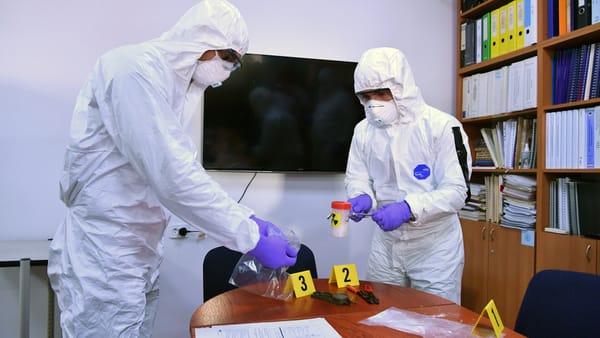

Quick: What’s the first thing that pops into your mind when thinking about Germany? Without a doubt, the same horrible images will immediately condense in all of your heads. And honestly, who could blame you?
We’re quite literally talking about the worst thing that has ever happened in the entire human history, so I think a long-term stain on Germany’s image is pretty darn justified. On the other hand, it would be narrow-minded to view an entire country exclusively in the context of a chapter that ended two or three generations ago. For beyond this subject, Germans also have a rich and diverse culture of horrors beyond human comprehension—which all too often get completely overlooked!
So let me broaden your perspective a little; let me guide you through some of the weirder and lesser-known evils my compatriots have committed over the years. Today, you’ll be presented not with one, but with two very different stories revolving around love and obsession, littered with nuances and gray tones, in which concepts like perpetrator and victim barely hold up to the next plot twist, and yet allow for enthralling glimpses behind the veil of human nature. Intrigued?
Let’s jump right in, then!
At Least Take the Roses I Brought
It was a sinister place, full of dark alleyways and seedy characters; a parallel universe, where anything and everything could be bought and sold, where you could indulge in all your vices, as the rules of society ceased to apply after sunset. The sights and sounds assaulted his senses. Potsdamer Street was lined with dubious betting offices and bars, and the air was thick with the smell of cheap alcohol and violence.
Peter had never been here before. His eyes glided insecurely over the women who worked the night; most of them scantily clad and beckoning to the men who passed by. Peter didn’t end up in Berlin’s most notorious red-light district by accident.
He had fantasized about this for longer than he could remember. However, now that he was about to follow through with it, he couldn’t shrug off the feeling that this might have been a mistake. While his stomach was begging him to leave, another part of his body commanded him to continue.
He had been lurking around for at least an hour, trying to work up the courage to approach one of the ladies. But how would he even do that? Was it the custom to start with a little chit-chat?
Should he just walk up to one and ask for sex whilst flashing a couple of Euro bills? Or would that get him into trouble? He didn’t have a clue.
He was 50 years old, married, and he had two children. A bourgeois academic who dutifully paid his taxes, separated his garbage, and never had even the remotest contact with the underworld. In many ways, Peter was the most boring person imaginable.
If people were poems, he’d be lorem ipsum. If people were spices, he’d be flour. If people were music, he’d be white noise—or maybe even a song by Coldplay.
There was hardly anything recognizable about him or his life. And yet here he was, in grey corduroy pants and a knitted sweater, surrounded by shadowy men haggling over prices for pleasure.
Sex work has generally been legal in Germany for almost a century at this point. Legislation has undergone several reforms since then, further liberalizing the market while strengthening the protection of sex workers. However, it is an open secret that these protection mechanisms rarely worked as intended and were virtually impossible to enforce. Human trafficking, forced prostitution, abuse of minors, and other unspeakable crimes were rampant in many places, nonetheless.
This was especially true for the street corner that Peter visited on that summer night in 2011. But due to a dangerous mix of ignorance and apathy, he did not spend a thought on that.
This is when something unexpected happened. A group of featureless silhouettes disappeared from Peter’s cone of vision, revealing a view of a young woman. She was of petite stature, graceful, and by her beauty seemed a little out of place, as Peter did for his own reasons. The headlight of some parking car gleamed through her long black hair as if she possessed a halo.
Peter interrupted his aimless walk; time seemed to have stopped for him. When the girl turned, and their eyes accidentally met for a second, the noises around him ceased to exist. Instinctively he knew that this was a moment of monumental significance. Peter could see a deep sadness in her eyes, which resonated with him in a way almost magical.
His heartbeat quickened as this divine being walked toward him.
The girl’s name was Anna, and her obvious vulnerability sparked a raging fire in the uncharted trenches of Peter’s twisted soul that could never be distinguished. This sudden warmth, however, was something only he could feel. To her, Peter was just another john among many. Routinely and without any passion in her voice, Anna explained that her price would be 20 to 50 Euros, depending on his desires.
Much later, Peter would testify in court that—from the very first moment—he had fallen undyingly in love with this girl not even half his age, and an obsession had taken hold of him that brought about his imminent doom. He went for Anna’s cheapest option, and so Anna followed Peter to his nearby car.
Later that night, Peter struggled to fall asleep. A magical gloom refused to fade from him, and when he closed his eyes, Anna’s porcelain face would appear. Lying next to his wife, Peter was wide awake, staring at the ceiling and contemplating. He loved Anna, and he understood that her life held nothing but untold misery for her. She deserved so much better, he decided. Peter was determined to find a way to save her from this suffering, and to make her fall in love with him in return.
I’m telling this story from Peter’s point of view, which is obviously flawed in many ways. Whether ethical sex work exists is not the point of contention here. It certainly did not in the realm Peter decided to go for. So, he kind of got that right in hindsight, but he failed to understand the irony of him being part of the problem, not the solution. Save Anna from whom? From exploitative predators like he was? From a hell that wouldn’t even exist without men like him?
By the following evening, Peter was already drawn back to Potsdamer street, but this time, he came prepared. He greeted Anna by handing over a bottle of homemade fruit juice, because he wanted to get some vitamins into her body. Anna didn’t recognize Peter at first, but ultimately accepted his gift in exchange for some reluctant small talk.
This game continued throughout the following weeks and months. Peter would visit her, bearing presents such as healthy food, warm clothing, or cash. She would in return pretend to somewhat like him back, besides the occasional sex.
For Peter, however, this wasn’t a business arrangement but a blossoming love story. Accordingly, his offerings became increasingly romantic. He would invite her to the movies, they would visit restaurants.
When Anna happened to be with a client, he’d leave fruits and vegetables at a nearby kiosk, so she could pick them up when she later returned to her spot. He even prepared a picnic in Berlin’s biggest city park, called Tiergarten. This is particularly remarkable, as you’d imagine him being very secretive about this liaison.
But he absolutely wasn’t. His primary goal was to establish an ordinary love relationship with Anna. He dreamt of Anna moving in with him, introducing her to his colleagues and friends one day, maybe even marrying her.
This idea quickly got out of hand. Soon Peter started bringing his children with him when he took Anna out for dates. He wanted them to get used to her. Maybe even to accept her as a pseudo-mother, although she was hardly any older than his boys.
Anna was having none of that. She was merely playing along, fuelling his alternative reality because he generously paid for it. But Peter flatly refused to acknowledge this. Two years later, he would decline revealing to the court the exact amount of money he had paid her during this phase.
But when asked if it was five digits or even higher, he didn’t object.
At this point, a few of you may be on the fence of harbouring a subtle grudge against Anna. Peter clearly is a fucking idiot, and she’s taking advantage of that for personal gain. Right? If this is your opinion, you couldn’t be more wrong. So let me map out her situation, because hearing Anna’s side of the story will unsurprisingly shed a whole different light on everything.
Anna was herself a victim of a power structure in which she occupied the lowest possible position. One level above her was a man whom I will call Dima. In case it isn’t obvious, I changed all the names in this story, as, in a way, almost everyone involved is a victim.
Most news outlets reporting on this decided to protect their identities by using pseudonyms; a motion that I can understand and therefore will continue. If you consider the relationship between Peter and Anna to be extremely toxic, her relationship with Dima would be highly concentrated ricin poison, as he was both her pimp—and her boyfriend. The bulk of whatever Peter was paying Anna would end up in Dima’s pockets, from where it would be further distributed upwards an endless ladder of higher-ranking pimps.
Nothing Anna did in her life happened voluntarily or out of self-interest. Her hands and feet were tied to invisible strings, with Dima being her ruthless puppet master. Peter was nothing but an easy source of money, which Anna had little choice but to exploit, as she had a merciless slave driver to satisfy.
Dima was known to be extremely violent towards everyone, including Anna, whom he disgustingly still passed off as his sweetheart. Throughout the years, Anna apparently got so brainwashed by this cycle of powerlessness and violence that eventually she believed she loved Dima back. Stockholm Syndrome likely played a role here.
According to police protocols, there was at least one instance where the situation got so badly out of control that Anna had to flee to a women’s protective shelter. But only one day later, she returned to Dima because—and I quote this directly from her testimony—she had “a good heart.” Their “relationship” is the second romance in this story which absolutely never existed in reality.
I’m well aware that love comes in all shapes and sizes, but forcing someone into prostitution by resorting to violence constitutes a crime so disgusting that I think we can agree on not giving a flying fuck about whatever hardship Dima himself was stuck in. In his place, most would have preferred to go overseas under a false identity rather than do something so repugnant to anyone. There were clearly other options available, but Dima decided to continue with his sinister ways.
Now, Dima knew about Peter pretty much from the beginning, but not the other way around. Scamming a man out of his money with a make-believe love story doesn’t really work when you’re also open about sharing a bedroom with another guy. Dima wanted to keep Peter as a happy customer. Therefore, he hid behind the curtain.
He still had his hand in everything by instructing Anna how to rip their patsy off exactly. For quite a long time, the strategy was pretty basic, though. Step 1: Provoke Peter’s pity and guilt for Anna. Step 2: Profit.
Step 3: Repeat.
But around two years into this mess, Dima decided to step up his game by orders of magnitude. In Autumn of 2013, Peter’s mobile phone rang. He didn’t recognize the number, but still decided to accept the call. From the other end of the line, he immediately heard a panicked, yelling woman’s voice.
At first, he couldn’t make out any words and was about to hang up again, but when he picked out Anna’s name, his ears perked up. He could tell it wasn’t Anna herself calling, but the woman did clearly mention her name. After a while, the unknown voice explained to him that Anna had been abducted and they had received a ransom note. Whoever took her demanded 4,000 Euros for her safe return.
You will certainly assume that if you had been in his position, you would have instantly recognized this call as a scam. But I beg to differ. Keep in mind that Peter didn’t understand the first thing about the dangerous world Anna lived in. Maybe random abductions were a thing that regularly happened to sex workers at Potsdamer street.
And, you know, they somewhat are. Maybe not daily, but this is also nothing utterly unheard of among rivaling human trafficking rings. So, you might want to give Peter a pass for taking this call very seriously. He was instructed to bring the money in cash to a specific location, where a friend of Anna’s would be waiting for him.
This friend was then to use the money to buy Anna out. Without hesitation, Peter obliged. He probably would have paid ten times this amount for Anna’s safety.
From an outside perspective, it’s not hard to deduce the truth behind this call. No abduction had ever happened. The woman on the phone was just another sex worker Dima had at his disposal. To cut out the middleman, Dima himself went to pocket the cash Peter selflessly delivered. This was the first time Peter met his nemesis in person, even though he wouldn’t realize at this point. With some educated guesswork involved, Peter had lost about 25,000 Euros to Dima so far.
As we have thoroughly established, Dima wasn’t the nicest of all people. But I cannot deny being a little impressed by his level of creativity going forward. The fake abduction was quickly followed up by Anna’s parents suddenly dying.
Funerals are expensive, so take a guess who stepped in to pay for the expenses? In Dima’s defense, at least they only lied about Anna’s parents being dead instead of literally killing them. The next cash grab was even more absurd.
What I have failed to tell you so far is that Anna had a secret daughter living in another European country. This was a massive surprise to Peter as well, since this subject had never come up in all those years of their supposed intimacy. Still, when she explained to him that her daughter had now reached school age and that she simply could not afford the necessary school supplies, Peter readily opened his wallet.
After all, Peter had recently gotten his own kids such great school bags and pencils, as Anna casually reminded him. This might be a shocker for you, but the existence of a daughter was just another big fat lie, serving as a ticket for yet another guilt trip.
It took Peter more than three years of this madness until he started raising questions. In March 2014, despite still being blind by love, he couldn’t help but notice that all those little oddities were forming a devastating pattern. There was no big revelation, no popped lie, no accidental slip of the tongue that suddenly revealed the truth or anything like that. But for some reason, one day, Peter’s brain decided to consider the whole picture for one second.
And once doubt had settled into his mind, there was no way back. Only a few months ago, for the first time ever, Anna had confessed her love to him. He had been the happiest person, albeit only for a while. Full of shame and pain, he dragged himself to the police department and began to report.
Now, obviously, a case as complex and multi-layered as this one requires quite a bit of investigation. Pimping, human trafficking, dangerous bodily harm, fraudulent extortion—it would probably take at least five minutes just to list every law that had allegedly been broken in the process of this Shakespearean drama. Because of this, it is neither surprising nor odd that the trial did not begin until 2016, a good two years later.
When Peter went before the judge, all that was left of his inner fire was ashes. His eyes were sunken and had a defeated look to them, with a certain tension to his body that made him appear smaller than he was. His testimony resembled the reading of a romantic novel by a broken person who had lost everything. Every word he spoke carried tangible weight for all who listened to him; and according to at least one report, tears were shed by many.
When it was Anna’s turn to testify, not a single emotion was present in her demeanor. She portrayed Peter as if she had hardly ever known him, a random john among many, bare of any details. He sometimes was a nuisance to her, she explained, and spending time with him was a slight inconvenience, but he did pay good money, so, you know, whatever.
The case against Anna was relatively quickly decided. The judge clearly had sympathy for the situation Anna found herself in five years ago, but there was no denying the fact that she committed fraud. So, she pretty much got a slap on the wrist, as she was objectively guilty of the crime she had been accused of, but not so much on a semantic level. A couple of months on probation for good measure it was. I think I can agree with this ruling.
For Dima, however, the trial dragged on for several additional days, given the number and seriousness of the charges against him. On the last day of his trial, Peter was once again called to the stand in order to clarify some final details. As the judge asked him when he had last spoken to Anna outside of this courtroom, everyone was expecting an answer such as “two or three years ago.”
But to everyone’s shock, Peter quietly responded: “Yesterday, after she had been released.” Peter found out where she was staying and decided to visit, he explained. But instead of her, another man opened the door and told him to get lost, as Anna had no intentions of meeting him.
When Peter insisted on at least exchanging a few words with her, Anna yelled from another room, ordering him to piss off. “Okay,” Peter yelled back, unable to catch even a glimpse of her. “But please, at least take the roses I brought!”
This is where our story concludes. I don’t know about you, but both researching and retelling this has somewhat messed me up. You see, when Peter first decided to visit Potsdamer street, I highly doubt his underlying motivation was anything related to sex.
I firmly believe Peter fell victim to one of the worst and deadliest pandemics this century has to offer. No, I’m not talking about Covid; I’m talking about loneliness. Peter seems to have been so depraved of human connection, that somehow, he projected all his hopes to escape this solitude into one person.
While being with Anna, he became enchanted by that notion of love, but not necessarily by Anna herself. I don’t believe in love at first sight, at least not to this extreme. But I know for a fact: The general isolation of modern society can easily mess up one’s psyche this severely.
According to a meta-study involving more than 3.4 million adults, 35% of people of Peter’s age can be categorized as critically lonely. This study also found that excessive loneliness often directly contributes to all sorts of health problems, including mental ones, sometimes even death.
There is, however, just one more piece of information that I owe you: What happened to Dima? Well, in contrast to the rest of this peachy story, that’s quite a downer. The court was unable to prove most of his alleged crimes.
Thus he was completely acquitted of human trafficking and pimping. The relevant witnesses turned out to be extremely fickle and reticent in court, much as if intimidation had been involved. However, the court found some minor charges for which Dima could be held accountable.
For example, he bought an expensive car with the money he stole from Peter. Being the show-off he was, he proudly drove his new car down Potsdamer street regularly. Unfortunately, he never bothered to get a driver’s license because he probably thought it was beneath him.
His final ruling? A year and eight months on probation. He did go to prison, though, as he already was out on probation for completely unrelated petty crimes.
Despite my best efforts, tracking Anna’s traces after the trial was to no avail. I really wanted to assure you she ultimately got the support she needed and is doing fine nowadays. But I can’t. She basically vanished from the records. This might be for the better, though. If I can’t find her, maybe her past can’t either.
The Imitation Game
Few people know this about me, but I used to be a hip-hop artist! My career started about five years ago, when I dropped some acid and had the funniest idea for a rapper name ever. So, I immediately recorded my first freestyle rap song in one single take and proudly uploaded it to YouTube.
When I checked back on it a couple of days later, I found a very constructively written comment pointing out the fact that this was only six minutes of me growling and making animal noises, with some manic laughter at around the four minutes mark. Furthermore, I was informed there already was a well-known artist going by Jack the Rapper. After some careful consideration, I quickly deleted my account and never spoke of it again.
Don’t do drugs, kids! This, however, still qualifies me as a seasoned professional within the German hip-hop scene; at least that’s what my Tinder profile says. Therefore, I’m happy to let you in on my vast insider knowledge of German rap culture and a gruesome murder that shook it to its core.
From my understanding, rap has always been a story of empowerment, as it tends to turn entrenched hierarchies upside down. If you came from a difficult background, you didn’t have to be ashamed of it. On the contrary, you were respected for working up your unfavourable starting conditions in your rhymes. No one would judge you for it.
For many marginalized circles, hip-hop was one of the few outlets where you could earn recognition not in spite of your scars and disadvantages, but because of them. Seriously, how many rappers out there do you know who lack an exceedingly grim backstory? The only one that comes to my mind is probably Mike Shinoda, but he managed to cleverly compensate for his lack of an abysmal origin by being the best rapper to have ever lived. If you disagree, you’re clearly wrong; but by all means, feel free to fight me in the comments.
Anyway. Felix Weber hasn’t been raised by the streets of a violent urban dystopia, too. Instead, he was raised by the rolling hills of Germany’s rural south, with endless patchworks of greens, browns, and yellows in any direction. A mere thousand people lived in his village, where farmhouses dotted the landscape, smoke lethargically rising from their chimneys and chickens pecking in the middle of unpaved streets.
Felix would often lie among the grape vines, with large headphones on his head, fantasizing about being one of the rappers blasting into his eardrums. Then again, he often feared that this wish could never become reality. What was he even supposed to rap about? The nearby river, which peacefully meandered through the land?
He strongly doubted this would earn him any Street Cred.
Still, he was hell-bent on pursuing his dreams. They would eventually turn out to become nightmares. His best friend, Sinan, shared Felix’s ambitions.
Together they brought a lot of commotion to the otherwise sleepy area. They proved to be the bane of all teachers, experimented with soft drugs, admired the criminal prestige of their gangster rap idols, and dabbled in the art of rhythmic poetry themselves. And they weren’t even particularly bad at it, although none of their home recordings managed to escape the confinements of their MySpace pages.
From a technical point of view, the results were quite impressive, though. Felix possessed a promising, if still somewhat youthful voice clearly suited for this kind of music. Through a lot of ambitious practice, he also knew how to handle his vocal apparatus, earning him a small following online.
Sinan and Felix filmed each other striking cool poses, toying around with borrowed sports cars and handling fake weapons. Everything the big rappers in Berlin did, they imitated on a much smaller scale. That was one of the reasons why their big breakthrough was a long time coming.
In the rap game, authenticity is the lead currency. No matter how good you are, no one will give a crap about your tracks as long as you remain a knock-off. When you’re writing about drive-by shootings while sipping away a cup of warm vanilla chocolate milk your loving mom prepared for you, people can usually tell.
And then fortune played a hand in Felix’s favour. Another rapper named Devin Jones happened to randomly stumble across a track by Felix, which piqued his interest. Devin was none of the big players, but he had at least made a small name for himself. His greatest achievement: a feature with Bushido, probably the most prestigious German rapper at the time.
Naturally, Felix was thrilled when Devin Jones suggested working on a collab together. They put this idea into practice, and although the result was anything but successful, the experience further strengthened Felix’s fighting spirit. He felt that he now had a foot in the door.
In the 2010s, there were three undisputed luminaries at the top of the German hip-hop food chain. Bushido, whom I just mentioned, Sido and Fler. Of these three, Sinan and Felix had a definite favourite, which was Fler.
They deemed Fler some kind of rap god, which in retrospect seems like blasphemy against Eminem, but still amounted to nothing short of an obsession. Those two youngsters idolized Fler in such a morbid way that maybe not even your worship of Simon can compete with it. One day, the two hatched a plan which sounded so bonkers that it was doomed to fail from the get-go.
They decided to rent a car and head to Berlin, where they would track down Fler and ambush him. As soon as they had Fler before them, Felix was supposed to rap a few lines, which Fler would then be so enthusiastic about that he would immediately take him on as a disciple, get him a record deal, and become his very best friend. Absolutely realistic and down-to-earth stuff.
To be clear: Fler was gargantuan at the time. He was a nationwide A-list celebrity whose name and face could be recognized even by people who had nothing to do with rap. Nevertheless, these twats were absolutely convinced that their plan would somehow work out in the end. As creepy mega-fans, they knew practically everything about Fler and his life, both the public and the private one.
They had a rough idea of which parts of Berlin he often hung out in, what kind of pubs and clubs he visited, which shisha bars he preferred. Despite their ridiculous optimism, they had set themselves a time limit. If they couldn’t locate Fler within a week, so be it.
On the evening of the last day, as they began their tour of those venues most likely to promise them an encounter, they couldn’t believe their eyes. There he was, with a shisha pipe in his hand, surrounded by other greats of the Berlin rap scene; reflections of bright neon lights dancing on his face. Without hesitation, Felix gathered all his courage, walked straight up to his idol, and in a fake nonchalant voice he said: “Hi Fler.
I’m Felix. Can I rap for you?” This took Fler by surprise.
In a way, it was disrespectful to even address him without an invitation. But perhaps it was this crossing of boundaries that sparked Fler’s interest. “Alright,” Fler said after slowly putting down his pipe.
“Go ahead.”—And Felix did. A few minutes later, Felix found himself face to face with an approvingly nodding Fler. He seemed downright impressed.
His fellow guests also had an appreciative look on their faces. Felix had rapped a few lines, which Fler was so enthusiastic about that he immediately took him on as a disciple, got him a record deal, and became his very best friend. And I’m not even joking.
This fateful encounter developed into something that pretty much resembled Felix’s wildest dreams. Fler indeed took him under his wing, introduced him to all sorts of important personalities, taught him about both music writing and production, and also showed him how to navigate life as a professional rapper. He even allowed Felix to stay at his place for a while, since this country boy naturally had no other place to sleep in Berlin.
Fler invested heavily in his discovery. And in doing so, he hardly shied away from anything. He put Felix in expensive clothes and got him fancy jewellery—accessories that simply were part of being a gangster rapper.
After they recorded a few demo tapes, it was clear to Fler that this kid had a gigantic future ahead of him that needed to be nurtured. Shortly after, he officially announced that Felix was now part of his record label—and after sharing a stage side by side with his mentor for the first time, Felix’s career blew up.
Well, this story has been quite inspiring so far. But don’t get any wrong ideas. From now on, it will go steeply downhill.
During his meteoric rise to fame, it was never really questioned that Felix held great talent. Fler had certainly helped to further hone his tunes, besides giving him a serviceable outward appearance with a metric ton of glitter and showmanship. Yet we should not forget the fundamental flaw that hid beneath all of that.
At the core, Felix was still a fake who reeked of privilege for miles around. You see, Felix’s style of music started to change quickly. Whereas Felix previously served all the clichés by writing about flashy cars, guns, and naked women, his tone now became much more personal and somber.
At first glance, this was an improvement, but it was a risky one. The more openly he poured out the tragedies of his life, the more likely people were to realize that there was rarely any truth to it. Felix grew aware of this problem, though.
He tried to defend his lies by creating an underbelly of even more lies; an idea which of course hardly ever goes wrong.
He began to make more and more frequent insinuations about his involvement in the criminal milieu, especially with the Czech mafia for some unknown reason. To my knowledge, there was no indication that these innuendos were true. At one point, Felix appeared in front of the cameras with a scar on his face, around whose origin he was emphatically silent. This scar later turned out to be a tattoo.
In one of his latest songs, Felix described in detail how his father shot himself in front of his eyes due to a huge financial debt he could not repay. At the same time, Felix’s eccentric self-promotion became more and more the focus of his persona, increasingly displacing his passion for rap music itself. Fler did not appreciate this development in the least. Just like the public, he became suspicious of his protégé.
One day, Fler called Felix’s parents’ house with a disguised voice and some pretended request, asking to speak to the father. This was to verify whether the story about his suicide was even true. In the weeks before, Felix had constantly retold this story, for newspaper interviews, on the radio, even in youth magazines. He shared it all a little too willingly, Fler believed.
Contrary to his expectations, though, Felix had neither fabricated his father’s death nor the circumstances. Nevertheless, Fler was convinced that Felix could no longer be trusted. Even though Felix’s father had indeed taken his own life due to financial hardship a few years prior, Fler simply felt that Felix had artificially played up the details and consequences of this incident in order to exploit it for his flimsy image. And this was just one dubious topic from a boundless sea of questionable stories.
I’m not sure if I can completely agree with Fler on this one, though. Witnessing the death of one’s parents is a drastic experience that will undoubtedly leave deep wounds. Especially when it comes to this particular kind of passing.
I don’t know if Felix literally watched his father pull the trigger, as the lyrics claimed. But then again, isn’t hip-hop full of metaphors and figurative language by nature? His father died from horrible circumstances.
Going after the smallest discrepancies seems a little void of respect if you ask me. Of course, this changes nothing about the thousands of other shenanigans, which were outright preposterous. Yet, I am still a bit puzzled as to why this, of all topics, was the decisive one for Fler.
Why not Felix’s absurd fantasy stories about the Czech mafia, or the fact that he literally had a fake scar tattooed on his face? I mean, this guy had more red flags than the Soviet Union. Plenty to choose from.
A few months into their honeymoon, Fler acted on his instincts and made a final decision, which he painlessly relayed to his apprentice over the phone. Effective immediately, he would terminate any professional cooperation, as well as their friendship. This destroyed Felix in many ways, especially because he failed to see it coming.
He had just gotten used to his new life, but was not yet sufficiently established to stay afloat without Fler’s influence. Lacking the endorsement of a powerful benefactor, his career instantly lay in ruins. Overnight, Felix’s existence as a fast-rising rapper had been completely wiped out, and given his shaky reputation, merely a microscopic following would stay by his side.
For all intents and purposes, Fler had killed off Felix’s entire existence as quickly as he created it, just by snapping his finger. Maybe Felix was all too right in deeming Fler a rap god.
What now, though? His short-lived career had neither provided him with lasting wealth nor opened up viable alternatives. He was back on square one. Berlin suddenly felt very far away as he furiously tore Fler’s posters off the walls in his childhood bedroom, where he had moved in again.
He lacked any other professional training or prospect, and even if he did, he would have refused to pursue them. Felix had tasted from an addictive world of excess and opulence. For the life of him, he would never accept a “regular” job as a farmer or a mechatronics technician. A desire for revenge grew roots in his mind, and to some degree, he felt unable to put down this artificial persona he had diligently crafted for the big stage.
Between Fler and him, the final rhyme was yet to be dropped.
However, Felix was not the only one who had undergone a fundamental development in the last few months. His old circle of friends, who readily welcomed him back, somewhat ironically had mutated into a small criminal fraternity. They were no longer rowdies and class clowns; they had evolved into serious thugs.
The most surprising one was a guy named Levent. He had morphed into something completely different from what Felix had known months ago. The once shy boy had become a muscular jock who displayed a fundamentally aggressive demeanour, and he acted quite self-confident about his small drug empire, where even the harder stuff was available.
Sinan, who had previously posed with toy guns in an attempt to look badass, was now buying and selling actual firearms on the dark web, sometimes using their stock to rob surrounding gas stations. And while they still got a kick out of secretly drinking beer in the schoolyard roughly a year ago, they would now routinely get high on their own supply for breakfast. Sounds like an environment you could authentically gangster-rap about, doesn’t it?
Felix instantly recognized that he could capitalize on the new circumstances. He played up his significance by rigidly sticking to his strange declarations. For instance, he fervently recounted how he once visited an illegal crocodile farm in Prague which belonged to a high-ranking local underworld boss to everyone who would listen.
Another time he revealed to Sinan and Levent that he had randomly met a Czech mafioso on the train, to whom he had shared his beef with Fler just to pass the time. The mafioso was so taken by this tragic tale that he promptly offered to have Fler assassinated for free, you know, as it usually happens. Felix invested only small portions of his newfound free time into producing new tracks, due to the lack of an audience.
The songs he did release, though, showed an obvious thematic focus and reflected an inner ambivalence. Was Felix mad at Fler? Was he disappointed, hurt, heartbroken?
Was he longing to win Fler back or beat him to death? Presumably, all of these simultaneously. Some songs read like breakup drama, others like threats.
“Blue blood will turn red,” he wrote, alluding to Fler’s latest album, “Blue blood.” Then again, other lines feel like they came from a place of unilateral love and respect.
Up to this point, our story is quite clear and well documented. After all, most of it played out in public, and no one really seems to dispute the course of events so far. Unfortunately, it gets a bit murkier from here on out.
Although we’re already deep into this tale, Felix hasn’t really done anything resembling a crime yet. This will ostensibly change in the next paragraph, with one of the involved players being shot dead. This murder was later followed by a spectacle trial, in which the vastly divergent accounts of prosecution and defense were never fully reconciled.
For now, I’ll go with Felix’s narrative. Not because I find it particularly credible, but it is a good starting point to subsequently weigh it against inconsistencies and circumstantial evidence. You will probably notice several oddities right away.
But worry not. Later, we will work through all of them together, whilst constructing a timeline of events more in accordance with the facts. Keep in mind, however, that everything after this line is to be understood with the caveat of a capital “allegedly”.
At the end of 2014, with only two days left until New Year’s Eve, an emergency call reached the dispatch office very early in the morning. An agitated young man was on the line, audibly in shock, though he immediately got to the point. One of his buddies had been shot, right in the head, execution style. The unknown perpetrators then punched his body with their bare fists like rabid maniacs.
When they found that—despite the bullet wound in his forehead—there was still some movement left in his limbs, they shot him again and quickly drove off. And that wasn’t everything, declared the caller, who identified himself as Felix Weber upon request. He knew what the murderers were plotting; he knew who was next on their hit list. A man from Berlin, who had to be warned immediately, who needed police protection without further hesitation.
His name: Patrick Losenský, better known as Fler.
Police took this call very seriously and jumped into action twofold. 800 kilometres to the north, Berlin’s law enforcement immediately reached out to one of its most prominent residents, alerting him of impending danger. At the same time, an armada of emergency services and investigators was sent to the crime scene; a dirt road on the outskirts of the rural hamlet, where Felix Weber resided. Unfortunately for the murder victim, who turned out to be Felix’s friend Levent, all help came too late.
He had put up a fight but ultimately succumbed to his wounds. Investigators wasted no time, given that two insane killers were supposedly on the loose. They took Felix in for questioning, who, despite the traumatic experience, waived both psychological and legal counselling and agreed to answer all questions right away.
But in a way, he didn’t. When asked about the murder he claimed to have witnessed, Felix preferred to talk at length about all other topics instead. He recounted his childhood, his father’s suicide, his friendship with Fler and how the latter stabbed him in the back, his surge to stardom and how it was unfairly snatched from him again.
His testimony was basically an autobiographical self-dramatization, which by itself did not find its way back to the actual subject. He even openly admitted to being somehow associated with the Czech mafia, which seems to be an unreasonable small talk topic whilst sitting in a criminal police interrogation room. Of course, everyone processes shock moments in vastly different ways, yet this behaviour evoked a vague suspicion that something was amiss about him.
Hold on to your hats, though. After being gently brought back to the killing, he would eventually provide some specifics. Earlier that day, he had asked his friend Levent for a small favor.
Felix had explained to him that he was to meet a Czech mafioso at a secluded dirt road later that evening to do some crooked business. This Czech would bring along another person who, unfortunately, spoke only Romanian. Since Levent was of Romanian descent, he was asked to accompany Felix and offer his services as an interpreter.
Levent accepted his friend’s request, possibly hoping for a share. The dubious meeting was to take place in the middle of the night, in a place so remote that the only source of light was the shimmering ground frost of the fallow fields, reflecting the night sky. It was bitterly cold that night, around negative 8 degrees Celsius.
Fortunately, Levent and Felix did not have to wait long. The mysterious Czech arrived on time at the meeting point, driving a French police car, presumably stolen. He did not get out of his vehicle, but remained silently behind the steering wheel.
Instead, the passenger door opened, and the unknown Romanian stepped onto the gravel road. Felix did not speak Romanian; the Romanian did not speak German. Consequently, it was Levent’s task to establish diplomatic contact, as previously agreed.
So Levent approached the Romanian, who did not leave the car’s vicinity. They exchanged a word. What they talked about, Felix could not tell.
He did notice, however, that the tone was slowly becoming more strident. After a few exchanged sentences, the situation suddenly escalated. Without a warning, the Romanian pulled out a gun, shot Levent right in the face, beat his lifeless body like a madman, tore a piece of flesh from his neck and swallowed it, then shot him again before throwing himself back into the car, disappearing with the Czech into the darkness of the night, leaving Felix behind.
Felix had been so shell-shocked by this event that he practically lost all sense of space and time. Apparently, he had been wandering around all night, he claimed to the police officers. Shortly before dawn, he happened to cross the path of a mailman, who lent him his cell phone. Felix used it to make the police call.
In parallel with this interrogation, the forensic team was busy combing the crime scene for clues. Felix’s stories did not match their findings, which does not exactly come as a surprise. First of all, there was no indication of any vehicle recently being inter-parked at the site indicated. Both stopping and hastily speeding off causes very specific types of tire tracks on gravel roads, which were clearly absent.
On the other hand, they did find an object of utmost curiosity: A French-Czech dictionary. In a way, this supports Felix’s story. If the Czech arrived in a French car, he had probably also entered from France. The village where the fateful encounter took place was in fact located relatively close to the French border.
It is therefore reasonable to assume that the two Mafiosi could have used such a dictionary prior to their entry into Germany.
Now, let’s get cosy in our armchairs with a nice cup of tea, as this is the point at which reporting gives way to communal deduction. Does the presence of the French-Czech dictionary bolster our protagonist’s account so far? Well, I personally don’t think so.
Ask yourself this: How did the dictionary find its way out of the car? None of the people who attended this meeting were proficient in French. Therefore, the book would have been entirely useless.
No one would have had a reason even to touch it. Nevertheless, it must have somehow gotten out of the car, of which only one door was ever very briefly opened. I can’t think of a plausible explanation for this.
In my humble opinion, though, it doesn’t seem completely far-fetched to assume a red herring. Perhaps the dictionary was deliberately placed there by Felix as a way to lend more credibility to the two mobsters’ existence. He would have had sufficient time to do so, both before and after Levent’s untimely death.
When Felix was confronted with this evidence, he immediately changed his story. Mind you, his new statement fits the facts slightly better, yet it still leaves a lot to be desired. First of all, Felix meekly admitted that, yes, indeed, he had made up the two mobsters. They never existed.
However, he maintained that he had not placed the dictionary. Well, fine, let’s give him a pass on that for the moment. Maybe the dictionary had been lying there by complete chance. Stranger coincidences have happened in the world.
Instead of some random mobsters, Sinan was along for the ride. As a reminder: Sinan, Levent and Felix formed the inner circle of their criminal suburban empire, so to speak. But apparently, Levent and Sinan were in some serious trouble with each other.
So, the three of them happened to be walking along some random unlit field trails for no conceivable reason, in the middle of the night, in the maddening cold, Levent and Sinan heavily arguing, with Felix trailing behind like a child of divorce, keeping his head down. This went on for a while, until their dispute spun out of control. Now Sinan would pull a gun on Levent, shooting him dead on the spot, to the complete horror of Felix, who of course had nothing to do with this whatsoever.
Remarkably convenient. But this was only half of the story. Sinan then explained to Felix that he had been planning this murder all along, which is why he had steered them to this remote region in the first place.
He instructed Felix not to worry and to dish out some story about Czechs or Romanians or whatever, in order to distract the police from both of them. Felix, who of course had been enormously intimidated, followed this order.
You’ll probably assume, based on my rather sarcastic choice of words, that this is thoroughly fabricated nonsense as well. But maybe my tone has been a little misleading, as this account has a lot going for it. Do you remember what Sinan was doing for a living by then? Correct.
He dealt in firearms on the dark web, and in fact hid a large number of guns in a nearby forest, which the police later seized. He would have had easy access to a pistol, which are practically impossible to obtain for regular people in Germany. When investigators took an even closer look at Sinan, they also found clothes full of gunshot residue, of which Felix’s clothes and hands had been completely void. You weren’t expecting this turn of events, were you?
An open-and-shut case, then? Beyond any reasonable doubt, it was Sinan who had shot Levent, presumably over some random quarrel. Still, it somehow feels like we’ve missed something important here, even if we cannot put a finger on it.
But what would that be? Elementary, my dear Watson. First, a rhetorical question.
Why the hell would anyone spend the night walking pointlessly through the sticks freezing their butt off? According to Felix’s narrative, Sinan himself already gave an answer to that. Sinan had planned to murder Levent from the beginning and therefore led them into the nocturnal outskirts, where the darkness would cloak his evil deed from curious eyes.
But why bring Felix along, then? Felix was not a requirement for this plan in any respect, but an additional risk. The more confidants you involve, the more likely your downfall becomes.
Having a non-participant witness the crime would have been diametrically opposed to Sinan’s interests. Why hide the murder and then have Felix call the police anyway? This way, things don’t particularly add up, either.
Let’s briefly summarize our findings. It seems conveniently proven that Sinan had not only been present, but he had also been the person to pull the trigger. Felix deliberately witnessed the murder, only to call the police a few hours later and tell them an absurd fairy tale that immediately popped. The missing puzzle pieces: What role did Felix actually play in the grand scheme of things?
And what was the overarching motive? Obviously, these facts allow for several opinions, but how about this: Levent’s death was ultimately all about Fler.
You see, during the search of Felix’s living quarters, the police got their hands on about thirty handwritten pages whose genre hovered somewhere between diary and pamphlet. In it, Felix described detailed fantasies of global success, wealth, and fame, and how sooner or later he would also find his way back to Fler. He envisioned how people would eventually make a movie about his success, how they would write books about him, and how he would amass even more gigantic riches with the royalties.
These were not just harmless musings, but power fantasies completely out of touch with reality. Unfortunately, the pages were never released to the public, but according to journalists who were allowed to read them, they had an overall sinister tone.
The big question it all boils down to is this: Had Levent been murdered because Felix needed a PR stunt for his comeback? I am fully convinced of this assumption, and for precisely one reason: When Felix made his emergency call, he warned that the supposed killers were now after Fler. As we have discovered by now, these killers were only a product of Felix’s imagination.
Give me any rational reason why Felix would have dragged his former mentor into the matter in this specific way, other than gaining his attention. I thought about this for a long time; none ever came to mind. In my opinion, nothing can justify such a heinous crime, of course.
And yet, in a way, it was pretty darn clever. By letting Fler know that Felix was involved in an actual murder, but at the same time warning him of imminent danger resulting from it, he had delivered three highly manipulative but spot-on messages to his idol: I’m badass and in no way a fake; I still care for you; We’re still directly associated with each other.
I don’t want to conceal the fact that this account also has a large loophole: If it was just to impress Fler, what stock did Sinan have in the matter? Well, good point. I do believe I can fix this flaw, though.
First of all, Sinan was also an obsessive Fler fan. When Felix first sought out Fler months ago, it had been Sinan’s idea. And Sinan had gladly accompanied Felix on his hunt crisscrossing Berlin.
Sinan had always enjoyed his perceived closeness to Fler, even if it was only via Felix as a middleman. But he may also have had monetary expectations. As Felix wrote in his pamphlet, he was counting on a huge income.
Perhaps he had pledged a cut of it to Sinan. And last but not least, Sinan was the guy with the guns. Felix, who had always feigned his criminal ties, may simply not have known where else to get one.
So there was a kind of compulsion for him to get Sinan on board. My interpretation is broadly consistent with that later provided by the prosecution. Of course, this doesn’t necessarily mean anything at all, considering that it is the job of the public prosecutor’s office to work out such an accusation.
And yet this version makes an awful lot of sense to me. You’re obviously free to disagree completely.
However, even if this rendition is accurate, it must be said that it did not work as allegedly intended. When Fler was notified by the police that some crazy cutthroats were plotting his murder, it hardly impressed him. This guy had been threatened by essentially everyone at one time or another during his career, most famously by the Hell’s Angels.
When police relayed the warning, he was probably like, “No shit, Sherlock.” and hung up. One should also not forget that death threats are part of the daily business in the upper echelons of hip-hop. In most cases, these seemingly bitter wars are just for show, as they lead to profit increases on both sides.
Taking them seriously equates to watching wrestling matches unironically, for the most part. Of course, there have been cases where terrible consequences ensued. Just think of Tupac or The Notorious B.I.G.
But that happened in America, where rap culture had always been something entirely different. Nothing of that nature had ever happened in Germany. Our hip-hop wars are basically two grown men sitting in their rooms writing poems about each other, which is just the cutest thing ever.
I’m genuinely curious to read which theories you’ve derived from this. Unfortunately, an official version was never established. Sinan was found guilty of murder and sentenced to life imprisonment, as there was no denying the fact that he had pulled the trigger.
But the court deliberately did not specify his alleged motive, nor did they commit to a particular narrative around it, as contrary to popular belief, none of this is required for a conviction. Technically speaking, this remains an open question to this day. In Germany, there are two variants of being acquitted.
The first option is called: acquittal due to proven innocence. The second one is acquittal due to lack of evidence. In practical terms, both come to the same thing: you escape punishment.
But it leaves a different aftertaste. Felix was acquitted for lack of evidence. In a way, this means: The court strongly suspected him of being guilty somehow, but could not prove it beyond a reasonable doubt.
Felix was therefore free to go.
Dismembered Appendices
Not enough carnage, dislike! I strongly believe that when it comes to true crime stories, more extreme does not necessarily equal more interesting. For today’s episode, I focused on two smaller cases in hopes of providing some evidence in support of my thesis.
Don’t get me wrong, though. The extreme cases undoubtedly merit telling, yet I feel they are overrepresented at times. But if you are here to learn about hundreds of people chopped into a billion pieces, I don’t want you to leave empty handed either!
So, here’s a little fun fact. The most prolific serial killer from Germany is a medieval robber named Christmann Gniperdoliga, who is said to have murdered up to 964 people. He was sentenced to death after his capture, and allegedly his execution went on for nine days straight!
If you want to learn more about him, I’ll be happy to write a corresponding episode. However, this one would fit better with a history-focused format, since almost everything about this guy is shrouded in centuries of historic mystery. You don’t want to wait for that?
There is a short film about Christmann on YouTube that you can watch for free! Just search for “Gniperdoliga short movie”, you’ll probably find it. I both composed and produced the music for this movie a few years ago, but since the film is rather artsy and therefore pointless and unwatchable garbage, I went with the easiest option of random-ass string patterns in C# minor whilst not giving a crap about any of it.
No seriously, words cannot describe just how terrible this movie is. I literally asked them to not put my name anywhere near it, so they placed it very prominently into the credit roll as some sort of revenge for the shitty soundtrack I provided. A must-watch!
Loose Threads
In retelling these two cases, I couldn’t include all of the finer details and therefore had to leave out some of the side stories. For example: What role did Peter’s wife play in his tale of suffering? How exactly did the investigation proceed, what other witnesses came forward, and how did Anna get into this predicament in the first place?
You see, Germany is not fooling around when it comes to protecting individuals and their data. While the United States, for example, maintains public databases of criminals, most Central European countries do everything they can to conceal such information. In my opinion, that makes sense.
This is also why I chose to give every character a pseudonym. Now that I think about it, I might even be legally required to do so. However, I have kept the actual stage names of the great rappers unchanged, since their involvement in this matter isn’t really a secret to anyone.
The purpose of justice is not punishment in the strict sense, but the restoration of social fitness. State-funded stigmatization will not help, but has clearly been shown to only increase recidivism instead. For this reason, many public records are redacted or anonymized, and some information is simply impossible to obtain.
Unfortunately, this circumstance often complicates life as a German crime reporter. Even though I was usually able to derive a narrative from individual pieces of clues, I exercised caution and preferred to remain silent when it came to those less-documented side characters. My aspiration was not to fill any relevant gaps by guessing, so I straight up left them out.
Key Takeaways
- A lonely married academic named Peter fell obsessively in love with a trafficked sex worker, Anna, and was defrauded of tens of thousands of euros by her pimp-boyfriend Dima over several years.
- Anna was herself a victim of severe exploitation and violence, receiving only probation for her role in the fraud while Dima was largely acquitted due to witness intimidation and lack of evidence.
- An aspiring German rapper named Felix fabricated criminal connections and personal tragedies to build an inauthentic gangster image, leading his mentor Fler to abruptly terminate their professional relationship.
- Felix’s friend Levent was murdered in 2014; though Sinan was convicted of pulling the trigger, the author theorizes Felix orchestrated the killing as a manipulative PR stunt to regain Fler’s attention.
- Felix was acquitted due to lack of evidence despite strong suspicion of his involvement, while Sinan received life imprisonment without the court establishing an official motive for the murder.
Dana Ortiz covers prosecutorial mechanics, evidentiary procedure, and how investigations unwind decades after the original case file went cold.
Frequently Asked Questions
What was Peter’s background and family situation when he first visited Potsdamer Street in 2011?
Peter was 50 years old, married, and had two children. He was described as a bourgeois academic who dutifully paid his taxes, separated his garbage, and never had any contact with the underworld. The article characterizes him as ‘the most boring person imaginable.’
How much money did Peter estimately lose to Dima through Anna?
Peter had lost about 25,000 Euros to Dima. When asked in court if the amount he paid Anna was five digits or even higher, he didn’t object. The article notes this was over the course of more than three years.
What was Anna’s actual relationship with Dima?
Dima was both Anna’s pimp and her boyfriend. The bulk of whatever Peter paid Anna would end up in Dima’s pockets, then distributed upwards through a ladder of higher-ranking pimps. Anna had little choice but to exploit Peter as she had a ‘merciless slave driver to satisfy.’ The article suggests Stockholm Syndrome may have played a role in her attachment to Dima.
What were some of the scams Dima orchestrated to extract money from Peter?
The scams included: a fake abduction of Anna with a 4,000 Euro ransom demand; Anna’s parents suddenly dying and needing funeral expenses paid; and a fabricated secret daughter in another European country who needed school supplies. The fake abduction was the first time Peter met Dima in person, though he didn’t realize it at the time.
What was the outcome of the trials for Anna and Dima?
Anna received a couple of months on probation for fraud, with the judge having sympathy for her situation. Dima was completely acquitted of human trafficking and pimping due to inability to prove most charges, with witnesses being fickle and reticent. He received a year and eight months on probation for minor charges, including buying an expensive car with stolen money and driving without a license. He did go to prison because he was already on probation for unrelated petty crimes.
How did Felix Weber first meet his idol Fler?
Felix and his friend Sinan rented a car and went to Berlin to track down Fler. They knew his hangout spots from being obsessive fans. On the evening of their last day, they found Fler at a shisha bar surrounded by other rap scene figures. Felix walked up and asked to rap for him. Fler agreed, was impressed, and this led to him taking Felix under his wing.
Why did Fler terminate his professional and personal relationship with Felix?
Fler became suspicious of Felix’s fabricated stories and artificial persona. The decisive moment came when Fler called Felix’s parents’ house with a disguised voice to verify if Felix’s father had actually committed suicide as Felix claimed in his lyrics. Though the suicide was true, Fler felt Felix had artificially played up the details for his image. Fler was also concerned about Felix’s increasingly eccentric self-promotion displacing his passion for music.
What was Felix’s initial story to police about Levent’s murder?
Felix claimed he and Levent were meeting a Czech mafioso and a Romanian associate on a secluded dirt road for crooked business, with Levent serving as interpreter. According to Felix, the Romanian suddenly shot Levent in the face, beat his body, tore flesh from his neck and swallowed it, then shot him again before fleeing with the Czech in a French police car. Felix claimed he wandered in shock until finding a mailman whose phone he used to call police.
What evidence contradicted Felix’s initial story about Czech and Romanian mobsters?
Forensic evidence showed no tire tracks indicating a vehicle had stopped or sped away at the site. However, a French-Czech dictionary was found at the scene. The article questions this, noting none of the alleged participants spoke French, making the dictionary useless and suggesting it may have been deliberately placed as a red herring. Felix later admitted he made up the mobsters.
What was the outcome of the murder trial for Felix and Sinan?
Sinan was found guilty of murder and sentenced to life imprisonment, as there was no denying he pulled the trigger. However, the court deliberately did not specify his motive or commit to a particular narrative. Felix was acquitted due to lack of evidence, meaning the court strongly suspected him but could not prove guilt beyond reasonable doubt. The article notes the case remains technically an open question to this day.
Sources
- Original Casual Criminalist video: German Love Stories: Lost in Delusion
- Hero image source by Fridolin freudenfett / openverse, by-sa.