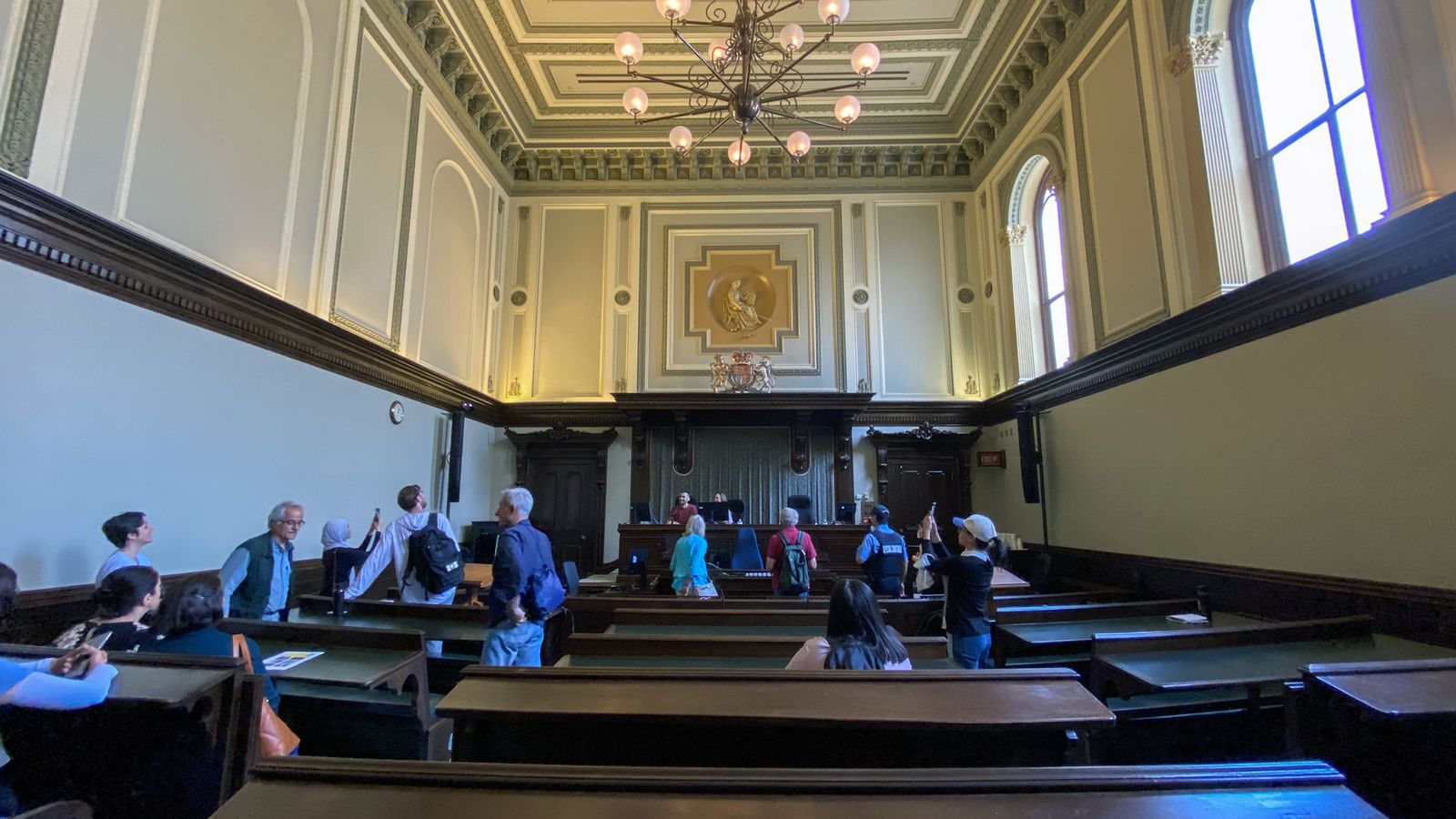
Who can remember the good old days before everything was utterly ruined by Cancel Culture? Well, you’d need to have a pretty long memory. Cancel Culture may be a modern term, but celebrities were already getting cancelled over a hundred years ago. Just ask Roscoe ‘Fatty’ Arbuckle.
Well you can’t, obviously, because he’s been dead for ages. But we can still examine his tragic story which may well be one of history’s most brutally unjust examples of a beloved figure getting downgraded from celebrated hero to villainous zero overnight.
The hugely influential comic star of the silent cinema screen was one of the most famous people on the planet for many years, but unlike his legendary contemporaries—such as Charlie Chaplin and Buster Keaton, who gained cinematic immortality—it seems that Arbuckle’s career was quietly brushed under the red velvet carpet. And it’s a bit tricky to revisit his classic pioneering works for yourself as the majority of his films no longer exist. He may have been one of the very first stars of Hollywood, but he also found himself embroiled in Tinseltown’s very first scandal, and later became the very first actor to get blacklisted in a saga which forever changed the motion picture industry in more ways than one.
A technically illegal party thrown by the fabulously wealthy Arbuckle in 1921 led to the mysterious death of a young aspiring actress in his hotel room, after which Arbuckle was accused of rape and accidentally crushing her to death with his own vast weight. The aggressive persecution from a lawyer with an axe to grind led to a series of media circus trials in which dubious tactics were displayed on both sides, and the witnesses couldn’t seem to make up their minds on what exactly they witnessed. Popcorn and custard pies at the ready as we try to piece together what exactly happened in Room 1219 in San Francisco’s St Francis Hotel on 5th September 1921, and consider how the shifty behaviour of certain individuals led to the dramatic fall of Hollywood’s forgotten Prince of Silent Film.
Fatty Makes a Dramatic Entrance
Roscoe Arbuckle didn’t get off to the kindest of starts in life. That’s partly because even before he was given the cruel nickname of ‘Fatty’, he had to put up with his real full name which was Roscoe Conkling Arbuckle. And he was only given that name because his dad hated him from birth.
Roscoe weighed in at a pretty hefty thirteen pounds when he was born in Kansas in 1887, and his opening scene in life proved to be a difficult experience for his mother Mary who was of a small and slender build. Come to think of it, his dad William was of a small and slender build too, as were all of Roscoe’s eight siblings. This raised suspicions in William’s mind that he wasn’t Roscoe’s real father, and that Mary had been playing around with a much bigger guy on the side.
The suspicions were almost certainly completely unfounded, as Mary was a devout God-fearing Christian who would never dare dream of infidelity, bearing false witness, or coveting her neighbour’s ass. But that didn’t stop William from naming his new bouncing baby boy after Senator Roscoe Conkling of New York, a womanising philanderer whom William utterly loathed. Nice.
In fact, William was an utter knob who would regularly get drunk and dish out random beatings to Roscoe for the most trivial of reasons. His simmering resentment for his son was further fuelled by his wife Mary’s severe health problems which followed on from the traumatic birth, and of course this was apparently all Roscoe’s fault for being so big. After the family moved to Santa Ana, California, an 8-year-old Roscoe had an unpleasant time at school where he was regularly teased and bullied about his weight, and this was where he was first given the nickname of ‘Fatty Arbuckle’ – a name that he always despised, even though it was destined to become the name by which he was best known.
It wasn’t all bad news for young Arbuckle, though. It was around this age that he first took to the stage when a travelling theatre troupe pitched up in town and were in need of an emergency replacement for a child actor who had been taken ill. Roscoe was happy to fill in, although it maybe wasn’t the most noble first chapter in a beckoning career in showbusiness—not only was he required to wear blackface, the barefoot role also required him to wear blackfeet. And whilst life at home was turbulent and occasionally violent, Roscoe enjoyed a healthy relationship with his loving mother.
Things settled down a bit when his father—who frequently disappeared without explanation—finally left the family home for good, taking one of his older sons with him to start new jobs in a hotel miles away from Santa Ana. But sadly, this more settled home life was more of a short than a feature-length film. In 1898, when Roscoe was just eleven years old, his mother died, quite possibly from the health issues which had arisen from Roscoe’s own birth.
There are conflicting reports as to what exactly happened next, although the gist of the events are broadly the same. Roscoe was sent away to live with his father and brother in the hotel. One account tells of Roscoe catching the train alone, and then waiting for twelve hours at the platform for his father to pick him up, until he eventually realised that this wasn’t going to happen.
Another tells of Roscoe arriving at the hotel only to find that his father and brother had quietly moved on the previous week without a forwarding address, in anticipation of Roscoe’s imminent arrival. It’s possible that both accounts are true. We do know for certain that Roscoe was sent away to the hotel to live with a father who wasn’t there.
And the hotel staff took pity on the bereaved, clearly distraught, and now homeless 11-year-old boy, offering him board and a tiny room—some say it was actually a closet, although that sounds a bit Harry Potter to me—in return for doing odd jobs around the hotel. Depending on your perspective, this is either an act of overwhelming kindness from the hotel staff, or a troubling case of child labour which would probably be frowned upon today. But at least Roscoe Arbuckle was off the streets.
And life was about to take a turn for the better.
Fatty Goes to Hollywood
So many entertainers seem to enjoy recounting far-fetched ‘origin’ stories of how they were accidentally discovered singing in their shower or how their career took off following a surprise plot twist which wasn’t even meant to happen. Fatty Arbuckle’s rise to fame is no different. He was apparently accidentally discovered when a talent scout staying at the hotel just happened to overhear Roscoe singing to himself whilst he was polishing a door knob or whatever.
Roscoe was then encouraged to take part in a local rowdy talent show in which the acts were harshly judged by the tough crowd. The act was judged a success if the audience were cheering, but if they began to boo and jeer, the act was unceremoniously dragged off the stage with a shepherd’s crook.
Roscoe attempted a bit of singing and fooling around, but his performance didn’t go down as well as he’d hoped, and he found himself the target of vicious heckling, prompting the slow entrance of the ominous shepherd’s crook to yank the failure off stage. In genuine fear of the approaching shepherd’s crook, Roscoe panicked and executed a perfect somersault into the orchestra pit, much to the surprise and delight of the audience who began roaring in approval, ensuring that Roscoe won the competition. This story does have a whiff of fairy tale about it, but the idea of a vastly overweight boy performing a perfect somersault isn’t as hard to swallow as you might think—a point that we’ll come back to later is that Roscoe was surprisingly nimble on his feet and proved in adulthood that he was still more than capable of somersaulting on demand.
But by whatever means he was first discovered, Roscoe Arbuckle was already touring in travelling theatre groups by the time he was on the verge of turning 18. He performed songs, told jokes, clowned around a bit, and demonstrated those impressive acrobatics, whilst making a bit of a name for him as the upcoming new star of vaudeville. In 1908, he met and fell in love with Minta Durfee who was at the time a chorus girl but who would later appear in silent films herself, going on to become the first leading lady for Charlie Chaplin.
They married the very same year, although it was often remarked that they looked like an odd couple—by this time the 5ft 9inch Roscoe tipped the scales at well over 300 pounds, whilst Minta was just over 5ft with a petite figure, leading to speculation that sharing a bed might have been a bit dangerous for little Minta. It wasn’t the last time that people would speculate on how Roscoe’s weight could lead to very serious issues in the bedroom for the other party.
After embarking upon a long tour of China and Japan with a vaudeville company in 1909, Roscoe’s gaze finally settled on the emerging movie industry upon his return to the US. His very first on-screen appearance was captured the same year in the ten-minute comic short “Ben’s Kid” produced by the Selig Polyscope Company. Ten minutes might seem like a surprisingly short length for a film, but this was standard at the time as it was the maximum length that could be fitted onto a single film reel.
There was a gradual move onto ‘two-reelers’ in later years in which viewers were treated to a whole epic twenty minutes of footage, even though the smaller cinema houses with only one projector had to take a brief clumsy intermission in-between as they changed over the reels. The burgeoning industry generally felt at the time that the cinema audience were incapable of maintaining their attention on the screen for more than an absolute maximum of twenty minutes. That may sound a bit silly nowadays to anyone who’s managed to sit through a ‘Lord of the Rings’ movie without needing to dash outside for a gulp of air, but maybe we’ve come full circle now that YouTube has decided that a typical viewer’s attention span is no more than 60 seconds.
An interesting point to bear in mind here is that the very early stars of cinema weren’t really stars at all. They usually weren’t even given any kind of credit, so nobody even knew their real names. Instead they were often given descriptive nicknames by the audience, such as ‘The Girl with Dimples’, ‘The Man with The Stern Face’, and of course, in Arbuckle’s case, ‘Fatty’.
The reasoning behind this lack of credit was probably down to the studios feeling cautious about actors getting too big for their boots. If an actor became too well-known, they could potentially start demanding more money for appearances, so it was better to just keep their identities a secret and have the audience regard them as familiar yet largely nameless faces. It was certainly a cost-effective strategy for the studios.
The actors weren’t really earning that much money in the early days, and there was little risk of them getting poached by another studio.
But it only took a few years for the industry to change their stance on this issue. By around 1912, the actors were receiving their rightful credits, effectively giving rise to the very first Hollywood movie stars, with Fatty Arbuckle leading the charge of this new breed of celebrity. After appearing in dozens and dozens of one-reelers for Keystone Studios, Arbuckle then gradually moved onto those epic two-reelers before forming his own production company Comique, and showing the world that he could write and direct as well as star in his own movies.
A typical Fatty Arbuckle film was a fast-paced frolic involving slapstick comedy, chase scenes, and the obligatory pie-in-the-face gag. In fact, Arbuckle was one of the first actors to ever receive a pie in the face on screen in the 1913 one-reeler ‘A Noise from The Deep’. These shorts were often given such intriguing names as ‘Fatty’s Wash Day’, ‘Fatty’s Plucky Pup’, ‘Fatty’s Magic Pants’, and the slightly less snappy ‘Mabel and Fatty Viewing the World’s Fair at San Francisco’. He wasn’t really playing the same character as such in all these shorts—the name ‘Fatty’ was just an indicator to the audience that this was another Fatty Arbuckle film.
Although Arbuckle disliked the nickname and was actually still very self-conscious about his weight, he believed it was inevitable that the old taunt from his school days would stick with him throughout his movie career. He did however refuse point-blank to get cheap laughs from his girth. You never saw Fatty Arbuckle stuffing his face on screen, or getting stuck in a door, or sitting on a collapsing chair.
Quite the opposite, in fact. You were more likely to see Arbuckle perform those incredible acrobatics or break out into a delicate dance routine. Not just on screen either—he liked to keep up these demonstrations of elegant agility even when a camera wasn’t pointing at him.
Canadian actor Mack Sennett recalls that when he met Arbuckle for the first time, he was left gobsmacked when Arbuckle “skipped up the stairs as lightly as Fred Astaire” and then “without warning went into a feather light step, clapped his hands, and did a backward somersault as graceful as a girl tumbler.”
It’s clear that Arbuckle wanted to be recognised as a truly talented performer rather than just a man who was funny because he was overweight. He once said in 1917: “I refuse to try to make people laugh at my bulk. Personally, I cannot believe that a battleship is a bit funnier than a canoe, but some people do not feel that way about it.” It does seem a bit odd then, that the name ‘Fatty’ appeared in the title of at least 27 of his shorts.
Still, if you ever dared to call him that to his face, he’d brusquely respond with “I’ve got a name, you know.”
Although Roscoe Arbuckle is often described as a contemporary of those cinematic legends Charlie Chaplin and Buster Keaton, he was actually more of a mentor to them, particularly Buster who got his first big break from Arbuckle and later revealed: “I learned it all from him.” Whilst we’re at it, Arbuckle can also be credited with first discovering the comedian, actor, and entertainer Bob Hope who got his first job with a touring troupe thanks to Arbuckle, and who would go on to enjoy a career spanning nearly eight decades. But it was perhaps Buster Keaton that shared the most chemistry with Arbuckle, as they appeared in around 14 shorts together, and became very close buddies.
And in 1920, Arbuckle relinquished control of his Comique production company to Buster. It might seem like an extraordinarily generous move to just hand over your successful company to a mate, but Arbuckle didn’t have time to run his own business anymore. He’d just landed a juicy new contract with Paramount to appear in eighteen new feature-length films over the next three years, on the assumption that the audience were now capable of maintaining their attention over five whole reels.
In fact, it was an incredibly juicy contract. Arbuckle would be paid $3 million in total, briefly making him the richest actor in Hollywood, and the first to secure a contract worth over a million dollars a year. Just to put that in perspective, his three-year contract with Paramount would be worth around $45 million in today’s money. One slight downside to the contract is that Arbuckle had to promise never to slip under the weight of 250 pounds.
In fact, he’d be given a lucrative bonus by the studio every time he piled on another 50 pounds. But Arbuckle probably wasn’t too bothered by that when he bought his first 21-room mansion. It didn’t look as if shifting weight was ever likely to be on the cards anyway, with or without a $3 million dollar contract.
Not everything else in Arbuckle’s life was entirely peachy, though. He and wife Minta separated in 1921, although it wouldn’t be until 1925 that Minta eventually filed for divorce, on grounds of desertion. Arbuckle was also hitting the bottle quite heavily, and the combination of his drinking and his weight led to a serious bacterial infection in his leg.
At one point, he was advised that he may possibly require amputation below the knee to save his life. He eventually managed to battle through the infection without amputation, but it’s reported that he briefly became addicted to the morphine that he’d been prescribed. But his career had never looked brighter.
In late 1921, he’d just got through an exhausting schedule in which he had completed three different films at once by frequently hopping from set to set. He was surely due a short celebratory break after this remarkable achievement, before commencing work on the next movie in the pipeline. So, on the 5th September, Roscoe Arbuckle decided to throw a party.
It was a party that would end with horrific consequences.
Fatty’s Big Party
It was a party which he very nearly didn’t attend at all. Along with his chums—actor Lowell Sherman and director Fred Fishback—Arbuckle had decided to drive down to San Francisco and rent out a whole suite of three connecting rooms at the top of The St Francis Hotel in which to hold the planned weekend-long party. Just before Arbuckle had set off in his custom-built Pierce-Arrow touring car, he had received an alternative invitation from buddy Buster Keaton to spend the weekend on Buster’s new yacht. It was an invitation he should have accepted, but he instead decided to stick with his original plans.
Another potential spanner had also been thrown in the works when Arbuckle had decided to get his car serviced before the trip. In a scene which could have been lifted from one of his own comic shorts, Arbuckle had accidentally sat down in the garage on a rag drenched in acid which burned right through his pants and ended up causing second-degree burns to both his buttocks as he leapt and pranced around the garage. Arbuckle later contacted his mates and told them that the trip might be off, as he didn’t think he’d be able to sit comfortably on the car seat after his arse had caught fire.
Fred Fishback was having none of it, though—he generously sent Arbuckle a nice padded rubber ring on which to perch his scorched posterior. It was a nice gesture from a good friend, but it was another potential escape route from disaster which had been unwittingly roadblocked. Nothing was going to stand in the way of this wild party.
I’m sure most of us have been to a few wild parties that got a little out of hand. The one that springs instantly to my mind is the time when things got so bad that the party host had been aggressively evicted by his landlord by the end of the night. I’m not sure why so many of us had clambered up to the roof of his house in the middle of the night.
And I’m not sure why we thought it would be a good idea to respond to the angry screaming from next door by getting out a couple of bongos and chanting the lyrics to “Give Peace a Chance” for about 90 minutes. I know this sounds incredibly anti-social, and I wouldn’t say I’m proud of my involvement, but you have to bear in mind that this was taking place on the noisiest street in the North of England, and the host of the party was probably one of the quieter residents. The party came to an abrupt halt when we heard the clattering of ladders against the side of the house, and the boiling red face of the landlord popped out of nowhere to inform us all that if we didn’t get down immediately, he would beat seven shades of shit out of the lot of us.
With hindsight, this would have been a brilliant moment for one of us to execute a perfect backward somersault over the landlord, and land in the front garden to rapturous applause. But seeing as the landlord was much bigger than us, we kind of just meekly apologised and got down from the roof with our bongos to figure out what we were going to do about our now homeless friend. He wasn’t that bothered, actually.
It had still been a top party, and the sticky chicken skewers were exquisite.
I would have expected Fatty Arbuckle’s party to have been a little more refined than that. The St Francis Hotel was one of the swishiest joints on the West Coast, with telephones in every room which was practically unheard of at the time. From the three huge rooms rented out by the trio, Room 1219 was to be a bedroom shared by Arbuckle and Fred Fishback, whilst Lowell Sherman got his own private quarters in Room 1221, and Room 1220 was the designated party room.
A whole gang of show business types had been invited to the party to enjoy the free-flowing booze provided by Arbuckle and his mates, and in fact this was the biggest draw of the party. The year was 1921 and prohibition had been in full swing for two years, but Arbuckle had managed to secure vast quantities of illegal hooch. This might have been considered a bit naughty, but there was a growing feeling at the time that these new celebrity movie stars from Hollywood could pretty much get away with whatever they wanted without consequence.
It seemed unlikely that the police would dare to break up a party hosted by the now legendary Fatty Arbuckle. The stars of Tinseltown were above the law. Within reason.
And so, with all that bootleg liquor up for grabs in Room 1220 of The St Francis Hotel, it’s little wonder that the party attracted a whole raft of guests eager to join in the celebration. And one of those guests was Virginia Rappe.
Not that much is really known for sure about the life of Virginia Rappe. I mean, plenty was said about her in the immediate aftermath—and much of this was just salacious fabrications cooked up to denigrate her character. As we’ll later discover, this got very unpleasant indeed.
It’s often reported that Virginia was a failed actress who had fallen on hard times and whose life was beginning to spiral out of control, but this didn’t seem to be the case at all. Hailing from Chicago, Virginia had forged a pretty successful career as both a model and a fashion designer, during which time she became engaged to dress designer Robert Moscovitz who was then tragically killed in a car accident. She later embarked upon a long-term relationship with the leading silent film director and producer Henry Lehrman, and it was around this time that she tried to break into the movie industry herself.
She hadn’t yet become a fully-fledged star, largely appearing in uncredited bit parts in shorts, although she did have a single prominent role in the 1917 comedy romance ‘Paradise Garden’. But that’s not to say that she’d given up on her ambition. Virginia was still a 30-year-old aspiring actress when she turned up to the party hosted by Arbuckle, a man whom it’s believed she did not know that well.
It’s not known for sure if Virginia was even officially invited, or whether she just kind of gate-crashed the event. But we do know for sure that Virginia would never get the chance to appear in another movie.
At some point during the party, Virginia had visited the bathroom in Room 1219—the bedroom shared by Arbuckle and Fishback—and is said to have had some sort of encounter with Roscoe Arbuckle. Following this encounter, Virginia could be heard screaming in pain, and was found writhing in agony on the bed. It was initially suspected that she may just have drunk too much dodgy hooch.
The first doctor on the scene concluded that her condition was most likely caused by intoxication, and that there was no need for Virginia to be rushed to hospital. Instead, she was moved into Hotel Room 1227 of the hotel for a couple of days, paid for by Arbuckle. But Virginia’s condition was to deteriorate dramatically.
Still suffering from chronic pain in her abdomen, Virginia was eventually taken to Wakefield Sanitorium where she sadly died just two days later from peritonitis—an infection of the inner lining of the belly, brought on in this case by a ruptured bladder. But the question remained over how exactly Virginia Rappe had endured a seemingly spontaneous bladder rupture over the course of a party.
It’s possible—yet incredibly rare—for a bladder rupture to be sparked by binge-drinking, and of course this is the conclusion at which many people arrived—Virginia had gone way overboard with the illicit booze and had effectively drunk herself to death. But it’s more common for a spontaneous bladder rupture to be brought on by intense physical trauma, and this led to speculation of a more sinister kind. Just what exactly had taken place between Roscoe Arbuckle and Virginia Rappe in that hotel room?
An alternative theory began to take shape: Arbuckle had lured Virginia Rappe into his own hotel bedroom and made unwanted sexual advances on the actress. After forcing himself upon her, the sheer bulk of Arbuckle—who weighed around 266 pounds at the time—had crushed Virginia and damaged her internal organs, causing her bladder to rupture which led to the fatal infection. A slightly mysterious woman by the name of Maude Delmont seemed convinced that this was more than just a theory.
She was apparently a good friend of Virginia’s who had been there at the party. And after Maude had first rushed into Room 1219 upon hearing her friend’s screams, she came across both Arbuckle and Virginia, the latter of whom was laying on the bed and screaming that she was dying. Virginia was only capable of uttering three other coherent words: “Arbuckle did it.”
Fatty’s Spot of Bother
Maude Delmont wasted no time in recounting her version of the story to the press, the police, and pretty much anyone else who was willing to listen. For reasons that aren’t entirely clear, it was well established that Arbuckle had spent a big chunk of the party wandering around in his pyjamas, bathrobe, and slippers. You’d think that the host of such a lavish party would have had the decency to at least get dressed, but it seemed that nobody really batted an eyelid.
Fatty Arbuckle was a major motion picture star, he was allowed to be a bit quirky. Maybe he planned to put on some proper clothes when the party really got going later in the evening.
According to Maude, her friend Virginia had been enjoying a few drinks with Arbuckle in the main party room, but she had no more than three in total and she certainly wasn’t drunk. Arbuckle had apparently seemed enthusiastic about the prospect of helping to further Virginia’s movie career, before he pulled her into Room 1219 with the words: “I’ve waited for you for five years, and now I’ve got you.” Maude was concerned by this turn of events, and became even more concerned when she first heard Virginia’s screams.
She claims to have dashed over to the door of Room 1219, only to find it was locked. After furiously battering and kicking at the locked door, she was eventually let into the room by Arbuckle who seemed in strangely high spirits considering all the drama. Maude recalled that he was initially wearing a comical grin alongside his pyjamas and bathrobe.
But it seems that he eventually became annoyed by all the noise that Virginia was making, as he turned to Maude and barked: “Shut her up or I’ll throw her out a window.” He soon cheered up again as he then skipped out of the room and went back to mingle and dance with the other more considerate guests who weren’t screaming the whole place down.
Maude’s accusation was backed up by two other female witnesses from the party—Zey Prevon and chorus girl Alice Blake—who both later made statements to the police confirming that at some point they had heard Virginia utter the words: “Roscoe hurt me.”
Roscoe Arbuckle was said to be quite taken aback when the police first arrived on his doorstep in Los Angeles on 9th September and announced that he was under arrest on suspicion of rape and first-degree murder. It’s reported that he initially thought it was a wind-up and he responded with a hearty laugh, asking: “And who do you suppose I killed?” But he soon quietened down when the police responded with the name of Virginia Rappe. It’s worth remembering that at this point, Arbuckle may not even have been aware that Virginia had been taken seriously ill and rushed to hospital—the last he may have known of the matter, she was still recuperating from a particularly bad hangover in a room at the St Francis Hotel for which he was footing the bill.
Arbuckle’s initial defence would differ significantly from the defence he would later give in court. He claimed that Virginia had been enjoying a few drinks when she suddenly started complaining that she couldn’t breathe and then became “hysterical”, stripping off her clothes in front of everyone. Two of the other female guests had taken Virginia to the privacy of Room 1219 where they tried to calm her down by fully disrobing her and placing her in a bathtub of cold water, whilst Arbuckle telephoned for a doctor. In this version of the story, there was no point at which Arbuckle and Virginia Rappe were ever alone together.
San Francisco District Attorney Matthew Brady wasn’t convinced by that. Following the statements given by Maude Delmont and the two other witnesses, he seemed determined to bring Roscoe Arbuckle to trial. Brady kicked off by issuing his own statement to the press: “The evidence in my possession shows conclusively that either a rape or an attempt to rape was perpetrated on Miss Rappe by Roscoe Arbuckle. The evidence discloses beyond question that her bladder was ruptured by the weight of the body of Arbuckle either in a rape assault or an attempt to commit rape.”
He then got to work on forming a case, as Roscoe Arbuckle was held without bail at the San Francisco Hall of Justice. And Brady wasn’t mucking about. He wanted to see Arbuckle convicted of first-degree murder, punishable by the death penalty.
Matthew Brady was keen to push on with the prosecution so quickly that much of the crucial evidence—such as an autopsy result—wasn’t even available yet. He seemed to think that the testimony provided by his star witness Maude Delmont and the other two party guests would be more than enough to send Roscoe Arbuckle to the gallows or the electric chair. But then he quickly came across a minor snag with his star witness Maude. It turns out she was about as reliable as a bank statement belonging to a Nigerian prince.
Brady’s suspicions had first been aroused when he noticed that Maude couldn’t appear to stick to the exact same version of events. In one version of her story, she barely drank anything at all before the incident, whilst in another version she’d already downed between eight to ten whiskeys. In one version, she’d been a lifelong friend of Virginia Rappe, whilst in another version, they’d only met each other a few days prior to the party.
It felt as if Maude was just making stuff up on the spot without bothering to try and remember what she’d said in the previous statement. That was only the tip of the iceberg. After digging a little deeper, Brady discovered that Maude had a pretty extensive criminal record for bigamy, fraud, and, oh dear, extortion.
As if that wasn’t bad enough, it was later discovered that Maude had sent a telegram to her friend whilst Virginia was still screaming in pain at the hotel. The 15 words say it all: “WE HAVE ROSCOE ARBUCKLE IN A HOLE HERE. CHANCE TO MAKE MONEY OUT OF HIM.”
Brady knew that there was no way he could use Maude Delmont as a witness. And bearing in mind that Maude’s original allegations were the catalyst for all of this, he must have known that his case had now almost entirely fallen apart. But he wasn’t going to let such a trivial matter get in the way of a prosecution. He still seemed fiercely persistent in his pursuit of Roscoe Arbuckle.
We can only speculate why he was so keen to see Arbuckle’s head on a spike. Brady had been described by acquaintances as “a self-serving ruthless man with blind ambition and a quick temper.” It’s been suggested that he had his eyes on the job of California governor, and he felt that exposing the seedier side of Hollywood and securing a successful prosecution against Hollywood’s biggest star might ramp up his profile and credibility.
But the decision on whether or not Arbuckle would ultimately face trial rested in the hands of the police judge Sylvain Lazarus. And he eventually concluded that Arbuckle should indeed be put on trial, but on the reduced charge of manslaughter rather than first-degree murder. His reasoning, though, was very odd.
Judge Lazarus stated in his ruling: “I do not find any evidence that Mr. Arbuckle either committed or attempted to commit rape. The court has been presented with the merest outline.
The district attorney has presented barely enough facts to justify my holding the defendant on the charge which is here filed against him. But we are not trying Roscoe Arbuckle alone; we are not trying the screen celebrity who has given joy and pleasure to the entire world; we are actually, gentlemen, trying ourselves. We are trying our present-day morals, our present-day social conditions, our present-day looseness of thought and lack of social balance.
The issue here is really and truly larger than the guilt or innocence of this poor, unfortunate man; the issue is universal and grows out of conditions which are a matter of comment and notoriety and apprehension to every true lover and protector of our American institutions. I have decided to make a holding on the ground of manslaughter.”
The first important point to note here is, contrary to how this saga is often reported, Roscoe Arbuckle was never once charged with rape. The second important point to note here is that everyone just seems to have gone bat-shit crazy in their decision-making. Matthew Brady was pursuing a prosecution triggered by a known extortionist who couldn’t get her story straight and who had already signalled her intention to get money out of Arbuckle.
Aside from the two other party guests who later claimed to have heard Virginia confirming that Roscoe had hurt her, there was no other evidence to go on. Judge Lazarus seemed to agree that the case for the prosecution was woeful, and that Arbuckle barely even deserved to be detained. And yet he’d come to the quite bizarre conclusion that Arbuckle should stand in the dock whilst the court ponders over modern-day morals and lack of social balance.
Arbuckle was again denied bail, but as he sat in his cell and pondered over his fate, he may have taken some comfort from the charge against him getting downgraded to something that didn’t potentially conclude in execution by the state. He may also have pondered over how that yachting weekend with Buster Keaton would have panned out.
Of course, all this made a few headlines, and that’s putting it mildly. It’s often been said that OJ Simpson’s trial was “The Trial of the Century”—helped along in no small measure by the blanket live television coverage—but The Trial of Fatty Arbuckle would have given OJ’s trial a run for its money, and Arbuckle was arguably an even bigger star in the prime of his career. The newspapers couldn’t get enough of it over the following five months, as doctored photographs of Arbuckle behind bars ran alongside headlines such as “ARBUCKLE FACES GALLOWS!”
and “FATTY ARRAIGNED AS SLAYER!” Some quarters of the press took a reasonably fair and balanced perspective of the unfolding events, but it seems that any of the massively popular newspapers owned by media baron William Randolph Hearst took a far more sensationalist and judgemental stance, as Arbuckle was depicted as a clearly guilty drug addict, drunk, and philanderer who preyed on young defenceless women. One editorial cartoon in Hearst’s ‘San Francisco Examiner’ was given the caption of ‘They Walked Into His Parlour’, and portrayed Arbuckle at the centre of a spider’s web, drinking from two liquor bottles and contemplating the seven women who have been caught in his web.
You might think that William Randolph Hearst was another individual who just had it in for Arbuckle, but it sounds as if it was more about just shifting newspapers. Every time another sensationalist Arbuckle story appeared on the front page, sales would go through the roof. As Hearst himself observed: “I sold more newspapers during the Arbuckle trials than when The Lusitania went down.” But his papers went way, way too far.
I’m not going to dwell on this in too much detail, but it’s often wrongly reported that Arbuckle had to defend himself in court over the allegation that just prior to accidentally crushing Virginia Rappe to death, he had sexually assaulted her with a piece of ice, although this piece of ice later evolved into a Coke bottle and a champagne bottle. Not true at all. This story originated in one of Hearst’s newspapers, and was possibly a twisted version of a genuine moment when some of the party guests rubbed ice on Virginia’s stomach to help calm and cool her down. But although this allegation pops up all the time in association with the trials of Roscoe Arbuckle, it never existed outside of the sickest fabrications thrown up from Williams Randolph Hearst’s attempts to sell even more papers.
Roscoe Arbuckle did get a bit of support from family and friends, most notably his then estranged wife Minta Durfee who travelled from her mother’s home in California to attend the first trial and pose for pictures standing loyally by his side. Studio executives had apparently warned actors not to speak publicly in defence of Arbuckle as the movie industry was keen to avoid any further association with this very first Hollywood scandal. All of Arbuckle’s films had already been effectively banned from cinemas, although there was a general expectation that the ban would be lifted should Arbuckle be found innocent.
It seems that most actors complied with the request from the studios to keep shtum, probably in fear of getting reprimanded or destroying their own careers. And it maybe wasn’t too hard for them to keep quiet during the era of silent movies, as they’d already had a fair bit of practice in that kind of thing. But Buster Keaton and Charlie Chaplin were both brave enough to defy the instruction and speak to the press in support of Arbuckle.
Not only were they good friends with the actor, but they would also have been aware that they were both such big crowd-pullers that no studio in their right minds would dare to fire them. So Chaplin seemed more than happy to tell the press: “I know Roscoe to be a genial, easy-going type who would not harm a fly.” A big chunk of the general public seemed to agree with this sentiment, perhaps finding it impossible to comprehend that the lovable comical roly-poly star of the silver screen could ever have been responsible for the death of an innocent woman.
But not everyone was convinced of Arbuckle’s innocence, and not everyone was patient enough to wait for a verdict.
Before the main trial had even got underway, hundreds of women gathered around the San Francisco courthouse to protest against the acceptance of sexual misconduct in society, and to call for Roscoe Arbuckle to be held accountable for his wicked crimes. And it was against this backdrop of vocal condemnation that Roscoe Arbuckle arrived at the city courthouse on 14th November 1921 to defend his name.
Fatty’s Day Out in Court
It was always going to be a bit tricky dealing with a case in which most of the witnesses were completely plastered on illegal hooch. And the constant changing of stories and statements from everyone involved—notably Roscoe Arbuckle himself—made for a deeply confusing and chaotic trial. If it had ever been adapted into a blockbuster movie, they may as well have gone the whole hog and thrown in a few pie-in-the-face scenes for light relief.
Still, maybe the medical experts and criminologists weren’t always completely wasted during their involvement in the saga, and they might have been able to stick to the same story. But every time Matthew Brady appeared to land a sucker punch with one of his witnesses for the prosecution, the effects were diluted somewhat when the same witnesses faced cross-examination from Arbuckle’s defence counsel Gavin McNab.
Grace Hultson was a local nurse who had attended to Virginia after she had been rushed to hospital. Grace appeared to glare angrily at Arbuckle throughout her testimony as though she was utterly convinced of his guilt. She told Brady that she believed Arbuckle had raped Virginia as there were bruises on her body, and her internal organs had been torn in a way that suggested brute force.
But under cross-examination, Grace admitted that it was possible that the bruises could have been caused by the heavy jewellery that Virginia was wearing, and that the bladder rupture could have been the result of an existing medical condition. Venturing further back into the timeline of the tragedy, Brady posed questions to Dr Arthur Beardslee who had been the hotel doctor first on the scene in Room 1219. Dr Beardslee also seemed to be of the opinion that Virginia’s ruptured bladder may have been caused by an external force, despite the fact that he initially seemed to conclude that Virginia was just suffering effects from heavy intoxication.
The doctor later admitted to Gavin McNab that during the whole period that he spent with his patient, Virginia never once said anything that implicated Roscoe Arbuckle.
The local criminologist Dr Edward Heinrich sent a shockwave through the court when he took to the stand with what was believed to be compelling evidence, something which Brady’s prosecution case had so far been very much lacking. Dr Heinrich claimed that he had come into the possession of Virginia’s fingerprints on the door handle of the hotel room, which were superimposed by Arbuckle’s fingerprints, indicating that Virginia had tried to get out of the room but Arbuckle had placed his hand over hers and slammed the door shut in a bid to prevent her escape. However, former federal investigator Ignatius McCarthy later took the stand to propose that he believed the fingerprints were faked, whilst the hotel maid insisted that the whole room had been comprehensively cleaned several times from top to bottom before any investigation took place.
Well, the experts aren’t doing a very good job of convincing anyone of Arbuckle’s guilt, so let’s see how we fare with those inebriated party guests. What about those other two guests who claimed to have heard Virginia confirm that Arbuckle was responsible? Well, chorus girl Alice Blake proved to be a bit of a non-starter.
Although she had initially told the police that she had heard Virginia speak, she now appeared to have had a change in her recollection and refused to confirm this in court. Meanwhile, the other guest Zey Prevon went several stages further in demolishing the prosecution and making a mockery of her original police statement. She now said: “I didn’t see very much and I was repeating what Maude Delmont had told me.
Virginia Rappe went into the bedroom with Roscoe Arbuckle because she wanted to. That’s all I have to say.” Well, it wasn’t quite all she had to say.
For an encore, she went on to say that she had always considered Arbuckle to be a kind and thoughtful man.
Still, Matthew Brady had another party guest witness to pull out of the hat. This time it was model Betty Campbell who revealed in her testimony that Arbuckle was smiling a few hours after the incident. That’s it. I think Brady was trying to convey the message that Arbuckle hadn’t shown the slightest bit of remorse or concern after a guest had been taken ill at his party.
But Brady may have been better off asking Betty Campbell to stay at home. Under later cross-examination, Betty admitted that the prosecution had threatened to get her sent to prison if she didn’t cooperate and testify against Arbuckle.
So far, Roscoe Arbuckle probably wasn’t sweating too much over the verdict, as the prosecution seemed to be tripping itself up at every turn and performing a series of comedy pratfalls for the courtroom audience. When he took the stand himself for a testimony that spanned over four hours, he appeared remarkably calm and measured, if perhaps a little tired after having swapped his lavish millionaire lifestyle for a couple of months behind bars. But the curious thing about Arbuckle’s defence is that his story had changed significantly since he had originally told the police and press that he had never once been alone with Virginia Rappe who had suddenly become hysterical and started stripping off her clothes in the main party room.
He now claimed that he had wandered into his bedroom in Room 1219 in order to finally change out of those pyjamas, bathrobe, and slippers. He was surprised to discover Virginia Rappe vomiting in the toilet of his bathroom. Initially assuming, like many others, that she had just had too much to drink, he became more concerned when Virginia began trying to tear off her clothes whilst screaming in pain.
Arbuckle helped her out of her dress and laid her down on the bed, spending no more than ten minutes alone with her before he called in other guests to help. One of the other guests was Maude Delmont who applied ice to Virginia’s stomach to try and cool her down. But it sounds as if Maude then needed calming down herself, as she suddenly became very confrontational with Arbuckle who eventually lost his patience and threatened to throw Maude—not Virginia—out of the window if she didn’t shut up.
I think we’re meant to assume that Arbuckle was just annoyed in the heat of the moment and had no intention of carrying out his threat, but it’s still a bit weird to admit that you were threatening to throw a woman out of a top-storey hotel window whilst trying to defend yourself on a manslaughter charge. In fact the whole defence from Arbuckle was a little puzzling, and you have to wonder why this version clashes so much with his original statements to the police and press. It could be construed that he was guilty and was now panicking after realising his original story wasn’t strong enough as nobody else at the party witnessed Virginia tearing off her clothes in the party room.
Or it could have been that he was reluctant to admit in his original statements that he had ever been alone in a hotel bedroom with a partially undressed woman who died four days later, but now he had been forced to reveal more of the truth to prove his innocence. Whatever the case, it seems that the other defence witnesses called up by Gavin McNab did a much better job of defending Arbuckle than Arbuckle himself.
Medical evidence was presented to the court which showed that this was no case of a spontaneous ruptured bladder. Doctors testified that Virginia had a pre-existing chronic bladder condition, whilst a nurse revealed that Virginia had complained of severe abdominal pain six weeks prior to the party. The coroner concluded that Virginia Rappe had been suffering from chronic inflammation of the bladder and acute peritonitis, and whilst there were a few bruises on her body, there was no evidence whatsoever of an attempted sexual assault.
One final interesting point about the defence is that Gavin McNab had originally intended to present several other unsavoury implications regarding Virginia’s personal life and medical history, but Arbuckle himself had reportedly requested him to drop this angle out of respect for Virginia Rappe. The defence were probably still pretty confident of a ‘not guilty’ verdict, though. However, it was not to be.
After over 44 hours of deliberation, the jury conceded defeat and returned to the courtroom to declare a hung jury. They were deadlocked with a 10-2 majority in favour of acquittal, and a mistrial was ruled. Some of those jury members who had voted against conviction later admitted that they felt that Arbuckle probably was guilty, but not beyond reasonable doubt.
There was something a bit dodgy about the selected jury though.
One of the two jury members who voted for conviction went by the name of Helen Hubbard and she had been particularly vocal in her condemnation of Roscoe Arbuckle right from the very beginning. She had reportedly told other jurors that she would continue voting guilty “until hell freezes over” and had refused to even examine exhibits or read trial transcripts during the deliberations. It turned out that her husband was a lawyer with close connections to prosecutor Matthew Brady.
But she had never tried to hide this, and indeed felt quite surprised herself that she had made it through the selection process. She also strongly maintained that her marriage had nothing to do with her judgement. She was just convinced that Arbuckle was guilty.
But if you were to listen to both Gavin McNab’s and Roscoe Arbuckle’s public response to the hung jury, you’d be forgiven for thinking that they hadn’t been in the same courtroom when the verdict was declared. There were two jury members who had voted for conviction. The other was called Thomas Kilkenny, but unlike Helen Hubbard, he refused to speak to the press afterwards and so it seems that he was very conveniently forgotten, whilst all the blame for the verdict was pinned on the apparently hostile and prejudiced Helen Hibbard.
Gavin McNab even began making blatantly false public statements in which he referred to an entirely fictitious 11-to-1 verdict. Meanwhile, here’s Arbuckle’s take on the hung jury, if we’re to assume that he had any hand in putting together the public statement: “But for one woman on the jury of twelve representative men and women—a woman who refused to allow her fellow jurors to discuss the evidence or reason with her, and who would not give any explanation for her attitude—my trial would have resulted in an immediate acquittal.” It’s worth remembering that at this point, women had only very recently been legally allowed to serve on some US juries, and were still considered ineligible in most states.
And the defence team’s angle seemed to be along the lines of “See what happens when you put a woman on a jury? Whatever next? A woman judge?
It’s political correctness gone mad!” Maybe the next jury would be kinder to Arbuckle’s cause. Or maybe not.
Arbuckle’s defence team certainly seemed a lot more relaxed during the second trial which got underway on January 11th 1922. Well, that’s one way of looking at it. Another way of looking at it is that they were so confident of a favourable outcome that they could barely be bothered to put up a defence. In fact, Gavin McNab decided that Arbuckle didn’t even need to testify for this one.
And McNab himself didn’t even bother to deliver a closing statement. It was as if he was either hoping to squeeze in a few extra rounds of golf over the next few weeks, or he just assumed it was in the bag.
If the case for the prosecution was a little shaky during the first trial, it was positively convulsing in death spasms by the time we got to the second. One witness for the prosecution we didn’t mention during the first trial was studio security guard Jesse Norgard who had originally testified that Arbuckle once approached him with a cash bribe in return for the keys to Virginia Rappe’s dressing room. Jesse said that Arbuckle had insisted he just wanted to play a little prank on the actress, but Jesse didn’t trust him and refused to hand over the keys.
This didn’t really lead anywhere during the first trial. Arbuckle openly laughed off the suggestion as ridiculous and claimed that he would never have done such a thing. But during the second trial, more evidence came to light.
Jesse Norgard already had a criminal record, and he was currently facing charges over the sexual assault of an eight-year-old girl. Jesse had been offered a potential sentence reduction from Matthew Brady if he agreed to provide some sort of testimony against Arbuckle. So it sounds as if he just made up something juicy to try and shave a few years off his prison time.
Dr Heinrich was back in court for the retrial—he was the criminologist who claimed that he came across incriminating overlapping fingerprints on the handle of the door which had already been debunked by a former federal investigator and the hotel maid. Dr Heinrich now took back his original testimony and revealed that he himself had been mistaken about the authenticity of the fingerprints, and now believed them to be fake. Oh, and party guest Zey Prevon made another appearance, this time to testify that Matthew Brady had intimidated her and forced her to lie in her original police statement.
There seemed to be so little going the way of the prosecution that the outcome may have seemed to many like a no-brainer. But the verdict was surprising. After another forty hours of deliberation, another hung jury was declared, leading to another mistrial.
Once again, the jury had found themselves deadlocked in a 10-2 vote. But this time, the 10-2 majority was quite bizarrely in favour of conviction of Roscoe Arbuckle.
It was later suggested that the lack of testimony from Arbuckle and the sheer laziness of the defence had suggested to the jury that the defence didn’t expect a favourable outcome and couldn’t be arsed to put up a fight. The defence team weren’t going to let that happen again. They knew they had to up their game for the third trial which began on 13th March 1922, and this time they were pulling no punches. In fact, they got quite incredibly nasty.
Remember when Arbuckle requested that his defence team should show respect to the dead and refrain from digging up dirt on Virginia Rappe’s private life? That idea went right out of the window of a top-storey hotel room.
Gavin McNab found witnesses who claimed that Virginia often drank heavily at parties, had a habit of taking her clothes off in front of all the other guests, and shock horror, was known to be sexually active. It was also implied that her health conditions had been further complicated by as many as five backyard abortions dating back to when she was a young teenager, and that some of these illegal procedures may have been badly botched. It’s hugely important to note that I couldn’t find a single scrap of compelling evidence that any of this was remotely true, and there is no medical proof that Virginia had ever had an abortion in her life. But Gavin McNab was ruthless in his determination to paint the victim as an out-of-control sexually promiscuous exhibitionist drunk who had brought all this on herself.
I’d like to think there were other factors which resulted in the jury taking a more favourable view of Arbuckle third time round. Arbuckle gave a heartfelt testimony in which he again protested his innocence, and McNab had clearly woken up as he delivered a robust defence and tore the prosecution witnesses to pieces. In his closing statements, McNab appeared to passionately expose the sheer ludicrousness of a case which should never have come to court.
He explained how Matthew Brady had been conned by the testimony of a known extortionist—described as “The complaining witness that never witnessed”—and had then proceeded to build a case by bullying other supposed witnesses into making false statements. The prosecution really had nothing to fall back on this time. And the jury knew it.
After the protracted deliberations of the first two trials, this third jury took a mere six minutes to declare their unanimous verdict: Roscoe Arbuckle was not guilty.
I say that it took six minutes for the jury to make up their minds. They must have spent at least four or five of those minutes putting together a statement which effectively served as an apology on behalf of the United States for ever putting Arbuckle on trial in the first place. Seeing as the jury might have been pushed for time, I’m sure Arbuckle would have been more than happy with something short and snappy and to the point.
Something along the lines of “Soz, Fatty.” But the statement read out to court by the jury foreman went way beyond that: “Acquittal is not enough for Roscoe Arbuckle. We feel that a great injustice has been done to him.
We feel also that it was only our plain duty to give him this exoneration, under the evidence, for there was not the slightest proof adduced to connect him in any way with the commission of a crime. He was manly throughout the case and told a straightforward story on the witness stand, which we all believed. The happening at the hotel was an unfortunate affair for which Arbuckle, so the evidence shows, was in no way responsible.
We wish him success and hope that the American people will take the judgement of fourteen men and women who have sat listening for thirty-one days to evidence, that Roscoe Arbuckle is entirely innocent and free from all blame.” This written statement was then passed directly onto Arbuckle who is reported to have treasured it for the rest of his life. I bet he especially liked the bit where they called him “Manly.”
You’d never have gotten that kind of praise from Helen bloody Hubbard.
He didn’t get off entirely scot-free. Let’s not forget that the scoundrel was hosting a party flowing with illegal booze during prohibition. For that, he was fined $500 after being found guilty of violating the Volstead Act. But I wouldn’t imagine that kept him awake at night.
I don’t think we’ll ever know for sure what exactly happened in Room 1219 on 5th September 1921. Perhaps Roscoe Arbuckle was telling the complete truth, but it’s suspicious that he felt compelled to change his story so dramatically, and rendered his original version—in which he insisted he had never been alone with Virginia—a tissue of lies. If the story could change so much from the original police statements to the court testimony, could it have changed again under further pressure?
Was Roscoe Arbuckle still hiding something? I’m quite intrigued that opinion at the time seemed to be firmly divided into two distinct camps; Roscoe Arbuckle was either a sexual predator who was responsible for the death of Virginia Rappe, or he was a man who just happened to wander into his own hotel room as a party guest fell ill. There seems to be little suggestion of anything in-between.
Could Arbuckle have not been telling the whole truth about events which were not of a criminal nature but also not something he wanted made public? The fact that Arbuckle was in his pyjamas and Virginia was partially undressed during their time alone together in the hotel room was always going to raise a few eyebrows. Whilst Arbuckle was separated from his wife Minta at the time, he was still legally married and wasn’t known for chasing other women.
It’s not entirely implausible that something entirely consensual was going on between Arbuckle and Virginia in the hotel room before Virginia suddenly became ill, but Arbuckle didn’t want this to be known. And yet surely he would have eventually decided that telling the whole truth and just facing a little embarrassment about any intimate details was a better option than just making shit up and facing the risk of getting sent to prison for manslaughter. Whilst we may never know all the details, we do know that Virginia Rappe tragically died from a pre-existing health condition which had been causing her grief for quite some time, and that Roscoe Arbuckle had been cleared of any charges relating to her death, and was now free to pursue the next chapter of his movie career.
However, the career of one of the most famous silent stars in the world was about to go through a particularly quiet phase.
Fatty’s Downhill Ride
Arbuckle wasn’t exactly rolling around in money by the time the trials were finally over. His juicy $3 million dollar contract with Paramount had been terminated, and he had to sell his mansion and his cars in order to pay off the $700,000 he now owed in legal fees to his attorneys—that’s close to $12 million in today’s money. You’d think Gavin McNab might at least have offered him a compensatory discount for practically falling asleep during the second trial.
Arbuckle was keen to get back to work and back on the payroll. But despite his acquittal, he was to find that his old films were still banned, and he had become the first Hollywood star to be blacklisted by the industry.
Hollywood had been rocked by the scandal, and there was now a general vibe that Tinseltown’s mask had slipped to reveal a dark underbelly of wild parties and debauchery and illegal booze and adultery. Protest groups were now suggesting that the still completely unregulated industry was built on a foundation of immorality, and that the studios had free rein to produce their corruptive material without fear of restriction or any kind of censorship. Looking back, it is a bit strange to think that long before the days of age rating certificates for movies, a young child could technically be let inside a cinema to watch adult material.
Still, you would hope the cinema staff would exercise their own common-sense policy if 7-year-old Timmy Biscuits tried to buy a ticket to see ‘Murder Rampage of Lusty Naked Space Vixens on Cocaine’. But now the Hollywood bosses were getting a bit nervous that the US government might start sniffing around and imposing their own strict regulations on the still relatively new industry.
So, in a pre-emptive strike, the major movers and shakers in Hollywood got together to form a new organisation called The Motion Picture Producers and Distributors of America, and stuck the former postmaster William H. Hays in charge of it. The idea was that Hays would be seen to be cleaning up the darker corners of a new self-regulating and self-censoring Hollywood without the need for national interference.
The later introduction of the code of conduct guidelines known as ‘The Hays Code’ was a hugely important milestone in the movie industry, sowing the seeds for the end of the ‘Pre-Code Era’ and heralding a new dawn in which film studios could no longer get away with producing any old muck. But one of Hay’s very first acts as the head of this new organisation which would change the landscape of cinema forever was to ban the screenings of any old Roscoe Arbuckle films and also ban him from appearing in any new ones. This ruling was carried out very much at the behest of the studio moguls who had installed Hays in the organisation to do their bidding.
Although Arbuckle had been acquitted just ten days before this announcement, Hays later recalled in his autobiography that the studios felt the scandal had tainted the whole industry, and Arbuckle had to be thrown under the bus to deflect any further speculation about what the other wealthy movie stars might be getting up to in their spare time. There was no space for the toxic Arbuckle in the new-look squeaky clean Hollywood, whether he had been proved innocent or not.
This is partly the reason why so many of Roscoe Arbuckle’s hundreds of films no longer exist today. There wasn’t much effort made to preserve films in the early days anyway which is why so many other silent classics have been lost to the sands of time and will never be seen again. But Arbuckle’s surviving back catalogue is particularly sparse in comparison to his contemporaries, and this could be down to the fact that many of the films were burned or tossed in the bin on the grounds that they had been rendered utterly useless and worthless by the ban. He certainly hasn’t been entirely erased from history, and you can still watch restored Fatty Arbuckle films on DVD today, but around half of his entire extensive back catalogue has been destroyed.
Whilst the ban may have seemed a harsh punishment for an innocent man, it only actually lasted eight months before William H. Hays grew a backbone and generously moved to lift it. However, for many years afterwards, theatres were still reluctant to show old Arbuckle movies, and the actor found it difficult to find work.
During these wilderness years, his old mate Buster Keaton had already closed down the old Comique production company but had since formed his own new bigger production company ‘Buster Keaton Comedies’ and now agreed to give 35% of all the company’s profits to Arbuckle to help alleviate his financial stress. But Arbuckle still found himself on a downer and turned back to the bottle after his personal life took a tumble alongside his professional career. Estranged wife Minta Durfee eventually filed for divorce in 1925, yet she stayed good friends with Roscoe, and later noted: “Roscoe was the most generous human being I’ve ever met.
If I had to do it all over again, I’d still marry the same man.” Arbuckle swiftly remarried the same year to actress Doris Deane, but his alcoholism led to an unhappy relationship, and Doris filed for divorce just three years later on grounds of desertion.
Although Arbuckle eventually managed to get a few bit-parts in shorts as the 1920s progressed, it was a far cry from the heady days when he was the leading star in feature films. One of the entries in his IMDb profile during this period says it all, really. The former headliner of five-reel epics was reduced to this kind of entry for the lost 1927 short ‘Listen Lena’: ‘Fat Man With Strategically Covered Face (Uncredited).’
Between 1924 to 1932, he had a little more success behind the camera than in front of it, although the cinema audience wouldn’t have been aware of this at the time. He worked as a director on a series of low-profile shorts under the pseudonym William Goodrich, a slight twist on his original idea of Will B. Good which sounded more like an apologetic promise than a pseudonym.
Actress Louise Brooks recalls feeling a sense of excitement when she realised that she was going to be directed by the legendary Roscoe Arbuckle in the 1931 comic short ‘Windy Riley Goes To Hollywood’, but she was left somewhat disappointed by his lack of energy on set. She revealed: “He made no attempt to direct this picture. He just sat in his director’s chair like a dead man.”
However, things were finally beginning to look up for Arbuckle by 1932, in both his professional and personal life. After finally putting down the whisky bottle, he married his third wife, actress Addie McPhail, and the happy couple would remain together for the rest of Arbuckle’s life. That very same year, Fatty Arbuckle was destined to make a surprising bounce back to the silver screen.
He signed a deal with Warner Bros to star in six two-reelers shown over 1932 and 1933, all of which would be well-received. The silent film star even got the chance to use his voice in these new-fangled ‘talkie pictures’ for the first time. Four of these shorts had already been released by the time Arbuckle and Addie McPhail were celebrating their first wedding anniversary on 28th June 1933.
The couple had invited a small group of friends out to dinner as a joint celebration of the wedding anniversary and the beginning of Roscoe Arbuckle’s remarkable comeback which now looked set to go one step further with talk of a new Warner Bros feature film on the horizon. Arbuckle is reported to have told his friends “This is the best day of my life,” as they all chinked glasses and tucked into their crabmeat cocktails. That very same night, Roscoe ‘Fatty’ Arbuckle died in his sleep from a heart attack at the age of 46.
It’s often remarked upon that the comic career of Roscoe Arbuckle ended up playing out as a tragedy. One of the biggest and greatest talents to emerge from the very early days of Hollywood had his career destroyed by scandalous allegations of which he was fully acquitted, yet he still couldn’t escape the blacklist and cancellation. And whilst his contemporaries would forever be etched in legend over the course of the next century, Roscoe Arbuckle’s legacy was largely demolished and forgotten.
It’s certainly a story in which appalling behaviour was displayed on both sides, and very few people involved in the saga came out of it looking good. The circus trials were sparked by an extortionist looking to squeeze money out of a Hollywood legend by making wild accusations. These were pursued by attorney Matthew Brady who appeared to be trying to further his own career by intimidating witnesses into lying to prop up his crumbling case.
Roscoe Arbuckle gave conflicting accounts of what happened on that night, and then helped his defence team push a false narrative in which the hung jury of the first trial could be entirely blamed on one vindictive female juror. After falling asleep during the second trial, his defence team managed to secure an acquittal for the third trial, but only after resorting to a shameless character assassination of Virginia Rappe.
And this perhaps is the biggest tragedy of all. Virginia Rappe is one of the few characters in this tale who did nothing wrong at all, aside from falling seriously ill at the wrong time and place. Even years after her death, the rumours still swirled that she was a troublesome alcoholic parasite who was down in the gutter and who once spread pubic lice around Keystone Studios.
There’s no evidence to suggest that she was anything other than a young, talented, and successful woman who was just trying to forge a new career in the movie industry. But after her life was cut short by an incredibly painful health condition, her name was dragged through the mud by the gutter press who were keen to sell a story, and the defence team who were keen to get their client off the hook at any cost. In some people’s eyes, Virginia is ruthlessly dismissed as the desperate hanger-on who was inconsiderate enough to fall ill during a party and cause great inconvenience to a movie star.
If only she’d stayed at home and died somewhere out of the way.
There are actually plenty of ‘If Only’s” from the perspective of Roscoe Arbuckle. If only the police judge Sylvain Lazarus hadn’t brought the case to trial for the most unfathomable of reasons, despite believing that he was probably innocent. If only Arbuckle hadn’t decided to throw an illegal party.
If only he’d accepted that alternative offer of a nice yachting weekend with Buster Keaton. If only he’d decided to stay at home and rest his scorched buttocks. And whilst the reputation of a seriously ill woman was so callously ripped apart following her tragic death, I think it’s still reasonable to reserve some sympathy for Roscoe Arbuckle whose own legacy was swiftly destroyed from the consequences of a party that should never have been thrown.
He’s often still regarded by some as the disgraced actor who sexually assaulted a woman with a champagne bottle. That blatant press fabrication is a far cry from the eulogy by someone who actually knew him—20th Century Fox co-founder Joseph Schnenck: “All who have ever known the real Roscoe Arbuckle will always treasure the great generous heart of the man. His was the tragedy of a man born to make the world laugh and to receive only suffering as his reward.
And to the end, he held no malice.”
Cinema aficionados may still remember Roscoe ‘Fatty’ Arbuckle as an early pioneering comic genius, but many more will remember him as an early victim of cancel culture, and the man who accidentally prompted a far-reaching clean-up of Hollywood which spelt the end of the ‘Pre-Code Era’. When it comes to his actual film career and all those missing movies, the superstar of silent cinema was the talk of the town for so many years before sadly slipping back into a century-long silence.
B-Movie Double Feature: The Curse of Fatty Arbuckle
Perhaps Roscoe might be better remembered today if a recent blockbuster movie had chronicled his mighty rise and fall. It makes you wonder why nobody has bothered, as the story seems like prime popcorn fodder. Well, it turns out that such a movie has been stuck in development hell for several decades, but the problem is that the big name attached to the star role always ends up dropping dead before the camera can start rolling.
‘Blues Brothers’ star John Belushi was one of the first names attached to the screenplay, but he then died after being given a fatal speedball shot in 1982. Stand-up comedian and actor Sam Kinison was later up for the role, but he was tragically killed in 1992 in a car collision with a drunk driver. John Candy was said to have signed on to play Arbuckle before he suddenly died from a heart attack in his sleep in 1994.
And comedian Chris Farley was then reportedly offered the role on the condition that the troubled star stayed clean for two years in order for the film to secure insurance. He died from a drug overdose in 1997, aged just 33.
The fact that all these actors died so suddenly and so closely to the time at which they were connected to the role, has naturally led to speculation that the project is haunted by The Curse of Fatty Arbuckle whose ghostly spectre looms large over any attempt to put him back on the cinema screen. It’s an intriguing thought. Perhaps a more likely explanation is that a certain breed and shape of actor would be required to comfortably fill Roscoe Arbuckle’s shoes, and without wanting to sound too mean, that’s unlikely to be an actor who has a gym membership and treats his body like a temple.
In some of these cases, the cause of death is more likely to be related to speedball injection and too many KFC buckets than any curse. Still, with the project apparently still in development, it would be a brave man to risk permanent cancellation of a very different kind by signing on the dotted line now.
Key Takeaways
- Silent film star Roscoe ‘Fatty’ Arbuckle was Hollywood’s first major celebrity scandal and blacklist victim after actress Virginia Rappe died at his 1921 party.
- Arbuckle endured three highly publicized manslaughter trials; the first two ended in hung juries before a unanimous acquittal with a formal jury apology in 1922.
- Prosecutor Matthew Brady pursued the case despite his star witness Maude Delmont being a known extortionist with a criminal record who sought to profit from Arbuckle.
- William Randolph Hearst’s newspapers fabricated sensational claims—including a bottle assault—that fueled public outrage and sold papers, though never appeared in court.
- Despite full acquittal, Arbuckle was banned from films by Will H. Hays and the new MPPDA, destroying his career and leading to the loss of roughly half his filmography.
Dana Ortiz covers prosecutorial mechanics, evidentiary procedure, and how investigations unwind decades after the original case file went cold.
Frequently Asked Questions
What was Roscoe Arbuckle’s real full name and why was he given it?
Roscoe Arbuckle’s real full name was Roscoe Conkling Arbuckle. He was given this name by his father William, who suspected that Roscoe was not his biological son due to his large size at birth (13 pounds) compared to the rest of the family. William named him after Senator Roscoe Conkling of New York, a womanising philanderer whom William utterly loathed.
How did Roscoe Arbuckle first get into show business?
Around age 8, Arbuckle was first discovered when a travelling theatre troupe came to town and needed an emergency replacement for a child actor who had fallen ill. He was later apparently discovered by a talent scout who overheard him singing while working at a hotel. His big break came at a local talent show where, after being heckled and facing removal with a shepherd’s crook, he panicked and performed a perfect somersault into the orchestra pit, delighting the audience and winning the competition.
What was unique about Arbuckle’s approach to comedy regarding his weight?
Despite his nickname ‘Fatty’ and his significant weight, Arbuckle refused to get cheap laughs from his girth. He never stuffed his face on screen, got stuck in doors, or sat on collapsing chairs. Instead, he showcased surprising agility through acrobatics and delicate dance routines. He once stated in 1917: ‘I refuse to try to make people laugh at my bulk. Personally, I cannot believe that a battleship is a bit funnier than a canoe.’
What happened at the St. Francis Hotel party on September 5, 1921?
Arbuckle threw a technically illegal party during Prohibition at the St. Francis Hotel in San Francisco, renting three connecting rooms (1219, 1220, and 1221). During the party, aspiring actress Virginia Rappe visited the bathroom in Room 1219 and had some kind of encounter with Arbuckle. She was later found screaming in pain on the bed, and died two days later from peritonitis caused by a ruptured bladder. Arbuckle was subsequently accused of rape and accidentally crushing her to death with his weight.
What was the outcome of Arbuckle’s three trials?
The first trial ended in a hung jury with a 10-2 majority for acquittal. The second trial also ended in a hung jury, but bizarrely with a 10-2 majority for conviction. The third trial resulted in a unanimous ‘not guilty’ verdict after just six minutes of deliberation, with the jury issuing a formal apology stating that ‘a great injustice has been done to him’ and that there was ‘not the slightest proof’ connecting him to any crime.
Who was Maude Delmont and what role did she play in the case?
Maude Delmont was a woman who claimed to be a friend of Virginia Rappe and was present at the party. She was the first to accuse Arbuckle, claiming Virginia had said ‘Arbuckle did it.’ However, she proved to be an unreliable witness with an extensive criminal record for bigamy, fraud, and extortion. She had also sent a telegram stating ‘WE HAVE ROSCOE ARBUCKLE IN A HOLE HERE. CHANCE TO MAKE MONEY OUT OF HIM.’ Prosecutor Matthew Brady eventually realized he could not use her as a witness.
What was the Hays Code and how was Arbuckle connected to it?
The Hays Code was a set of moral guidelines that governed the production of American films, marking the end of the ‘Pre-Code Era.’ It was established when Hollywood formed the Motion Picture Producers and Distributors of America and put former postmaster William H. Hays in charge. One of Hays’s very first acts was to ban all Arbuckle films and ban him from appearing in new ones, making Arbuckle the first Hollywood star to be blacklisted.
This was done to help clean up Hollywood’s image after the scandal, even though Arbuckle had been acquitted.
What happened to Arbuckle’s film career after the trials?
Despite his acquittal, Arbuckle’s $3 million Paramount contract was terminated, and he had to sell his mansion and cars to pay $700,000 in legal fees. His films remained banned, and he became the first blacklisted Hollywood star. Though the ban was lifted after eight months, theaters remained reluctant to show his films. He worked behind the camera under the pseudonym William Goodrich, and eventually made a comeback in 1932 with Warner Bros talkie shorts, but died of a heart attack in 1933 at age 46, just as a feature film comeback seemed imminent.
What is the ‘Curse of Fatty Arbuckle’?
The ‘Curse of Fatty Arbuckle’ refers to a pattern where several actors attached to play Arbuckle in a biopic died suddenly before filming could begin: John Belushi (fatal speedball overdose, 1982), Sam Kinison (car collision, 1992), John Candy (heart attack, 1994), and Chris Farley (drug overdose, 1997). The article suggests a more likely explanation is that the role required a certain body type, and the causes of death were related to lifestyle factors rather than any supernatural curse.
How did William Randolph Hearst’s newspapers cover the Arbuckle case?
Hearst’s newspapers took a sensationalist and judgmental stance, depicting Arbuckle as a guilty drug addict, drunk, and philanderer. They published doctored photographs and headlines like ‘ARBUCKLE FACES GALLOWS!’ One editorial cartoon showed Arbuckle at the center of a spider’s web. Hearst later admitted: ‘I sold more newspapers during the Arbuckle trials than when The Lusitania went down.’
His papers also fabricated the story that Arbuckle had sexually assaulted Rappe with a piece of ice (later evolving to a Coke bottle or champagne bottle), which never actually appeared in court.