Editors Notes:
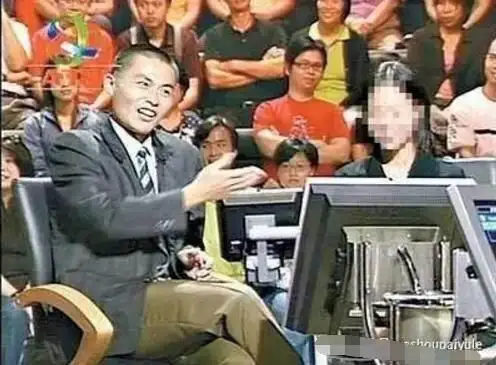
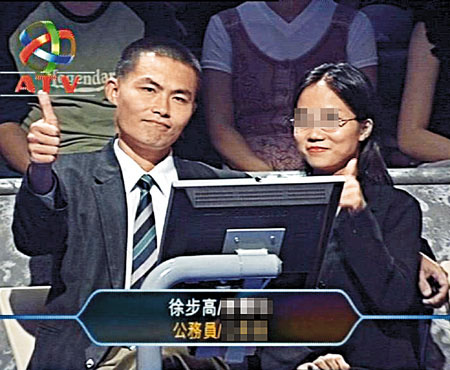
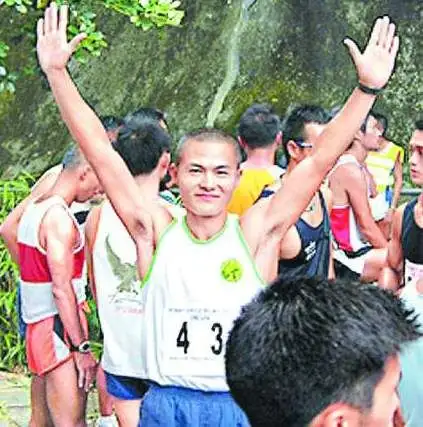
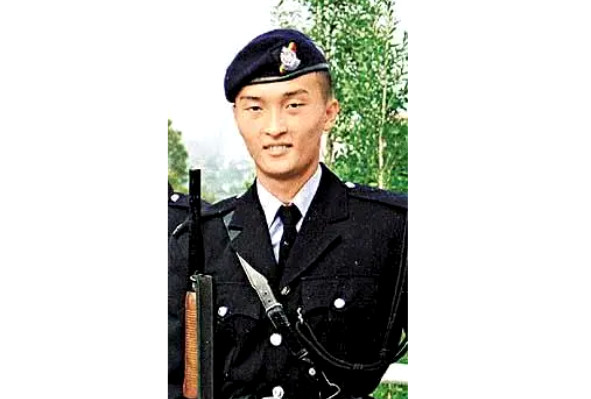
Photos of this case are hard to find on the English language internet, so I’ve strip mined the Chinese internet for you and included a useful repository of photos at the end.
To make your job easier, wherever there is swearing in quotes, I have included an asterisk in the text, this should allow you to find them all with a quick ctrl+f.
Pre-Reading Notes:
I’ve stopped including currency conversions. My reasoning for this is twofold – firstly, it helps with flow, and secondly due to the exchange rate it invariably makes it sound more dramatic… just so you know its intentional!
I’ve tinkered with the usual structure a bit here to try to keep the focus on action and investigation – as these seem to be the parts that go down well. I’ve completely cut out interesting, but ultimately secondary parts such as ‘media influence’ and I’ve chopped out biography and just included the relevant parts as and when they come up in the main body of text.
I haven’t included transliterations guides as per usual, but just to be sure with the main name for this one it is ‘Choy (as in toy) Po (as in the Teletubby) Ko (as in go)’.
Tsui Po Ko: Hong Kong’s Devil Cop
Introduction
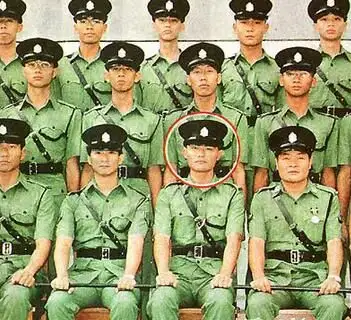
From the outside looking in, Tsui Po Ko was just an ordinary police officer. He wore the uniform with apparent pride and patrolled the streets with seeming diligence, as far as anyone could tell he was the absolute model of a reliable and well-polished cog in the machinery of Hong Kong’s law enforcement.
But this devoted professionalism was but a façade, and a chilling reality lurked underneath. For Po Ko was no ordinary officer. This man, who was sworn to uphold the law, instead became its most terrifying transgressor. He was not the protector he had pledged to be, but a wolf in sheep’s clothing that used his uniform as a cloak for his heinous crimes, a man who not only crossed the thin blue line but obliterated it in a horrifying symphony of violence and deception.
In a chilling series of events that shook the very foundations of the Hong Kong Police Force in the early 2000s, Po Ko committed acts of such unparalleled barbarity that they seem more befitting of an outlandish fictional crime filler than a biographical documentary, but the ‘devil cop’, as he would come to be known, was very real. The crimes that made up the twisted symphony he composed – a bank robbery, and the cold-blooded murder of both his colleagues and members of the public.
Today we will be delving into the enigma that was Po Ko, exploring his dual life as a devoted public servant and dark souled murderer, untangling the sinister web of lies and treachery that shrouded his life, and ultimately, trying to get to the bottom of exactly what made his warped and twisted mind tick.
So, strap yourselves in, because this is an intense one.
Chapter 1, The First Murder
Tsui Po Ko’s first victim was 24-year-old Constable Leung Shing Yan, whom he murdered on the 14th of March 2001.
Shing Yan clocked on at 7am, and his day initially was like any other – boring. He was posted to the Lei Muk Shue Police Station, a precinct right on the very northernmost edge of Hong Kong’s metropolitan mass. This sleepy suburb was hardly a hotbed of triad antics, so he occupied his morning with a foot patrol and a few house-to-house courtesy visits before returning to the station to dually eat his lunch and fill out some paperwork… so far so dull.
And dull his day seemed destined to stay when the Station Superintendent swung into the lunchroom and gave him his first task for the afternoon; someone had phoned in a noise complaint on the Shek Wai Kok Estate just down the road, and Shing Yan was to head over, slap some wrists, and deliver some stern words until the inconsiderate neighbour packed it in. He opted to handle the matter alone, as his partner was still eating his lunch, and he saw no need to drag him away from it for such a trivial matter.
He found himself at the address in question, Flat 552, Shek To House Block B, in no time at all, but bizarrely, all was deathly silent. He reasoned that the situation had already sorted itself out, but he was already there, so what the hell, he may as well knock and have a word. The situation only got more bizarre when despite repeated knocking, no one answered the door. He radioed back to the station at 12:25 to report the situation and was ordered to give it one last knock before giving it up as a bad job and returning to the station.
Unfortunately for Shing Yan however, he would never make it back to the station, and that radio call would be the last time that anyone ever spoke to him, because as he raised his hand for that final knock, Tsui Po Ko, who had been lingering down the hallway, attacked.
A vicious melee ensued, one in which Shing Yan desperately fought to break away, and Po Ko tried to subdue Shing Yan while reaching for his revolver. We don’t know exactly how this melee played out, but we do know that Shing Yan lost - Po Ko got his revolver and shot him five times at point blank range: twice in the back and three times in the head.
The chilling and sudden burst of gunfire echoed through the tranquil estate, slicing through the mundane chatter and ambient noise of daily life. The shocking sound of violence was instantly recognizable, and residents, hearts pounding in their chests, hurried to their phones, and dialled 999 to report it. As the calls flooded into the police station, the urgency and concern in the voices of the residents were palpable.
Officers quickly began to piece the situation together, cross-referencing the location of the reported gunfire with the positions of their on-duty colleagues. It was then that a sinking feeling gripped the hearts of those in the command centre: one of their own, Shing Yan, was on the estate and was likely the target of this gunfire. This speculation was unfortunately confirmed when they radioed him for a sit-rep and received nothing but silence in response.
Without missing a beat, the police sprang into action, desperate to get to their embattled colleague and any injured civilians before it was too late. In an instant, the Lei Muk Shue precinct was a ghost town, as every single officer on duty downed tools and raced to the scene. Leading the charge was the stations Police Tactical Unit, or PTU, a crack team of highly trained and heavily armed officers. By 12:29, only 3 minutes after the first 999 call, they were in position, their Saxon APCs forming a mighty ring of steel from which nothing would (hopefully) escape.
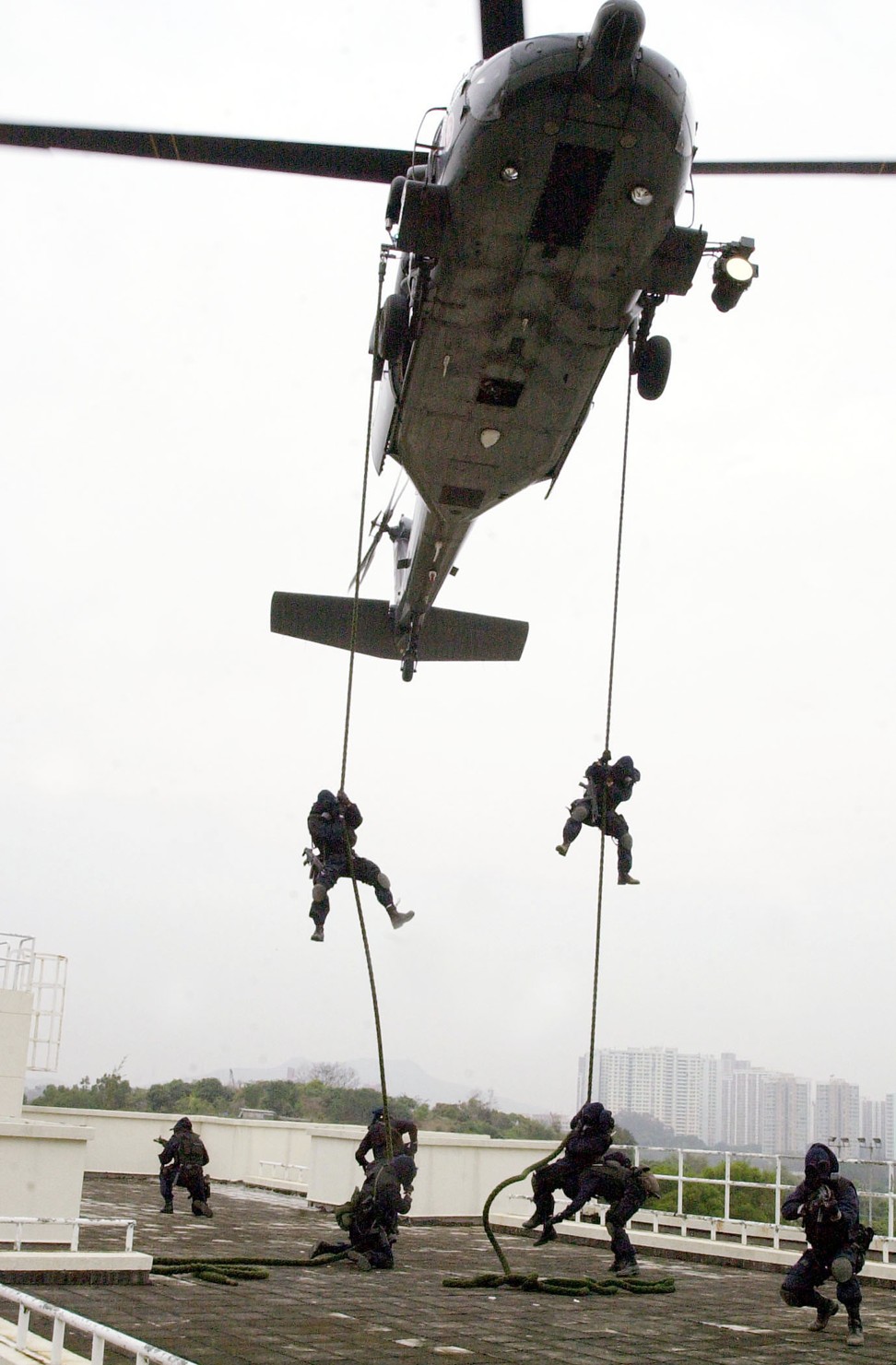
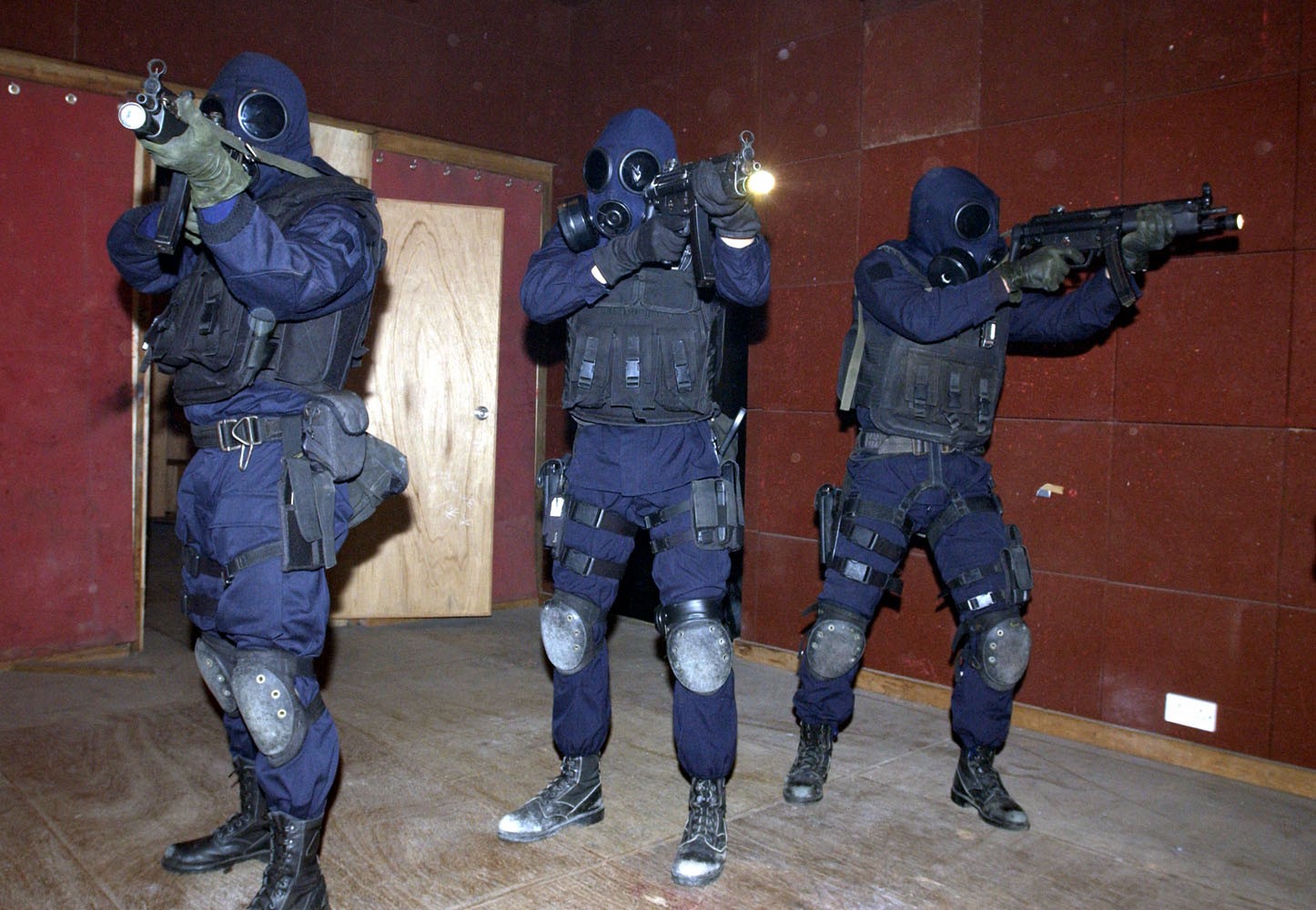
But they would not be penetrating the building, that duty would fall to the Special Duties Unit, or SDU, Hong Kong’s SAS trained SWAT team – the best of the best. They arrived on the scene at the same time as the PTU, having been dispatched by helicopter from the Police’s rapid response station at the airport. For them, their response was one of pure instinct honed through harsh and demanding training - they had no time to sit around and debate strategies, there was an active shooter in the building, and every second of dallying was another second that other officers and civilians could be getting killed!
Their approach was two pronged. Four fireteams would enter the building, two from the top (having rappelled onto the roof from their helicopters), and two from the ground floor. In each direction one team would take point, clearing the building floor by floor, corridor by corridor, and room by room, while the second teams hovered on their heels and evacuated civilians to the safety of both the roof and the cordon on the ground.
Immediately behind the ground teams was a group of paramedics, who had the most unenviable task of treating the wounded and recovering the dead. Fortunately, these brave paramedics were at least well protected, as not only did they have a wall of black clad handy lads covering them, but the PTU had also insisted that they take their body armour before entering the tower block.
The crowd outside, which now comprised not just the PTU, but also a cohort of curious locals watched on with bated breath as the building was penetrated, and a steady stream of rescued civilians flowed from the building. For several minutes time flowed in a circle, as a constant repetition of “apartment clear, no hostiles, civilians evacuated” was called out over the radio. This repetition was only broken when the ground teams reached the fifth floor, and the call of “officer down, fifth floor” was made.
The paramedics immediately leapt on Shing Yan, clinging to the faint hope that contrary to what their lying eyes were telling them, they might somehow be able to save him. It was to no avail however, Shing Yan was dead, and his body was covered and removed from the building.
Meanwhile the SDU were still pushing deeper and deeper into the tower block – tragic though their discovery was, there was still civilians to extract and a shooter to find, so the tears would have to wait. They steeled themselves as they continued, certain that with the discovery of Shing Yan, the shooter wouldn’t be far… but much to their shock, the next firearm they would see wouldn’t be in the hands of a psychotic criminal, but in the hands of their colleagues, as the four fireteams met each other on the 14th floor.
Their search had been meticulous, they had been over every single inch of the building, so this meant only one thing: the gunman had escaped. Clearly however, this was not the consequence of incompetence, their response had been absolutely flawless, so they assumed the shooter must have shot Shing Yan and immediately fled the scene, somehow having legs fast enough to carry them away from the scene in the three minutes it took them to respond.
With nothing more to be done both the SDU and PTU left the scene, handing it over to forensics to get to the bottom of what the hell had happened. They discovered blood stains on the door frame and the back stairs, but not on the smoke-proof fire door to the right. From this it was deduced that the murderer had opened the right door and ambushed Shing Yan from there. The blood stains also showed that Shing Yan had been shot five times, with three of the shots being at near point-blank range.
More answers came following Shing Yan’s autopsy at Wan Chai Police Headquarters. The medical examiner successfully recovered all five bullets lodged within his body, and upon close examination, it was determined that the rounds were all .38 special… the same round issued to the police. This naturally raised further questions: had Shing Yan been shot by his own revolver?
Had a criminal somehow gotten his hands on a police issue revolver? Fortunately, the police keep extensive records on its issuing of firearms, with each officer drawing their firearm from inventory at the start of each shift and returning it when they clock off – with the serial number being noted by an armourer at both points. In addition, a monthly inventory was also carried out on every police cache to make sure nothing had gone missing.
Thanks to these meticulous procedures, the police knew that not a single firearm had gone missing, which left only one possibility: Shing Yan had been shot with his own revolver… a revolver which also happened to be missing, and was now unaccounted for somewhere in Hong Kong…
This gave detectives a possible motive: the theft of Shing Yan’s firearm. But they were taking nothing for granted in this case, the theft of a police revolver could have just been the icing on the cake for the killer. What if someone had a grudge and was targeting Shing Yan specifically to settle some vendetta? To get to the bottom of this they interviewed 350 of his friends, colleagues, and family members, but once again… nothing.
No one had a bad word to say about Shing Yan, and by all accounts he was an upstanding guy who would never do anything that would inspire any kind of perverse murderous ire.
Also recovered from the scene was a mask and some stray clothing fibres from the killer. They were carefully analysed by forensic experts who were desperate to uncover more information about the elusive killer we know to be Po Ko. Using advanced scientific techniques, they managed to extract DNA evidence from these seemingly innocuous items.
This was a huge breakthrough, but sadly not one which would lead to any arrests, as after running the DNA samples through every database they could get their hands on… not a single match was found. There was little else they could do with this DNA for now except keep it on file and wait until a match popped up in the future…
All of this left detectives with the most arduous task, as it would be nothing short of a miracle to find the killer after hitting this dead end. Nevertheless, they persisted, and followed every lead to its endpoint. They began by going through every single second of CCTV footage from Shek To House and the surrounding area and found… nothing.
The footage from the apartment building proved fruitless, every single person identified had a stone hard alibi, which led detectives to deduce that the killer must have escaped through the fire escape immediately beside flat 552 – the only escape route not covered by CCTV. This at least explained why the killer had chosen that ambush location, but it brought them no closer to actually identifying them. Footage from the wider area proved equally useless, the greater distances of the footage made it harder to identify passers-by, and those who could be tracked all too had watertight alibis.
All hope was not lost yet however! Over 15,000 people lived on the Shek Wai Kok Estate… surely one of them had seen something of use? But alas… no. Whoever the killer was, they were a pro, the detectives reasoned, as they had entered and left the scene with all the stealth of a phantom.
This left detectives with one last lead: the mask. Even though the DNA evidence found was useless, maybe, just maybe, if they could track down where it had come from, they could find something; some CCTV footage from the store, a clerk who remembered selling it, truly ANYTHING at this point would have been a boon. But once again, there was nothing.
They even went beyond the borders of Hong Kong and contacted mask manufacturers on the mainland, desperate for absolutely anything that could ratchet them closer towards an answer. But this search also yielded naught, and with that, the case went cold, and Po Ko was left free to roam the streets and strike again.
Chapter 2, The Bank Robbery
As the clock struck midday in the Belvedere Gardens branch of the Hang Seng bank on the 5th of December 2001, all appeared normal. At the counter an elderly woman was withdrawing her pension for the month, and to her side was a young man making enquiries regarding a car loan. Behind them stood a small group of a half dozen or so people, all staring at the clock with great disinterest as they waited to complete their days dreary financial chores.
This mundane scene wouldn’t last long however, as a short while later, when the clock ticked over to 12:21, the great glass door that separated the sleepy bank from the hustle and bustle of Hong Kong’s streets was kicked open with a mighty crash, and through it stormed Po Ko. Like many of the patrons already queued up he was there to make a withdrawal, but unlike them, he wasn’t carrying a bank book, instead, he carried Shing Yan’s revolver… it was a robbery!
Immediately Po Ko waved it high for all to see, and issued all the usual threats that bank robbers tend to: get on the f*cking ground and heroes get bullets before he began advancing on the teller’s counter as fast as his legs would carry him. His approach was not an easy one however, because as soon as he took his first step forward, he was intercepted by Zafar Khan, the banks armed security guard.
Zafar had only milliseconds to react, and found himself with a very unenviable choice to make in that short time: did he try to bring his shotgun to bare, a process that between pulling it round, shouldering it, and cocking it would have taken several seconds, and almost certainly escalate the situation into a shootout that would put the civilians in danger, or did he try to talk him down, leaving himself unable to react, but potentially better able to ensure the safety of the civilians?
He chose the latter, and selflessly placed himself in Po Ko’s path without any hesitation, engaging him in conversation with a simple question: “what are you doing?”. He answered this by pushing the muzzle of his revolver into Zafar’s forehead and barking a simple command at him: “throw your shotgun onto the floor, now!”
Zafar was having none of that, and he ignored the command, unwilling to give up his potential leverage over Po Ko. Instead, he pushed his fear aside, and continued trying to talk Po Ko down. “Don’t mess around, turn around and leave” he said, his determined voice never cracking nor showing fear.
Po Ko was not moved by Zafar’s bravery however, and instead simply repeated his earlier command. But once again Zafar refused to comply, and so, with it being clear that he was not going to play ball, Po Ko pulled the trigger, sending a single .38 special round straight into Zafar’s temple. He immediately crumpled onto the floor, and just to make sure his resistance was over, Po Ko put another round into his chest.
But Zafar was not out of the fight just yet. Contrary to what Hollywood tells you, shots to the head, particularly shots from small low velocity rounds such as .38 special tend not to be instantly fatal, and so, Zafar mustered the last of his strength, and began reaching for his shotgun as the world around him went dark and fuzzy, managing to pull it round, cock it, and begin raising it towards Po Ko. Try as he might however, he was unable to get a shot off, as Po Ko noticed what he was up to, and was standing above him in deranged bemusement, and put one more bullet in Zafar’s head as the shotgun was shakingly raised towards him, and he finally fell down dead.
Zafar’s sacrifice was not in vain however, because while he might have only kept Po Ko distracted for half a minute at the longest, these precious few seconds had allowed Ou Li Jing, the branch manager to sound the alarm. She first hit the silent alarm under her desk, then retreated to a shrouded back corner of the bank to call the police, giving them whispered, almost muted updates of the ongoing situation in the bank.
These updates would soon be cut short however as Po Ko, having dealt with Zafar, then turned his attention back to the teller counter, and the precious loot that lay inside of it. He leapt through the glass security partition on the edge of the counter, and onto the desk. It was then that he spotted Li Jing speaking into the phone, whom he could easily spot from his new elevated position.
Infuriated by her interference with his plans, he raised his revolver and let off a single shot. Fortunately for Li Jing however, for some reason Po Ko chose a warning shot rather than an aimed one, discharging his revolver into the ceiling. He then issued a threat: “Don’t move, I have a bomb, drop the phone and get down on the floor!” Poor Li Jing was absolutely terrified, but not so overcome with fear that she wasn’t able to make a very smart and calculated move as she obeyed his demand; leaving the phone off the hook so that the police could continue to listen in.
Po Ko either didn’t notice, or didn’t care about the clearly still connected phone, because he then took his sights off of Li Jing and placed them onto the counters, jumping down and ransacking them, prying them open and scooping out the cash inside with lightning efficiency, netting himself a total take of HK$492,880 and USD$1,091. With that, his job in the bank was done. He leapt over the counter and made for the door, bursting back out into the bustling streets of Belvedere Plaza, making a left and heading for Hai’an Road before completely disappearing, having only been in the bank for one minute and 18 seconds.
With the coast clear in the bank, staff and customers alike dived on Zafar, desperate to aid him however they could, but their efforts were to no avail, he was already long gone. Meanwhile Li Jing steeled herself following her ordeal and got back on the phone to inform police of the developing situation, who informed her that they were en-route and would be there any moment.
The police were true to their word, and less than a minute later the PTUs Saxon Armoured Cars were screeching to a halt outside of the bank. They moved with a choreographed precision, securing the bank’s perimeter as their trained eyes scanned the scene for any signs of the culprit. Meanwhile, other units fanned out into the surrounding neighbourhoods, their gazes sharp and their senses alert, hunting for any trace of the elusive robber.
They sifted through the urban maze, their radios crackling with updates and their hands steady on their weapons. But fate was not on their side, Po Ko had slipped through their grip and gotten away once again.
Simultaneously, paramedics arrived at the scene, their focus firmly set on Zafar. They hastily loaded him into an ambulance and made for Hong Kong Adventist Hospital. They exchanged grim looks as they departed, their faces reflecting the grim reality of his situation. Tragically, their assessments were correct, and Zafar was confirmed dead at 12:30, before he had even reached the hospital.
With Zafar’s tragic passing, the immediate situation in the bank had come to an end, and the task at hand was then figuring out who the hell had robbed the place. With that in mind, once the crime scene was released by the tactical units, forensic investigators began to meticulously search for any remnants of Po Ko’s presence. All they found however was three shoe prints on the bank’s counters, which clearly indicated a sports shoe of some kind.
The shoes had to be identified, as they could prove to be a vital clue that would lead to them identifying Po Ko, and fortunately, CCTV footage from the scene gave them a pixilated, but reasonably clear image of the shoes, and they began trawling through the Decathlon catalogue in search of potential matches. Soon enough, they found one that matched the rough blur from the CCTV and the footprint exactly, jackpot!
The shoes in question were Mizuno Next Alphas, a model that had only recently been released, and that sales records showed had only sold 130 pairs in the criminal’s size prior to the robbery… you can imagine the air punching that happened in the office when the investigators managed to narrow the search down to such a small pool.
They then tracked down the 40 retailers in Hong Kong that sold the shoes, and interviewed the staff and looked at their CCTV to see if they could find anything that would lead them to the robber. One retailer in particular proved most interesting… the Police Quartermaster that officers could privately purchase gear through. This naturally cast a wide net of suspicion over the police force, so the detectives turned their attention inward, paying particular attention to the shoes that officers brought to physical training. They also offered a HKD$300 coupon for shoes of that size being turned in, having created some false pretence of why they suddenly needed that model of shoe in that size, hoping that if the robber was indeed one of their own, that they might slip up and accidentally hand themselves to them. 12 officers came forward to take them up on the offer, but sadly, none of them proved an exact match for the worn footprints that had been recovered from the bank, and so, with the other 39 retailers not providing any leads either, the shoes became a dead end.
All hope was not lost however, because while the shoes were being investigated, another group of detectives had rolled up their sleeves and taken on the arduous task of interviewing over 250 individuals with any and every connection to the robbery. The bank’s employees, its patrons, and the unsuspecting passers-by in the vicinity were all meticulously questioned, their memories probed for any shred of information that could help them ID the robber. But as hours turned into days, the sea of voices yielded nothing, not a single promising lead or shred of telling discrepancy. It was as though the criminal had vanished into thin air, leaving behind only a chilling void where answers should have been.
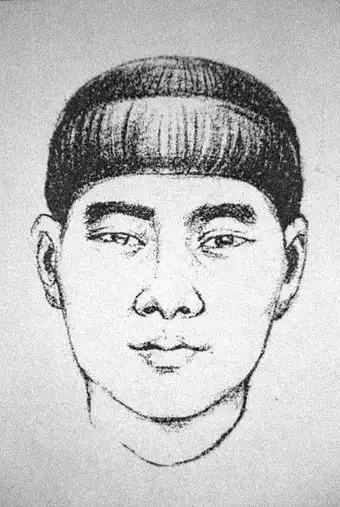
With little else they could now do, detectives created a best guess sketch of the robber and dangled it out to the public in the hopes they would get a bite, even offering a HK$1,000,000 reward for any information leading to his arrest, a bounty that was also matched by Hang Seng Bank.
The case was starting to look hopeless, but they did at least make one solid discovery: the bullet that had ended the life of Zafar was a .38 special round, with the exact same rifling indents as the bullets recovered from Shing Yan’s body earlier that year, meaning that while they couldn’t be certain, it was likely the same firearm was used to kill both of them.
With this revelation, the police merged the two cases together, and the now HK$2,000,000 reward for a successful arrest made the unidentified Po Ko one of the most wanted men in the world at the time. But unfortunately, no further evidence emerged. Once again, Po Ko had meticulously planned and executed his robbery, and thus completely avoided justice and remained free to offend yet again.
Chapter 3, The Tsim Sha Tsui Shooting
Following the Hang Seng Bank Robbery, Po Ko went quiet for several years, and retreated back into the life of an ordinary, law-abiding police officer – presumably because he had caught wind of just how close he had come to being identified following the robbery. But he could only repress his true, demonic nature for so long, and after a few years, he found himself with a murderous itch he just had to scratch, and so he set up his next crime: the ambush of two police officers in Tsim Sha Tsui.
It all began on the 16th of March 2006 at 11pm when Constables Sin Ka Keung and Tsang Kwok Hang were walking the streets of Kowloon during a standard night-time patrol. Their night started off tranquil, but eventful, as the 24-hour city presented no end of issues for the pair to resolve. They began at the Tsim Sha Tsui Star Ferry Pier, helping drunken revellers and exhausted businessmen alike navigate their way across the calm waters of Victoria Harbour, before turning their attention northwards and pounding the concrete of Canton Road.
As they walked, they allowed the ambient glow of neon to be their way finder, making courtesy visits to the various late-night establishments that littered the area and seeing if their proprietors required any aid. All proved well, and so they continued their patrol further northwards. Proceedings continued to be calm, with the most eventual occurrence of that early stage being a suspicious looking, but ultimately harmless man found loitering on Haiphong Road.
But unfortunately for the two Constables, this placidity was not long lasting. At 1:12am, they found themselves beside the Austin Road Pedestrian Subway, and after deviating briefly to check in at the police station that stood immediately adjacent to it, they descended into the tunnel. Initially all appeared well, with the faint flicker of the subways lighting revealing nothing untoward, but as they reached the bottom of the stairs and turned a corner, a strange sight greeted them: a man lingering in the shadows. The man was wearing thick tortoise shell sunglasses as well as a very obvious and badly passing wig, furthermore, he also had a very unsettling expression.
Naturally, this attracted the curiosity of Ka Keung and Kwok Hang, who moved in closer to investigate. They initially gave the man the benefit of the doubt; bizarre though the scene was, there was every chance of there being a reasonable explanation – a mental health crisis, intoxication, or simply just an unorthodox fashion sense. This benefit of the doubt would prove to be fatally misplaced however, because the man, of course, was Po Ko, and he was waiting in ambush. Sure enough, as the officers moved closer, he pulled Shing Yan’s revolver from his waist band and opened fire.
Ka Keung and Kwok Hang had absolutely no time to respond, and before they could even process what was happening in the shadows, let alone have time to draw their own revolvers in response, four rounds had been sent their way… two for each of them. For Kwok Hang, who had been the closer of the two to Po Ko and thus received the most accurate fire, the results were immediate. He took a round to the temple and neck, and immediately fell to the floor.
Ka Keung too was hit, but luckily for him, one of the rounds destined for him at missed altogether, and while the other hit him in the face, it only glanced his eye socket, this left him temporarily blinded, but still very much in the fight. Immediately his muscle memory, honed through countless hours of monotonous and repetitive training kicked in, and without even having to think about it he found himself bringing his revolver to bare, and pulling the trigger once to clear the empty safety chamber.
Procedure at this point would have been to repeatedly pull the trigger until the threat had been neutralised, but Ka Keung knew that wasn’t an option, as there was no cover at all in the subway that he could dive to, and if he started exchanging fire while so exposed, sure, he would probably be able to neutralise the shooter, but the shooter would also probably return the favour. So, with few other options, he did the only thing he could do; try to disarm the shooter.
He advanced and discharged as much fire as his short approach would allow: one single round, which duly found its way into Po Ko’s torso. He then discarded his revolver and initiated a melee, putting all of his weight into a fierce charge, while doing his best to grab the revolver. Unfortunately, Po Ko was a strong guy, and he managed to resist Ka Keung’s charge, and so, the two found themselves in a grapple for life and death.
This wasn’t quite the disaster it may first sound however, because while he no longer had his own revolver in hand, he had also taken away Po Ko’s ability to shoot him. Not for want of trying on Po Ko’s part however, because as the pair wrestled, he desperately tried to get his muzzle pointed at Ka Keung so he could finish the job. Unfortunately for Po Ko however, he had met his match in Ka Keung, who was able to match his strength, and so, he began firing wildly in desperation. He let off two further rounds, one of which completely missed, and the other hit Ka Keung in the foot.
This made him recoil and take his strength off Po Ko, who then managed to break free from the melee, and took a step back, reloaded his revolver, and pointed it at Ka Keung.
But Po Ko had let his guard down. He had been so fixated on neutralising Ka Keung, that he had given no thought to Kwok Hang, assuming him to be dead. This assumption proved to be very, VERY wrong, as Kwok Hang still had some life in him yet, and he was laying on the floor, revolver drawn, desperately praying that the melee would separate before he bled out so that he could save his partner, and so, when Ka Keung recoiled and took a step back after being shot in the foot, Kwok Hang did what had to be done, and emptied his cylinder in the nick of time, placing all five of his shots on target and sending Po Ko to the floor in a crumpled heap.
He then holstered his revolver and made a single chilling call on the radio: “Shots fired on the Austin Road Underpass, multiple officers down, send help.” Then, with his duty done, he took one last look at his injured, but very much still alive friend, smiled, and collapsed back onto the floor.
That call was made at 1:14am, and with the police station being so close, the first responding officers, Sergeant Huang Zhi Qiang and Constable Lin Zhen Xiong, were on the scene in less than a minute, arriving breathless with revolvers in hand. As they descended the subway stairs they were greeted by a scene of abject bedlam. Blood, spent cartridges, and tile fragments were strewn everywhere. To their right lay the unresponsive Kwok Hang, and immediately in front of them was Ka Keung, clinging to Po Ko’s collar with all his remaining strength.
Without missing a beat, the two officers sprang into action, with Zhi Qiang leaping on Kwok Hang to begin administering first aid while Zhen Xiong handcuffed Po Ko and turned his attention to Ka Keung. Mere seconds later an entire stations worth of PTU officers piled down the stairs, after which, with the immediate scene under control, they were ordered to span out, secure the area, and ensure that the inbound ambulance had a clear path.
That ambulance arrived mere minutes later, and Kwok Hang, Ka Keung, and Po Ko were all raced to Queen Elizabeth Hospital… with the latter being accompanied by an MP5 wielding PTU officer just to be safe. Despite having been shot twice, Ka Keung’s injuries were found to be minor, and he was back on his feet in no time. The same could not be said for Kwok Hang however, the hospitals sterile white walls echoed the solemn finality of his fate, and so, having lost far too much blood and sustained far too much physical trauma, he was declared dead at 1:47am. But in a final act of mercy, fate did at least allow him to outlive Po Ko, who was declared dead two minutes earlier.
And so, at long last, the devil cop was dead, and with him now lying cold in the Wan Chai Police Headquarters Mortuary, it fell to detectives to piece the story together.
Chapter 4, Investigation
With evidence from the scene still being recovered, the detectives on duty on the 17th of March had one task: identifying Po Ko. We of course have known his identity for this entire video, but don’t forget he had totally evaded identification until this point!
Fortunately, this task proved to be an easy one, because as they clocked on early that morning, they emptied their pigeonholes and found a note from the PTU officer that guarded Po Ko when he was taken to the hospital; turns out he recognised him! This was a hell of a tip, but it still needed confirming, and so, armed with copies of Po Ko’s Hong Kong Identity Card and Police ID they descended into the basement and towards the mortuary, where, sure enough, the tip was correct, it was indeed Po Ko – one of their own.
This revelation was an unsettling one. Across police headquarters, silence descended like an all-smothering shroud as the unthinkable revelation spread. A miasma of disbelief, betrayal, and sorrow suffused the air. The detectives, usually stoic figures of unwavering resolve, now found themselves wrestling with an insidious unease, as they tried to process this betrayal most foul.
But ultimately, those considerations would have to wait, there was still a job to be done, and so the detectives steeled themselves and continued their investigation.
Officers were immediately dispatched to raid his home, his lockups, his police locker - anything in any way associated with him, and strip it bare of any and all evidence.
This naturally took some time, so in the meantime other detectives occupied themselves with piecing together Po Ko’s movements on the day of the Tsim Sha Tsui incident, and by the end of that same day, by combining his work schedule with CCTV footage from both traffic cameras and business’ in the surrounding area, they fully understood his movements.
They discovered that he had clocked off work and left the Lantau North Police Station at 11:48pm and then headed for his home at Yu Tung Court on foot, before then jumping on his motorbike and heading for Yat Tung Estate. From here he then hitchhiked his way to Yau Ma Tei, and walked southwards down Nathan Road to the Austin Road Subway, arriving on the scene at 12:21am, less than an hour before he ambushed Ka Keung and Kwok Hang. Although it pained them to admit it, detectives could only be impressed by the meticulousness of his planning – by using a vehicle not tied to himself and completing the final leg of the journey on foot, tracing him would have been highly difficult, if not impossible had he not been foiled and caught red handed.
This at least answered the ‘how’ and ‘what’ questions, so now the detectives turned their attention to the ‘why’ – this would be a much more elusive question, and one that would take much longer to answer. Fortunately, the day spent piecing Po Ko’s movements together had given the detectives at the crime scene and at his house to do their thing, so now a steady stream of evidence was flowing into police headquarters.
Hundreds of pieces of evidence were bagged and tagged for the detective’s consideration, so for the sake of expediency let us now focus on one item of particular interest: a piece of paper found on his motorbike, on which was a scribbled copy of the Tsim Sha Tsui Police Stations patrol schedule, as well as some notes regarding the various pedestrian subways on the route, highlighting how the one on Austin Road was the only one equipped with dome mirrors and how it had, and I quote, ‘particularly bad lighting’. This chilling revelation made it apparent to the detectives that they were not dealing with a deranged crime of impulse, but one that had been carefully and meticulously planned, and once again, they begrudgingly had to acknowledge just how good he was at planning out his crimes.
Small pieces of evidence such as this continued to pile up as the days went on, but it was only when they came to investigate Po Ko’s revolver that they pieced all three of his crimes together. It was in a very bad way when it hit the detectives desk: its grip was covered in layers of aged and well-worn electricians’ tape, and its frame was showing scars from years of negligent maintenance, but worn though it was, as ballistic experts peeled back the layers of tape, the serial number ‘RHKP 4893’ was still clear as day, firmly identifying it as a police firearm.
Naturally they ran its serial numbers, with everyone assuming that either it was his issued revolver, or that it was stolen from an armoury, and that accordingly, a negligent armourer was about to have the hammer of God come down on their head. But of course, WE know it wasn’t… we know it was Leung Shing Yan’s, and now, having run its numbers, the police did too… the case had suddenly gotten much bigger.
But this only firmly linked Po Ko to two of the three crimes we have discussed thus far, because if you recall, the revolvers use in the bank robbery was only speculative and hadn’t been proven beyond all reasonable doubt. They needed something else, something concrete that couldn’t be dismissed as circumstantial to really prove Po Ko had committed the bank robbery…
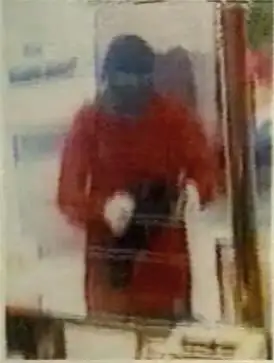
Fortunately, with the leftovers of Po Ko’s life finding their way to Wan Chai in a steady flow, that connection arrived soon enough. Specifically, it came from the contents of Po Ko’s TV cabinet, in which were mementos of his participation in the ‘2000 Yinchuan International Motorcycle Festival’, and a diary which mentioned a red tracksuit jacket which sounded very similar to one we saw earlier on a particular CCTV image…
Naturally, the detectives were like moths to a flame over this discovery, but still it wasn’t good enough, the evidence by this point was still circumstantial. Sure, by this point Po Ko was waddling like a duck, quacking like a duck, and flapping his wings like a duck, so generally could be assumed to be a duck, but assumptions weren’t good enough, because what if, somehow, it was just a hell of a coincidence.
So, with that in mind, detectives delved further into the box, keeping their fingers crossed and praying that they would find the tracksuit jacket from the CCTV images. But alas, it was nowhere to be seen… what was found however, were several polaroid photos of him in the jacket… and it was a one-to-one match for the jacket from the CCTV – bingo, they’d nailed him!
Ultimately, despite an exhaustive investigation, no connections to any other crimes would emerge, but that wasn’t the end of the detectives’ work, not by a long shot – there were still many questions to answer, and many blank details that needed filling in, what’s more, given the particularly barbaric and unusual nature of Po Ko’s crimes, the detectives were determined to leave no stone unturned.
So, with that in mind, the investigation ploughed ever onwards.
Some more evidence of interest came from Po Ko’s locker at Lantau North Police Station, in which was found evidence of extensive surveillance carried out on Shing Yan prior to his murder. More specifically, they found a notebook that contained extensive personal information about him, including biographic information, family details, as well as a scribbled copy of both his and his partners patrol schedule, with an additional, doubly underlined note saying that Shing Yan’s partner tended to take much longer to eat his lunch than Shing Yan himself. This made it abundantly clear that for some reason, Po Ko had gone out of his way to target Shing Yan specifically, although we have no idea why, because as mentioned earlier, no one interviewed could think of any reason why someone would take umbrage against the poor officer, and no evidence was ever found explaining Po Ko’s reason for specifically targeting him.
In another chapter of this complex saga, detectives also found themselves embarking on a quest to interview every person connected to Po Ko. The effort was colossal, and the process gruelling, as they sought to extract truth from the vast array of both professional and personal relationships that Po Ko had developed over the years. The number of people interviewed was simply staggering, with the officers involved conducting interviews with 2,849 serving police officers, 623 former officers, and 195 civilians who, due to their varying degrees of connection to Po Ko, were all considered potentially significant to the investigation.
Many of these interactions seemed to yield little to no valuable information, the majority merely adding to the seemingly endless ocean of dead-ends and red herrings. But every so often, a precious nugget of information would reveal itself; a remark he once made, a behaviour they had noticed, or irregularities in his schedule. Each piece of new information was like a tiny, but vital piece of the puzzle, inching the investigators closer to understanding the enigma that was Po Ko.
This stage of the investigation was of great interest to the police’s behavioural psychologists, who were paying very close attention, because as the story ratcheted ever closer to completion, the initial shock of the discovery was replaced with a stalwart determination that something like this should never be allowed to happen again – and they would be the ones to figure out how.
Meanwhile, the detectives focused on the bank robbery had a breakthrough… they discovered how he escaped unnoticed! They did this by comparing the Octopus Card records of Po Ko and his wife with the station CCTV footage, this revealed that he had actually used his wife’s card. The records showed that at 11:00 am, he took the E31 bus to Discovery Park, then transferred to the 96B green minibus to Belvedere Garden at 11:53 am, where he then committed the robbery just after noon. He also must have kept his head down and hidden in the immediate aftermath of the robbery, because the card wasn’t used again until 13:14 pm, when Po Ko took the subway to go to work.
Naturally, that same team was also very keen to know exactly what he had done with the money from the robbery, a curiosity that was soon satisfied when they started probing through his financial records, which showed he had opened 12 different investment accounts with different banks across Hong Kong, and over the next two years slowly trickled cash deposits into them that totalled $HKD557,718… given the fact he stole HK$492,880 during the robbery, I think we can guess where the majority of those deposits came from.
Eventually however, after months of painstaking investigation, meticulously combing through the fragmented pieces of Po Ko’s dual life, the police were now prepared to present their findings to the court.
With no perpetrator left to prosecute, the case was heard by the Coroner’s Court, rather than the High Court that would normally hear such crimes, with proceedings beginning on the 26th of February 2007, with Judge Chen Bi Qiao presiding. We shall not dwell too much on the actual proceedings of the trial, as largely they just heard an expanded and more detailed explanation of the evidence we have already discussed in this chapter. What is worth noting however, is that 116 witnesses were called to testify, and that 258 exhibits (out of a total of 1,073 collected) were presented to the court as evidence.
Two months later, on the 25th of April, the court fell into a tense hush as the verdict was delivered. The jury, standing unanimous, declared Po Ko guilty of his chilling crimes. This man, once seen as a protector in his uniform, was now condemned as a predator, a terrifying embodiment of betrayal.
This verdict marked not just the end of a gruesome chapter, but also the beginning of a critical period of introspection for the Police Force. With the investigation culminating in this monumental verdict, the police could now shift their focus inwards, and undertake a determined effort to prevent the emergence of another ‘devil cop’ within their ranks.
Chapter 5, Police Reform
So, we are well aware by this point that the police force was absolutely adamant in making sure that another Po Ko never joined their ranks ever again, but how exactly did they do this?
A major reform was the introduction of a stricter procedure for handling complaints in reporting rooms. Now, officers were obliged to request Hong Kong Identity Card details from any individual reporting a crime, in order to add a layer of verification and protection. Of course, the effectiveness of this measure was not without its limitations.
It relied on the honesty of the reporting individual, and during emergencies, it was instructed that officers be dispatched before the identity was confirmed. Yet, despite its flaws, this process was a clear attempt to provide some measure of safety against ambushes like the one that ended Shing Yan’s life. Arguably, there was no perfect solution to this problem, after all, the inherent risks of police work can never be entirely mitigated, but this procedure at least represented a proactive effort to protect officers to the best of the force’s ability, and in a way that didn’t compromise response time.
Another crucial reform tackled the issue of ‘lone patrolling.’ This practice had previously seen officers on their beats alone from time to time, which, as evidenced by Shing Yan’s murder, was a system prime for exploitation by criminal elements. As a result, the force made a decisive change: officers were no longer permitted to patrol alone, except in the most pressing of emergencies. Some senior members of the force did express concern that this would not leave enough manpower to staff all patrols, but fortunately, the size of the force, which had always been uncharacteristically large by world standards thanks to Hong Kong’s ‘wild’ colonial years, allowed for this adjustment without any problems, and there were more than enough officers on the books to accommodate this new measure.
Finally, and arguably most crucially, was the rigorous and comprehensive re-evaluation of the mental health screenings for potential officers. Po Ko’s crimes had made it blatantly apparent that a basic psychological assessment was insufficient to determine a candidate’s suitability for policing, and so, the force introduced world leading mental health screening for all recruits.
They also extended mental health screening beyond recruitment, and now would look after and monitor officers throughout their whole career. The updated screening process encompassed psychometric tests, structured interviews, and observational assessments, all undertaken by trained psychologists that were to identify any potential risk factors early, and if needed, immediately ensure that the officer received the treatment warranted, or was dismissed from the force if appropriate, and just to be safe, every officer was made to take this new assessment within a year of it being implemented.
Chapter 6, Psychoanalysis
So, now we have a comprehensive understanding of what Po Ko did, and the fallout of his crimes, but still, a burning question remains unanswered – why? Why did he commit such brutal crimes? What drove him to such depravity?
Ultimately, that is a question we do not have the answer to. Po Ko’s death meant he could never receive a full and proper analysis from psychologists, and furthermore, despite the litany of evidence he left investigators, an explanation was not among it. This leaves us having to speculate and draw what conclusions we can from the scraps of evidence he did leave us.
Fortunately, we are not the only people to have had these questions, so rather than having to draw from the lowly pontifications of a humble YouTube-wordsmith, there is an absolute wealth of expert insight we can draw upon… so let’s dive into it!
The first such analysis comes from one Dr Xu Pei Hong, a clinical psychologist who was serving with the Police Psychological Service Division at the time of Po Ko’s death. He led an investigation based on discussions with Po Ko’s family and 16 letters that he wrote to his wife immediately preceding his demise.
Dr Xu found that during his early years, his parents made every effort to shape him into an industrious young child with exceptional self-assurance and self-control. His upbringing was also found to be free from any irregularities or abuse that could have served as the foundations of a mental collapse. The closest thing to trauma that he found was some initial integration struggles when he relocated to Hong Kong from the mainland at the age of seven, mostly from having to adjust to speaking Cantonese rather than Mandarin, otherwise, Po Ko’s earliest years appear to have been generally joyful and happy.
Similarly, Dr Xu uncovered no real problems during Po Ko’s adolescent years, noting that by this stage he was fiercely intelligent, with a reading age well in excess of that of his peers. He was also exceptionally independent as a teenager, being perfectly happy in groups, but more than content with his own company. All in all, it appeared as though he was a perfectly well adjusted and normal teenage boy.
But as Dr Xu continued to probe into his adult life, potential issues and triggers started to present themselves thick and fast. Po Ko’s parents had gotten divorced in 1990, and despite being aged 20 at the time, he appears to have taken this VERY badly. Family had always been very important to Po Ko, so this divorce, which came as a complete surprise to him, was akin to his entire world being torn apart. He coped with this by placing all the blame on his father, with whom his relationship all but ceased following the divorce.
Still though, his psyche appeared sound all in all.
Dr Xu also pointed to his police record during this period. Po Ko had first joined the force in 1993, and as much as the psychometric tests of that period were admittedly crude, as we discussed earlier, they still highlighted nothing of concern. Furthermore, there was also no marks on his record for unwarranted violence or aggression early in his career. So where did it all go wrong?
According to Dr Xu, that turning point was in 1998, when two major events occurred that warped his mind dramatically: the first was a failed promotion to Operations Sergeant, which made him hateful towards the police force and exceptionally envious of other officers who were climbing the ladder quicker than him. But so what? There’s plenty of people who discover their dream career wasn’t all it cracked out to be, and confine themselves to a life of punching in and out and just collecting a pay cheque, but they don’t go on to murder their colleagues do they, so surely there has to be more to it. Well, sure enough there is, and that would be the second turning point in 1998 that Dr Xu identified.
Remember that divorce? The one that Po Ko had blamed his father for, and had subsequently cut off all contact with him as a result? Well… it turns out it was actually his mother who caused it, by cheating on her husband with another man and being caught in the act, which Po Ko found out about in 1998.
This sudden revelation threw his entire perception of the world into question, and he began to be riddled with self-guilt, and excessively question absolutely everything about the world around him. According to Dr Xu, this was the point that the cracks in his psyche started to show, as psychotic and schizophrenic tendencies began to gradually take over his mind.
But Dr Xu also stressed that this transformation was a slow and gradual process, it was not overnight by any stretch of the imagination, and that Po Ko had plenty of time to recognise the changes that were happening in him and try to seek help. Indeed, it appears that for a time that was exactly what Po Ko tried to do as in mid-1998 he took a sabbatical from the police force and embarked on a 3,000-kilometre cycling trip across mainland China to, and I quote, ‘clear his head’, in addition to regularly reaching out to his younger brother to discuss his inner struggles.
Unfortunately, this would do little to dispel the demon that was brewing inside of him, and over the following years his mental health spiralled ever deeper. Upon returning to the force in late 1998, he finally got that much coveted promotion to Operations Sergeant, but turned it down in favour of serving as a Traffic Officer, reasoning that a more ‘actiony’ field role would be better suited to him. But this choice ended up soft blocking further promotion, because the natural progression beyond this point was to try out for the SDU, a role which he was firmly rejected for on account of his unwillingness to give up smoking and drinking.
For Dr Xu, this was when Po Ko crossed the point of no return; when the cracks in his psyche fully gave way and his becoming a monster became not a matter of if, but when. This was then only made worse by a subsequent relocation to Tung Chung, a sleepy town on the northern tip of Lantau Island, as he now found life dull and monotonous, and found himself all but completely cut off from his support network of family and friends, which in turn further drove him to make reckless and impulsive decisions. This loneliness even led him to contemplate divorce, as well as developing an expensive habit of seeking solace in the arms of prostitutes.
Further still, Dr Xu also noted that in the immediate leadup to Shing Yan’s murder, Po Ko’s behaviour had become more erratic than ever, bordering on the frankly bizarre at times. For example, he listed himself as ‘unemployed’ when applying for a replacement Hong Kong Identity Card and was becoming notably short fused and aggressive at work, showing a clear disdain and hatred for the police force which had offered him gainful employment for so many years.
Taking all of this into account, Dr Xu’s final conclusion was that family stress and career disappointment had laid the foundations for his mental collapse, and introduced psychotic and schizophrenic traits into his mind, and that continued work stress coupled with a removal from his pre-established support networks had allowed these new traits to snowball out of control – turning him into the murdering monster that we have known him as throughout this video.
Now, this is certainly comprehensive, and makes for a fascinating insight, but Dr Xu was far from the only expert that the police utilised while trying to get to the bottom of Po Ko’s mental condition, so now, let us now look at what others had to say and see if we can garner any more insight. Specifically, lets look at the opinion of Huang Cheng Rong, who was the Director of the Criminology Curriculum Research Centre at City University Hong Kong at the time of Po Ko’s death.
He presented a different hypothesis, speculating that Po Ko’s recurrent failures to secure a promotion may have engendered a profound resentment towards his superiors. This, he proposed, could have spiralled into Oppositional Defiant Disorder, a condition characterized by persistent anger, irritability, and a vindictive defiance towards authority figures.
When Po Ko relocated to Tung Chung, he found himself bereft of outlets to express his mounting frustration. According to Dr Huang, this could have prompted Po Ko to seek validation and a sense of achievement outside his workplace, with his criminal activities serving as a twisted form of release for his accumulated discontent.
Dr Huang also suggested that Po Ko’s introverted personality could have contributed to a warped self-perception of victimhood, breeding a sense of superiority and a steadfast belief in his own infallibility. He pointed to Po Ko’s early career success as a catalyst for this inflated self-image. A feature article in the official police publication “Off Beat,” lauding Po Ko’s exemplary performance in the police promotion exam, was highlighted as the likely source of inflated sense of superiority.
However, as his career plateaued, this ego was bruised, leaving him embittered. In Dr Huang’s assessment, Po Ko may have sought to assuage his perceived failings in increasingly horrific ways, leading ultimately to the shocking crimes we’ve discussed earlier.
So, we currently have the opinion of two expert psychologists from Hong Kong, but let’s try to expand our perspectives and look of the opinions of those from further afield. Fortunately, there is no shortage of these, as the police themselves sought outside opinion while trying to get to the bottom of Po Ko’s mental state.
James J. McNamara, an expert in criminal investigation from the FBI, offered an altogether different perspective on Po Ko’s motivations. He proposed that Po Ko may have been wrestling with Dissociative Identity Disorder.
This theory emerged from his scrutiny of witness accounts, highlighting Po Ko’s extreme dedication to maintaining physical fitness, his choice of solitary sports, and his noticeable lack of participation in social activities, including work-related banquets and celebrations. These traits portrayed Po Ko as an introverted individual, seemingly disinterested in social accolades, while simultaneously demonstrating an unrelenting drive for professional growth.
McNamara drew particular attention to Po Ko’s failed attempt to join the SDU. He also discussed Po Ko’s puzzled reaction to his superiors’ lack of admiration for his diligent enforcement of minor offenses, as they instead encouraged him to concentrate on more severe crimes. McNamara hypothesized that these experiences contributed to a building wave of frustration in Po Ko. Over time, this simmering resentment might have compelled him to seek the adrenaline rush that he felt his day-to-day police work lacked.
This, McNamara suggested, could have been a pivotal factor leading to Po Ko committing those chilling crimes.
Another outside opinion comes from Roderic Broadhurst, Head Professor of the Department of Criminology at Queensland University Technology, Australia, like McNamara, he too was brought in by the police to provide expert counsel on Po Ko’s mental state.
Broadhurst suggested that Po Ko’s high intellect, juxtaposed with his lack of opportunity to pursue higher education, resulted in a profound dissatisfaction with his career in the police force. This discontentment, he believed, reached a tipping point just days before the horrific Tsim Sha Tsui shooting, following a reprimand from a female supervisor, which likely rekindled latent feelings of disappointment and humiliation.
In examining Po Ko’s personal life, Broadhurst hypothesized that his interpersonal relationships were superficial at best. He claimed that this was especially apparent in his marriage, which was marred by his repeated infidelity, which further evidenced Po Ko’s chronic dissatisfaction with his lot in life.
A curious facet of Po Ko’s personality, according to Broadhurst, was his possible delusions of grandeur, of moulding the world in his own vision. Po Ko, a fervent reader of Chinese and international war history, often expressed contempt for political leaders, hinting at his own political aspirations. A philosophical note found beside his bed spoke of life, purpose, and divinity, suggesting a desire to ascend from his mundane existence to a god-like status.
This brings our expert analysis to a close. We’ve journeyed through Dr Xu Pei Hong’s theory of a slow and gradual mental decline due to family trauma and career disappointments. We’ve considered Dr Huang Cheng Rong’s suggestion of Oppositional Defiant Disorder, born from a deep-seated resentment. We’ve entertained James J.
McNamara’s intriguing proposition of Dissociative Identity Disorder. Lastly, we’ve reflected upon Professor Broadhurst’s notion of Po Ko as a intellectual in the midst of a murderous identity crisis.
But which of these is correct? Well, that is for you to decide dear viewers, I am but a humble YouTube wordsmith, and such answers, if answers to a matter so subjective even truly exist, is significantly beyond my pay grade.
Chapter 7, Remembrance
We have no interest in producing mere murder p*rn here on this channel, but regrettably, it is the reality of the matter that these videos will naturally pay more lip service to the killers, who occupy a greater proportion of the story, than their victims, which occupy a lesser proportion. So, with that in mind, as we draw this video to a close, let us cast the name of today’s killer from our minds, and do what we can to right that wrong by focusing in on those who we really ought to remember – the victims.
Let us begin with Leung Shing Yan, today’s first victim. Following his murder, he was posthumously honoured with the Silver Medal for Bravery in 2002, in recognition of the extraordinary courage he displayed in his final moments. He left behind a family who had their home plunged into grief: a mum, a dad, a sister, and a brother, none of whom would ever get to see the family member of whom they had been so proud of ever again.
He was also survived by his fiancé, with whom he was set to marry in May 2001, less than eight weeks after his killing. He was buried with full police honours in a sombre ceremony attended by leading figures such as Chief Executive Tung Chee Hwa, Police Commissioner Tsang Yam Pui, and of course, his family. I won’t disclose which cemetery he is buried in, but you will be pleased to hear that his plot is well attended and cared for.
Sadly, there is no paper trail for what happened to Zafar Khan following his death. So instead, let us take the time to remember his exceptional bravery; for he was a man who had every opportunity to save his own skin and retreat to safety, but instead, he completely relinquished that opportunity in order to try and keep the civilians in his bank safe – a real hero if ever there was one.
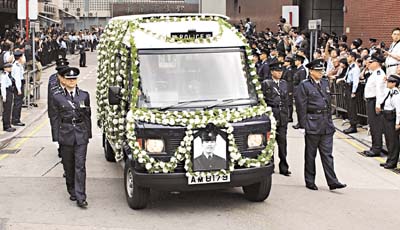
Then there is Tsang Kwok Hang, the officer who refused to die until he had ensured the safety of his friend and colleague – how am I even meant to put bravery of this magnitude into words? In recognition of this feat, he was posthumously awarded the Gold Medal for Bravery – among the highest gallantry awards one can be awarded in Hong Kong, which I think we all agree he more than earned. An elaborate funeral procession headed by his friends and colleagues escorted him on his final journey, and he was then cremated with full police honours at the Universal Funeral Parlour in Hung Hom in a service that was attended by Chief Executive Tsang Yam Kuen, Police Commissioner Lee Ming Kwai, and of course, his family.
We also mustn’t forget Sin Ka Keung, for while he might have survived his encounter with today’s killer, his life has been irrevocably changed, and he will carry the scars, both mentally and physically for the rest of his life. Like his colleague Tsang Kwok Hang, he displayed gallantry of the highest possible order, and so he was awarded the Gold Medal for Bravery in recognition. He went on to have a long and fruitful career following his recovery, remaining on the force, and eventually being promoted to Desk Sergeant, before he then retired recently, and began volunteering his time with a number of trauma and mental health charities. Despite bouts of despair, he appreciates the simplest joys of life and cherishes each passing moment, determined to live life to its fullest not just for himself, but also for his dear friend who never got the opportunity.
Dismembered Appendices
A few notes on my research methodology for this video. As ever, my first port of call was the Hong Kong Police Force, with whom I made a request to access archival information, as well as to see Po Ko’s service record, and otherwise receive their comments on the case. However, much like I found when researching the Yoga Ball Murders, this proved largely unfruitful, as today’s case was far too recent to be publicly disclosed, with many of the relevant files still being restricted under various privacy laws. This of course is completely understandable, as some of the people mentioned in today’s video are still alive to this day.
Similarly, my network of police veterans that I usually squeeze for information when writing these scripts proved to be of little utility, simply due to the fact that of the few of them that happened to be on the force during Po Ko’s time, none of them ever had any encounters with him on the job, and they had all long retired when his crimes came to public attention in 2006.
All of this put me on the backfoot somewhat and left me having to piece the story together using a patchwork of sources, including newspaper articles, official government press releases, the occasional passing reference in books, and of course, online sources. As ever with secondary sources, I typically prioritized Chinese language sources, because as I have said before, I find them to be far more reliable and trustworthy than English language ones, although I did make an exception when the Chinese sources claims seemed outlandish and unbelievable.
This dependence upon secondary sources brings me no joy, as often they are very contradictory in their claims, and without primary verification I am left having to judge their utility based purely upon weight of evidence, or gut instinct. This is nature of the beast with Po Ko’s story sadly… it is unavoidable unless we wanted to wait 20 years to publish this video!
Whilst I was researching this piece, I noticed how opinions on the police’s handling of this case are exceptionally polarized online. No doubt it is a tricky subject, and certainly it is easy to see why many would come away from this story with a negative opinion of the police, it was one of their own that went rogue after all. However, I cannot say it is an opinion I share, so I’m going to be brave here and stick my neck on the line: personally, all things considered, I think the police did a fantastic job in this case.
Sure, they didn’t catch Po Ko until they shot him, but his planning of the crimes was so meticulous, and his execution of them was so efficient and brutal, that frankly I don’t see how they ever could have been expected to. Had they failed to apprehend him due to incompetence or negligence, I’d be rightly criticising the force, but when they did pursue every single lead to its very end, and uniformly displayed nothing but bravery and a disregard for their own safety in the face of violence… good job Hong Kong Police as far as I am concerned!
And of course, it wouldn’t be a Hong Kong video without the traditional contextualising disclaimer! As ever, I implore you all to remember that the cases we look at in these videos, although always extreme in nature, are in no way representative of the territory itself, which by a country mile remains one of the safest places on earth. Take Hong Kong’s homicide rate for example - it’s consistently one of the lowest globally.
In 2022, the city saw a remarkably low murder rate of 0.2 per 100,000 people, which is a drop in the ocean compared to many other major cities. To put this into perspective, let’s consider London. According to the UK Office for National Statistics, in 2022, London had a homicide rate of 1.2 per 100,000 people - six times that of Hong Kong’s.
This isn’t to trivialize the seriousness of any violent crime of course, I simply wish to be fair to the city that I love, and never dissuade any of you from visiting based on these videos.
Photo Links (FAO Editor):
Tsui Po Ko:
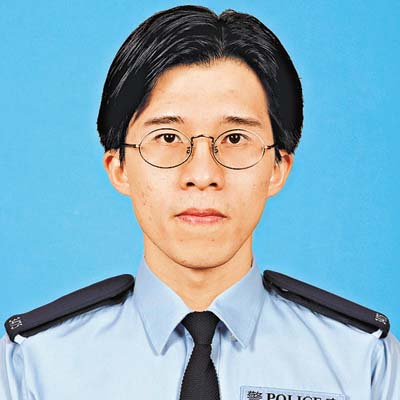
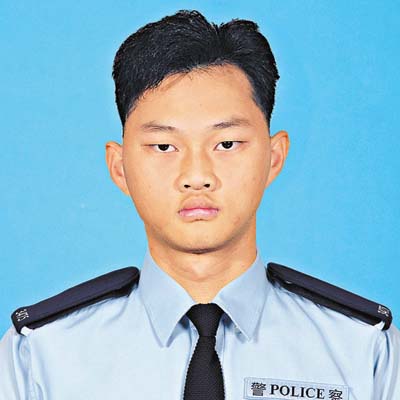
- Uniform shot: https://live.staticflickr.com/1333/1049568193_cdd95fdee3.jpg
- Another Uniform shot: https://i.ssjz8.com/upload/1/img2.baidu.com%2fit%2fu%3d3109704060%2c3509246938%26fm%3d253%26fmt%3dauto%26app%3d138%26f%3dJPEG%3fw%3d500%26h%3d699
- 3rd Uniform shot: https://nimg.ws.126.net/?url=http%3A%2F%2Fdingyue.ws.126.net%2F2023%2F0506%2Ffc2b4e17j00ru843b001lc000m800l3m.jpg&thumbnail=660x2147483647&quality=80&type=jpg
- Martial Arts: https://pic2.zhimg.com/80/v2-46e51fe323f204ff8ade5361acd3f769_720w.webp
- Graduation: https://pic1.zhimg.com/80/v2-5bdec73cfee69d0fec3d714252ef2604_720w.webp
- Who Wants to be a Millionaire: https://pic1.zhimg.com/80/v2-6f9e1fe264e901534a3bfc1461cc2648_720w.webp
- Who Wants to be a Millionaire 2: https://app3.rthk.hk/mediadigest/uppics/mfile_76_120909_1.jpg
- Running: https://pic1.zhimg.com/80/v2-4b89ae609ff5b1803246ef2699720a50_720w.webp
- Shin Yang’s stolen revolver used to commit his crimes: https://i1.wp.com/m1.ablwang.com/uploadfile/2017/0407/20170407084936986.jpg
Leung Shing Yan:
- Profile shot: https://pic.baike.soso.com/ugc/baikepic2/0/20220908213041-1872099118_png_591_399_218311.jpg/800
- Crime scene photo, (probably a bit much but figured it may be useful): http://the-sun.on.cc/cnt/news/20130220/photo/0220-00407-026b1.jpg
- Crime scene photo, 2007: https://media.gettyimages.com/id/1125005030/photo/fire-escape-where-the-body-of-police-leung-shing-yan-was-found-at-block-b-shek-to-house-shek.jpg?s=2048x2048&w=gi&k=20&c=nOyIViDH0nqYQ7zrNpIN7lUiJKPbMP827O2MPGK-_Kw=
- The mask Tsui Po Ko left behind at the scene: https://i1.wp.com/m1.ablwang.com/uploadfile/2017/0407/20170407084936908.jpg
- Shing Yan’s funeral: https://i1.wp.com/m1.ablwang.com/uploadfile/2017/0407/20170407084936340.jpg
- SDU deploying by helicopter: https://cdn1.i-scmp.com/sites/default/files/images/methode/2018/11/28/67755d02-f2f5-11e8-bbe8-afaa0960a632_972x_181131.jpg
- PTU Saxons: https://www.flickr.com/photos/zosofoto/3496338803/
- Period appropriate SDU photo: https://femto.scrolller.com/old-school-hong-kong-sdu-1446x1000-qu1g4087lf.jpg
- Another SDU Photo: https://www.easyatm.com.tw/img/9/497/nBnauM3X1IjMzATO0EDMwgDOxQTM4kDM0IDMxADMwAzMxAzLxAzL4EzLt92YucmbvRWdo5Cd0FmLxE2LvoDc0RHa.jpg
- 5th Floor Corridor Photo: https://nimg.ws.126.net/?url=http%3A%2F%2Fdingyue.ws.126.net%2F2023%2F0506%2Fb229b8dfj00ru843c002bc000m800i3m.jpg&thumbnail=660x2147483647&quality=80&type=jpg
Bank Robbery:
- CCTV still: https://pic4.zhimg.com/80/v2-79e682b191c1a040bcc5af18b6132563_720w.webp
- Police Sketch: https://pic4.zhimg.com/80/v2-280140608c35af83663c6a7acd06cc03_720w.webp
- Zafar Iqbal Khan and bank footage (the latter may be a recreation I am unsure) https://i1.wp.com/m1.ablwang.com/uploadfile/2017/0407/20170407084937327.jpg
- Crime Scene, (Might be a bit much but figured it may be useful): https://i1.wp.com/m1.ablwang.com/uploadfile/2017/0407/20170407084937575.jpg
- Another Crime Scene Photo: https://nimg.ws.126.net/?url=http%3A%2F%2Fdingyue.ws.126.net%2F2023%2F0506%2F05d95946j00ru843b001qc000m800gcm.jpg&thumbnail=660x2147483647&quality=80&type=jpg
- Robbery Photo (Definitely real): https://nimg.ws.126.net/?url=http%3A%2F%2Fdingyue.ws.126.net%2F2023%2F0506%2F12aacf7dj00ru843b002kc000m800f6m.jpg&thumbnail=660x2147483647&quality=80&type=jpg
- Police searching the streets after the robbery (if we have a Getty Images license!): https://www.gettyimages.ie/detail/news-photo/police-officers-search-a-car-park-for-an-armed-robber-who-news-photo/1126205050
Ambush:
- Shin Yang’s recovered revolver: https://nimg.ws.126.net/?url=http%3A%2F%2Fdingyue.ws.126.net%2F2023%2F0506%2Fd1e8fbbcj00ru843b001cc000m800etm.jpg&thumbnail=660x2147483647&quality=80&type=jpg
- The Subway where the shooting occurred: https://upload.wikimedia.org/wikipedia/commons/2/28/Tst_tunnel_crime_01.JPG
- Another view of the subway: https://upload.wikimedia.org/wikipedia/commons/5/55/Tst_tunnel_crime_02.JPG
- Tsang Kwok Hang: https://www.police.gov.hk/offbeat/826/images/p01.jpg
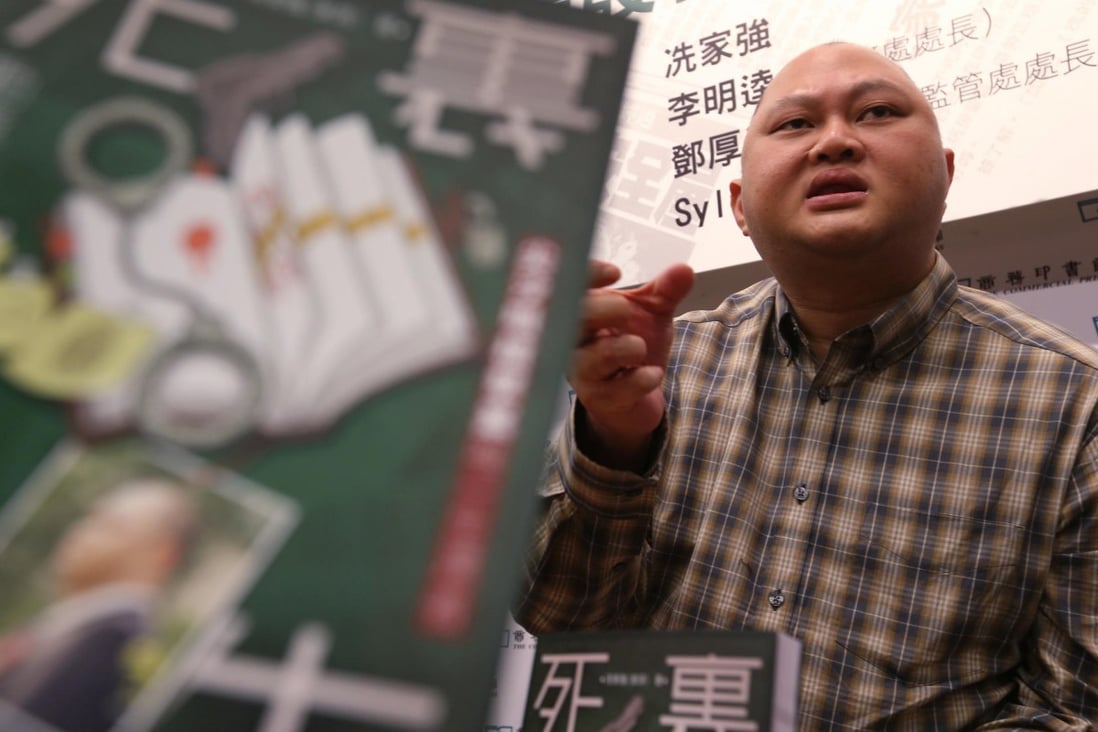
- Sin Ka Keung: https://www.police.gov.hk/offbeat/826/images/p02.jpg
- Sin Ka Keung now: https://img.i-scmp.com/cdn-cgi/image/fit=contain,width=1098,format=auto/sites/default/files/styles/1200x800/public/2014/02/27/1c1eb09affaf1e5411a6b95833b7b17a.jpg?itok=Q-vnrws-
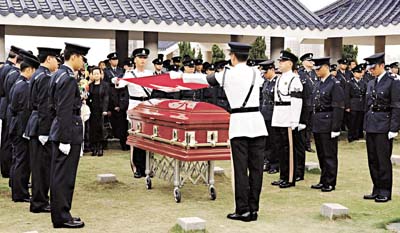
- Tsang Kwok Hang being laid to rest: https://www.police.gov.hk/offbeat/821/images/bottome.jpg
- Tsang Kwok Hang funeral procession: https://www.police.gov.hk/offbeat/821/images/bottome1.jpg
- Tsang Kwok Hang family during funeral (if we have a Getty Images license!): https://www.gettyimages.ca/detail/news-photo/police-constable-tsang-kwok-hang-who-was-killed-in-last-news-photo/1124910772
Key Takeaways
- Hong Kong police officer Tsui Po Ko murdered colleague Leung Shing Yan in March 2001, stealing his service revolver to commit later crimes.
- Po Ko used the stolen revolver to rob a Hang Seng bank in December 2001, killing security guard Zafar Khan and escaping with nearly HK$500,000.
- In March 2006, Po Ko ambushed two officers in a Tsim Sha Tsui subway; Constable Tsang Kwok Hang fatally shot him before dying himself.
- Police linked all three crimes through ballistic evidence and Po Ko’s meticulous planning, including surveillance notes and disguises found after his death.
- The case prompted major Hong Kong Police reforms including mandatory paired patrols, stricter complaint verification, and enhanced mental health screenings for officers.
Dana Ortiz covers prosecutorial mechanics, evidentiary procedure, and how investigations unwind decades after the original case file went cold.
Frequently Asked Questions
Who was Tsui Po Ko’s first victim and when was he murdered?
Tsui Po Ko’s first victim was 24-year-old Constable Leung Shing Yan, whom he murdered on March 14, 2001.
How did Tsui Po Ko escape detection after murdering Leung Shing Yan?
Po Ko escaped through the fire escape immediately beside flat 552, the only escape route not covered by CCTV. He entered and left the scene with such stealth that despite interviewing over 15,000 residents, no one saw anything useful.
What connected the murder of Leung Shing Yan to the Hang Seng Bank robbery?
The bullet that killed Zafar Khan during the bank robbery was a .38 special round with the exact same rifling indents as the bullets recovered from Shing Yan’s body, indicating the same firearm was likely used in both crimes.
How much money did Tsui Po Ko steal during the bank robbery?
Po Ko stole HK$492,880 and USD$1,091 during the bank robbery on December 5, 2001.
What type of shoes did Tsui Po Ko wear during the bank robbery, and why did this lead to a dead end?
Po Ko wore Mizuno Next Alphas, a recently released model of which only 130 pairs had been sold in his size. Despite narrowing down to 40 retailers including the Police Quartermaster, and offering a HKD$300 coupon for shoes of that size, none of the 12 officers who came forward proved an exact match for the worn footprints.
How was Tsui Po Ko finally killed?
Po Ko was killed on March 16, 2006 during an ambush of two police officers in the Austin Road Pedestrian Subway. After shooting both officers, he was shot five times by Constable Tsang Kwok Hang, who was lying on the floor and had been presumed dead.
What evidence finally proved Tsui Po Ko committed the bank robbery?
Detectives found polaroid photos of Po Ko wearing a red tracksuit jacket that was a one-to-one match for the jacket seen in CCTV images from the bank robbery.
What police reforms were implemented after Tsui Po Ko’s crimes?
Three major reforms were implemented: stricter procedures for handling complaints in reporting rooms requiring Hong Kong Identity Card details; elimination of lone patrolling except in emergencies; and rigorous comprehensive mental health screening for all recruits and throughout officers’ careers including psychometric tests, structured interviews, and observational assessments.
What did Dr. Xu Pei Hong identify as the turning points that led to Po Ko’s mental collapse?
Dr. Xu identified 1998 as the critical year when two events occurred: Po Ko’s failed promotion to Operations Sergeant, which made him hateful toward the police force and envious of other officers; and his discovery that his mother (not his father, as he had believed) had caused his parents’ divorce by cheating, which threw his entire perception of the world into question and introduced psychotic and schizophrenic tendencies.
What posthumous honors were given to the victims?
Leung Shing Yan was posthumously honored with the Silver Medal for Bravery in 2002. Tsang Kwok Hang was posthumously awarded the Gold Medal for Bravery. Sin Ka Keung, who survived, was also awarded the Gold Medal for Bravery and later retired, wrote a book about his experiences, and began volunteering with trauma and mental health charities.
Sources
- Original Casual Criminalist video: Tsui Po Ko: Hong Kong’s Devil Cop
- Hero image source by Dean Calma / IAEA / openverse, by.