I love taking deep dives into history. I once spent several days learning what I could about the War of the Roses, the Tudors, the Stuarts, the rise of the House of Hanover, and the baby race that led to Princess Alexandrina of Kent becoming Queen Victoria. And since I started working for Simon, I’ve also learned way more than I needed to know about the US’s founding fathers and ‘That Time Ben Franklin and John Adams Slept Together and the Hilarity That Ensued’.
A few years ago, I started reading the diary of Jan van Riebeeck. He was an official in the Dutch East India Trading Company, and he was responsible for setting up the Cape of Good Hope trading post in April 1665, which effectively kicked off the colonization of South Africa. His diary provides the reader with an insight into the hardships that South Africa’s first white settlers had to face, documents the customs and traditions of the three Khoisan tribes who lived in the area, and points out how trade with the Khoisan was instrumental in the Colony’s survival.
My knowledge of the next two centuries is spotty, but it involved the Cape Colony belonging to the Dutch, the British, the Dutch, and then the British again. There were several wars between the Colony and members of the Khoisan who’d realised that the white man had come to stay and wanted them gone. By the early 1800’s, the Colony fought several wars against the Xhosa (Koh-sah) after the Colony started expanding into their territory, and when the Cape Colony officially became a part of the British Empire in the 1820s, a group of Boers moved inland, got involved in a small war with the Zulu king Dingane, and started two independent colonies of their own - the Z.A.R or South African Republic, and the Orange Free State.
Initially, the British agreed to let these two struggling colonies be, but when first diamonds and then gold were discovered in these colonies in the 1880s, the British Empire insisted that the two independent Boer colonies were rebellious upstarts and tried to lay claim to the valuable diamond and gold fields, which in turn led to the First and Second Boer Wars.
Unfortunately, the Boers lost the Second Boer War in 1902, and in 1910, the Union of South Africa was established and became a self-governing country within the British Empire. In 1914, more than 229,000 South Africans of all races fought on behalf of Great Britain during WWI, and more than 10,000 of them lost their lives in Namibia, East Africa, the Middle East, and the Western Front – most notably during the Battle of Delville Wood in France.
But it was also during this time that one of South Africa’s most notable historical figures lived. Her name was Daisy de Melker, and she’s best known for being South Africa’s first female serial killer.
A Series of Unfortunate Events
Grahamstown (these days known as Makhanda) is located in the Eastern Cape, about 10 hours’ drive east of Cape Town. In 1812, it was a military outpost run by Lieutenant-Colonel John Graham who’d been ordered to get rid of the 20,000 Koh-sah who lived in the area. This led to numerous wars between the Koh-sah and the British soldiers, but the 10,000 koh-sah soldiers were only armed with rawhide shields and spears and were no match for 300 highly trained British soldiers armed with guns, swords, and canons, and by 1819, the Koh-sah were defeated.
After the Napoleonic wars, the British Empire had a poor people problem, so in the 1820’s they offered these people an alternative to the poorhouse – go to the Cape Colony and become farmers. Over 90,000 people from Ireland, Wales, England and Scotland applied, but the government could only afford to send 4000 of them to Cape Town. They were all handed pieces of land to settle in places like Bathurst, Albany, and Grahamstown, but what they didn’t know, was that they were now basically acting as a human shield by becoming a buffer between the Koh-sah and the Colony.
Understandably, these settlers didn’t like being murdered in their beds, so many of them later abandoned their farms and turned to different trades instead. They would go on to settle towns along the coastline all the way up to Natal, and many of their descendants ended up playing a significant role in South Africa’s history. Daisy de Melker’s grandfather, John Hancorn-Smith, was one of the 1820’s Settlers.
Daisy was born Daisy Louisa Hancorn-Smith on the 1st of June 1886 in a village known as Seven Fountains, just 25km outside of Grahamstown. She had been born with a cleft lip, but as she got older, it was barely noticeable apart from leaving her with a slight lisp. She had blue eyes and wild, curly, dark hair, and was “bright and chatty”.
Daisy was one of eleven children, and when she was about eight or nine, her father, William Stringfellow Hancorn-Smith, and her eldest brother, John, moved to the newly established country of Rhodesia (aka, Zambia and Zimbabwe) where they worked on a farm outside of Bulawayo. Daisy joined them when she was 10, and for the next three years, she helped her father and oldest brother to ‘tame’ the wilderness that they now called home, and that included learning how to safely use poison.
According to John Hancorn-Smith, they had several heads of cattle on the farm which were easy prey for the lions, leopards, hyenas, wild dogs, and other wild animals that roamed the area. They used to hunt them and set traps to keep the wild animals away from the cattle, but when that didn’t prove to be effective enough, they bought pink strychnine from the local pharmacy, doused animal carcasses with it, and left the poisoned meat out for the wild animals to feast on.
When Daisy was 13, her father sent her to Cape Town so that she could attend the Good Hope Seminary School. After finishing school, she moved to Durban where she attended the Berea Nursing Home, but she spent most of her holidays on the farm in Rhodesia, and that is where she met Herbert George Fuller.
Bert was a friend of John’s and worked for the Native Affairs Department in Rhodesia. When Daisy was home, Bert would show up on the farm and go along with John and Daisy when they checked on the traps, and before long, Bert and Daisy were engaged.
The two of them planned to get married on the 3rd of March 1907. But that February, John sent a message to Daisy to let her know that Bert was ill, and that she had to go home. Daisy packed her bags and went back to Rhodesia where she was told that Bert was suffering from an attack of malaria and that he now had black water fever. Basically, the virus was destroying his red blood cells, and he didn’t have long to live.
Daisy reportedly sat next to his bedside until he passed away on the 3rd of March 1907 – the day they were supposed to have been married. But Bert had left behind a will, and he’d left Daisy £95 (today it would be worth just over £9 500.)
Following Bert’s death, Daisy announced that she was abandoning her studies and that she would be moving to Johannesburg to live with her aunt. After all, the City of Gold made Bulawayo look like a dusty village, and Daisy had fallen in love with the city after a visit to her aunt the year before.
Ted Botha, author of the book “Daisy de Melker – Hiding among killers in the City of Gold”, explains that at the time, life in Johannesburg was equal to life in cities like London or New York.
“There were long wide main avenues where cabs parked outside the station on race days to take men to the [horse racing] track at Turffontein and ricksha boys waited at the post office in Jeppe Street. The ornate gardens in Joubert Park centred on a fountain and a bandstand where musicians played on weekends, and women flocked to a nearby art gallery that had a sculpture by Rodin. There was a million-tree forest at Sachsenwald, right near the millionaires’ mansions in Parktown, each on its own acre of land. The Carlton Hotel, with heating and cooling systems, penthouses and a Turkish bath in the basement, was where the mining magnates sat in their bathrobes making deals.”
Daisy’s aunt ran a boarding house in an area called Bertrams, and that is where the 23-year-old Daisy met the 35-year-old William Alfred (or Alfie) Cowle. He was originally from Braddan on the Isle of Man and had emigrated to South Africa shortly after the end of the Second Boer War. He worked as a plumber for the Johannesburg municipality and earned a modest income.
The two of them were married on the 3rd of March 1909 (and no, that’s not an error, she really picked the same wedding date twice) and they moved into 22 Tully Street in Turffontein. Their first children, twin boys, were born prematurely just four months later around the 20th of July 1909. According to the Johannesburg Municipal Register of Burials, one of the boys was stillborn, and the other died shortly after.
Daisy and Alfie’s third son was born on the 21st of June 1911, and they named him Rhodes Cecil Cowle after Cecil John Rhodes, who was the founder of the diamond mining company De Beers, a Prime Minister of South Africa and the man responsible for colonising Rhodesia. Their fourth son, Lester Bereford Cowle, was born on the 9th of June 1913, and their fifth and last son, Alfred Eric Cowle, was born on the 19th of October 1915.
According to their neighbours, the Cowle’s lived a modest life. Alfie was a hard worker who rarely called in sick. After work, he’d go home and spend some time working in his garden before eating dinner with Daisy and their sons. Daisy wasn’t exactly pretty, but she was described as having a “cheery and forceful personality”. She used to work as a porter at Hospital Hill, but shortly before Lester was born, she’d given up her position to raise her children.
Unfortunately, the Cowle men had really bad luck when it came to their health. Alfie had trouble with his stomach and kidneys and had to undergo numerous surgeries. He also kept a wide assortment of home remedies in the house and regularly dosed himself. Unfortunately, ‘bad health’ seemed to run in the family, and it wasn’t long before another one of their children died.
Little Alfie suddenly became ill just two months after his first birthday. He suffered from terrible convulsions and passed away on the 1st of January 1917. The doctor reportedly suspected that it might have been lead poisoning, but he wasn’t sure, and simply listed Alfie’s cause of death as “convulsions”.
That October, the 4-year-old Lester also became ill with ‘convulsions’, and he passed away a week later on the 17th of October 1917. His cause of death was listed as ‘an abscess of the liver’. Alfie and Daisy now only had one son left – the 6-year-old Rhodes – and Daisy took out an endowment policy in his name.
An endowment policy is a type of life insurance that either pays out after a certain amount of time, or in the case of the insured person’s death. In this case, the endowment policy was to run for 15 years, after which the 21-year-old Rhodes would receive £500. If he passed away before then, his next of kin would only receive £100.
Following Lester’s death, the Cowle’s moved into a new house on 67 Terrace Road in Bertrams. Daisy quickly befriended her neighbours, and they all soon learned that Rhodes Cecil was the apple of his mother’s eye, and that there wasn’t a lot she wouldn’t do for him. He’s described as being a “cheerful, nice boy”, though his teachers reportedly claimed that he was “not a very clever boy”, and preferred playing football to learning his ABC’s.
At some point after moving into the house, Alfie began building a stone wall along the side of the property that faced the street. The plan was to make it 50 feet long and 10 feet high. Three of his work buddies - Leonard Bradshaw, William Johnson, and Robert Sproat - often visited the house to help him out, and they soon befriended Daisy as well.
But the wall would never reach its intended height. By December 1922, the 48-year-old Alfie became sick. One of their neighbours, a Mrs. Ethel Balderow, would later explain that he was still going to work and puttering around in his garden, but that he looked –
“unhealthy and deadly pale”
Daisy told her neighbours that Alfie wasn’t sleeping well and that she’d watch him shiver and struggle to breathe at night. She also wrote to her sister in Kimberley to say that Alfie was “not doing well”. By Christmas Day, Alfie had lost his appetite, he was complaining about pain in his back and neck, and he took a home remedy for the pain. But around 8 am on the 11th of January 1923, a panicked Daisy called her neighbours, telling them to –
“Come at once, my husband is dying!”
The 11-year-old Rhodes ran to Mrs. Balderow’s house to ask her to come quickly, and when she arrived at the Cowle’s house, there were already several people there. They all watched on as Alfie clutched his stomach and rolled and convulsed on the bed, and some of them would later claim that they saw foam coming out of his mouth. He didn’t want anyone to touch him because it only increased his pain, and he refused to eat or drink anything that Daisy offered him.
Daisy told their concerned neighbours that Alfie had been complaining about stomach pain earlier that morning, so she’d given him some Epsom salts to drink. Not long after she brought him some tea, and he told her that he felt ill. Then he started convulsing.
When Daisy called their family doctor, Dr. Albert Pakes, she was told that he wasn’t available, so she sent Rhodes to fetch a Dr Leighton, who lived nearby. When Dr. Leighton arrived, he prescribed an anti-convulsant, and Daisy sent Rhodes to the nearest pharmacy. Dr. Leighton left to fetch some instruments from his house, and shortly after, the Cowle’s family doctor, Dr. Pakes, arrived.
Alfie told Dr. Pakes that he’d drank some Epsom salts earlier that day and that he started feeling ill shortly after. Dr. Pakes watched as Alfie suffered another convulsion, and he would later explain that there were several conditions which could have caused it, including cerebral palsy, a brain injury, pressure on the brain, tetanus, or strychnine poisoning.
Dr. Pakes also hurried back home to fetch some instruments to help Alfie, and while he was gone, William Alfred Cowle died. One of his neighbours helpfully noted his time of death as 9:03 am.
When Dr. Pakes returned to the Cowle household, he was told that Alfie had died, and he immediately asked Daisy to bring him the bottle of Epsom salts. She did, and Dr. Pakes examined Alfie’s body and looked for any signs of cerebral palsy or tetanus, but he didn’t find any.
Still, he suspected that Alfie might have been poisoned, so he called the police and told Daisy that he wouldn’t issue a death certificate before the police had a chance to examine the bottle of Epsom salts for poison. Then he left 67 Terrace Road and returned to his house.
The Jeppe Police arrived shortly after and took Alfie’s body to the government mortuary. No one told them that Dr. Pakes had ordered the Epsom salts to be tested for poison, and Dr. Pakes just assumed that Daisy had handed the bottle of Epsom salts over to the police.
Dr. Basil Fergus conducted Alfie’s post-mortem and concluded that he’d died from Bright’s disease – aka inflamed kidneys. A copy of his report was sent to Dr. Pakes, who just assumed that the Epsom salts had been tested. Since there was no mention of poison being found, Dr. Pakes signed off on Alfie’s death certificate.
William Alfred Cowle was buried on the 12th of January 1923 in the Brixton Cemetery. The 37-year-old Daisy was now a widow and a single mother, but Alfie had ensured that she was well provided for. Daisy had inherited the house on 67 Terrace Road, as well as an amount of £1798 – which would be worth just over £91 000 today.
Pushing up Daisy
Following her husband’s death, Daisy enrolled Rhodes at Hilton College in Pietermaritzburg. Back then it was South Africa’s version of Eton College and still is a very prestigious (and EXPENSIVE) private school.
Back in Johannesburg, Daisy moved to a new house and rented out 67 Terrace Road. She got a job as a ‘theatre portress’ at the newly established Children’s Memorial Hospital and earned between £90 and £100 a year (so between £4500 and £5000). Her duties included escorting patients to and from the operating theatre and cleaning the medical instruments, and later she’d also be responsible for greeting patients and escorting them to the relevant wards.
The 12-year-old Rhodes wasn’t happy at Hilton College, and by the end of 1923, he returned to Johannesburg. Daisy enrolled him at a private Catholic School, but soon had to admit to herself that Rhodes Cecil would never live up to his namesake, the ‘great’ Cecil John Rhodes.
In January 1926, the 40-year-old Daisy got engaged to one of Alfie’s old work friends – the 46-year-old Robert Sproat. He was originally from Carlisle in the UK, and had emigrated to South Africa in 1903. He also worked for the Johannesburg municipality as a plumber, and in 1923, he and his brother, William Sproat, went on a trip to the UK to visit their mother. They were able to travel on a luxury cruise liner both on their way to the UK and back to Cape Town, and he’d later regale Daisy with stories about life in the UK and his time aboard the cruise ship.
Shortly before their marriage, Daisy left her job at the Children’s Memorial Hospital, and the two said their “I Do’s” in July 1926. They moved back into Daisy’s house at 67 Terrace Road, and for a while, everything went well.
In December 1926, Robert and Daisy went to Durban on holiday, where they met up with Robert’s younger brother, William Sproat, and his new wife, Amy. During their visit, Daisy reportedly overheard Robert telling his brother that according to his current will, all of his money and belongings should go to their mother, Jane Sproat, who still lived in the UK. Daisy reportedly complained about this to her new sister-in-law, who urged her to discuss her concerns with Robert instead.
On a lazy Sunday afternoon in October 1927, Robert did some work in the garden, and that evening, Robert and Daisy were drinking beer on their veranda when Robert started complaining of a bitter taste in his mouth. He went inside looking for some mouthwash, and Daisy watched as he suffered a sudden convulsion and collapsed on the bed.
Daisy ran to her closest neighbour, Frances Bradshaw, and begged her to call a doctor. Frances alerted a Dr Samuel Mallenick to the emergency, and when Leonard Bradshaw returned home, Frances urged her husband to go over to the Sproat household to check up on Robert.
Again, the house was filled with concerned neighbours by the time Leonard arrived. Daisy told him that Robert had fallen ill while they’d been drinking some beer, and Leonard noted that Daisy had rinsed their glasses out in the kitchen sink.
Again, their neighbours watched on as Daisy’s husband suffered from convulsions. He cried out whenever anyone tried to touch him, reportedly claiming that –
“Please don’t, I can’t stand it!”
When Dr Mallenick arrived, Robert Sproat told him that he was experiencing sharp pains on the left side of his abdomen, and he was covered in sweat. Dr Mallenick couldn’t physically examine Robert’s abdomen since he flinched away and cried in pain, but the doctor suspected that Robert might have ruptured a stomach ulcer.
When Robert denied this, the doctor asked him if it was possible that he’d come into contact with lead recently, and Robert told him –
“To hang with lead poison. I haven’t worked with lead for years!”
According to Dr. Mallenick, he’d never seen anyone with symptoms like Robert Sproat’s, and he had no idea how to treat him. He gave Robert a sedative and said that he’d be back in about 30 minutes to administer another dose. He returned as promised, but couldn’t really say that the sedatives helped Robert’s condition much.
Robert begged Daisy to call his brother William, and another one of their friends, William Johnson, who ended up sitting next to Robert’s bedside all night. According to Johnson, Robert told him –
“If anything happens to me, tell [my brother] that Daisy must get everything, lock, stock, and barrel.”
When William Sproat arrived at the house on 67 Terrace Road at 4 am the next morning, Robert repeated his claim, telling his brother that –
“I’ve just been talking to Johnson, and I’ve told him that, if I don’t see you again, Daisy has got to get everything I’ve got, lock, stock, and barrel. And I know, Will, that you’ll see she gets it.”
Later that morning, Daisy and William Sproat discussed Robert’s new will, and Daisy insisted that they had to get it on paper before anything happened to Robert, but because Robert was still in a lot of pain, William refused, saying it can –
“Wait till he gets better.”
When Robert agreed that he’d draw up a new will once he felt better, Daisy surprised both men by pulling out a stack of papers and declaring that there was no need, she had already drawn up a new will. Robert only had to sign it. Which he did. It was witnessed by Daisy, William Sproat, their neighbour, Emily Stricker, and a contractor named Edward Osborne who’d been working for the Bradshaws.
Miraculously, Robert Sproat recovered and received a few bottles of health tonic from Dr. Pakes, the municipal doctor, to help him build up his strength. He was soon able to return to work, and on the 5th of November, Robert Sproat was once again working outside in the garden when he asked Daisy to bring him a beer.
That evening, he started feeling sick again, so he took a few mouthfuls of the tonics that Dr. Pakes had prescribed for him, and then lay down on a couch to rest. Rhodes heard a noise, and found Robert half on the floor in the living room, suffering from another fit of convulsions. Again, Dr. Mallenick was summoned, and this time, Daisy called Dr. Pakes as well.
Again, the house was filled with their concerned neighbours, who, once again, all looked on as Robert suffered a series of painful fits. By the time Dr. Mallenick arrived, Robert had lost consciousness, and Dr. Mallenick told the onlookers that Robert wasn’t going to make it.
Robert Sproat passed away surrounded by his doctors, neighbours, wife and stepson. When William Sproat arrived the next morning, he was shocked to learn that Robert had died so suddenly. When Daisy told him that Robert had – once again – fallen ill after drinking a beer, William insisted that a postmortem had to be conducted to find out why Robert had died.
According to William, Daisy didn’t seem too concerned over the loss of her husband, and simply told him that she wasn’t going to ask for a postmortem to be done, because –
“It will cost seven pounds.”
The next morning, Daisy proudly presented William with a signed death certificate, which listed Robert’s cause of death as a ‘cerebral haemorrhage’. That night, Daisy, her in-laws, and some of their neighbours were discussing Robert’s funeral when Daisy left the room to fetch Robert’s old will. In front of everybody, Daisy declared that it was no longer valid, and tore it into pieces.
Following Robert’s funeral, Daisy asked William Sproat to help her settle Robert’s estate. He escorted her to the office of a Mr. T.E Kenna, and listened as she told the lawyer that Robert hadn’t owned anything of value. When the lawyer asked him if this was true, William denied it, and told Mr.
Kenna that Robert had owned several shares in the local gold mines. Mr. Kenna took over the settlement of the estate, and Daisy wasn’t able to touch Robert’s money until February 1928. She ended up inheriting an amount of £4740 (that’s worth £249,880 today).
Still, Daisy had the gall to write to Jane Sproat in the UK, and claim that Robert hadn’t left her a penny. Jane forwarded her letter to William Sproat, who confronted his sister-in-law and told Daisy that –
“I never want to see you again, and I don’t want you to put your foot in my house again.”
The Prodigal Son
By the time Robert Sproat died, the 16-year-old Rhodes had already dropped out of school and started nagging his mother to buy him a motorcycle. Daisy didn’t give in and instead enrolled Rhodes in a technical college so that he could learn a trade – in this case, plumbing.
A few months after Robert’s estate was finalized, Daisy and Rhodes went on a tour of the British Isles. After all, she was now reasonably well-off and could afford it. They spent the summer months in the United Kingdom, went to see Alfie Cowle’s family on the Isle of Man, and when they returned to Johannesburg, Rhodes proudly showed off the new motorcycle that Daisy had bought for him.
Rhodes returned to the technical college, but he dropped out after a few months. He then spent his time riding around on his motorcycle, drinking with his friends, or cruising along in the new Chevrolet he’d asked Daisy to buy for them. He expected Daisy to pay for fuel and the maintenance on his motorcycle, and when he grew bored with it, his mother bought him a new one.
When Rhodes was 18, Daisy pressured him to find a job. She’d arranged for a position for him at a nearby hardware store, but Rhodes left after just a few weeks. Then he got a job on a construction site, but quit after three months, informing his mother that he didn’t like working in construction. However, they really should get a new car. Preferably a sporty 2-door one. Daisy eventually gave in to his demands for a new car but bought a brand-new Nash 400 4-door Sedan instead.
In January 1930, Daisy was already seeing husband number three, a 46-year-old widower named Sidney (or Sid) Clarence de Melker. Sid had been born in Kimberley, used to play rugby for the Springboks, and worked as a plumber for the Slimmer and Jack gold mine in the nearby town of Germiston (which is now a suburb of Johannesburg).
His first wife had passed away just two years earlier, and their only child, the 19-year-old Eileen de Melker, still lived with him. He introduced Eileen to Daisy and Rhodes in March 1930 but reportedly didn’t have any patience for the spoiled, layabout Rhodes, who had a habit of throwing tantrums when his mother told him ‘no’.
That April, Daisy took Rhodes to visit his aunt in Rhodesia and tried to get him a job on the railways. When that failed, Daisy took Rhodes south to Swaziland and got him a job with the transport division of the railway instead. Once he was settled, Daisy returned to Johannesburg and Sid de Melker, but still regularly sent Rhodes some spending money, which he spent on clothes, a gramophone, and his beloved motorcycle.
He also contracted malaria during his time in Swaziland, prompting Daisy to go and visit her son in June 1931. While he lay in bed, Daisy helpfully handed him some documents to sign, informing him that it was high time that he drew up a will. Since he was still unmarried, Daisy was his sole heir.
Sid and Daisy were married on the 21st of January 1931, and Daisy moved into Sid’s house at 19 Simmer East Cottages in Germiston. They had been married for just three months when the almost 20-year-old Rhodes appeared on their doorstep and informed his mother that he’d quit his job in Swaziland and was moving back in with her. Not long after, Rhodes fell ill, and a Dr. Donald Mackenzie informed them that it was an attack of malaria.
It isn’t unusual for people to suffer attacks of malaria long after they’d first come into contact with the parasite, which, if it isn’t killed off entirely, continues to live on in your body, resulting in repeated attacks of malaria. The symptoms are exactly the same – namely fever, chills, headache, nausea and vomiting, abdominal pain, fatigue, an increased heart rate and rapid breathing – and it’s treated the same way. It can also be just as deadly and can reoccur every few months to every year until the parasite is finally killed off entirely.
After a few weeks, Rhodes recovered from his malaria attack, and Daisy got him another job as a driver for a local laundromat, but once again, he only worked there for a few months before he was fired. She then got him an entry-level position at a goldmine, but again, he didn’t last long. According to Eileen, whenever Daisy told her son that he had to get another job, Rhodes would yell and throw things at Daisy, or threaten to kill himself if he didn’t get his way.
Daisy ended up writing to her sister that –
“I am rather disappointed in Rhodes and he really makes me very worried and ill… Rhodes’s one ambition seems to be to see how nasty he can be towards me. His one object in life seems to be to have a two-seater car.”
“I have done my best. Yet I am played out with worrying over him. This letter is just me to you with an open heart that is broken. I feel that if it were not for Sid and Eileen I would sell up everything I possess and go right away. That is how I feel. If anything should happen to Sid, I’d do it. I’d just sell up and take Eileen to Ireland and leave her with her aunts there and come back here …”
By the end of 1931, Daisy finally got Rhodes a job at the Motor Car Greasing and Oiling Company in Johannesburg, where he worked for a Mr. Robert Short. Every day, Daisy would send Rhodes off with a flask of coffee and some sandwiches for his lunch, and he’d spend his day cleaning and greasing car engines. He’d also brag to his co-workers that he was going to inherit some money from his father’s estate when he turned 21 and asked Mr. Short how much money he’d need to buy himself a new car.
On the 2nd of March 1932, Rhodes left for work as usual. Around 11 am, he had his first tea break. He shared his coffee with a coworker named James Webster, and around 1 pm, the pair took their lunch break. Webster ate six bananas for lunch, and Rhodes ate the sandwiches his mother had made for them. He also finished the flask of coffee.
An hour and a half later, Rhodes told one of his co-workers that he had a burning pain in his stomach. Webster also felt sick and blamed his upset stomach on the six bananas he’d eaten for lunch. When Webster got home, he was violently sick and lay in bed all night. That same evening, Rhodes had gone to the local rugby club for some exercise, and at 8 pm, he joined Daisy, Sid and Eileen for dinner.
The next morning, Rhodes told his family that he didn’t feel too well, but he had to attend a hearing at court for running a red light. He received a fine and returned to work immediately after, but Mr. Short noticed that Rhodes still looked ill, so he sent him home.
When he walked in the front door, Eileen asked him what was wrong, and he told her that he thought he was having another attack of malaria. Rhodes climbed into bed shortly after they’d eaten lunch, and that evening, he started vomiting. The next day, Daisy called Dr. Mackenzie to come and see Rhodes, and explained that he’d been sick for a few days.
Dr. Mackenzie established that Rhodes didn’t have a fever, didn’t have an elevated heart rate, and was breathing normally, and dismissed the idea that Rhodes was suffering from another bout of malaria. He asked Rhodes to describe his symptoms, and Rhodes explained that he had a sharp pain in his neck, as well as a bad headache. Dr.
Mackenzie thought that Rhodes was suffering from the flu, so he prescribed some painkillers, and left Rhodes in his mother’s care, reassuring Daisy that Rhodes should feel better by the next morning.
That night, Eileen took Rhodes some food and a glass of ginger ale, after which Daisy offered to sit with him. The next morning, on the 5th of March 1932, Daisy made Rhodes some custard, but later told Eileen that he’d refused to eat it, so Daisy had eaten the custard herself. Shortly after, Rhodes’ condition worsened. That afternoon, a neighbour of theirs, Mrs.
Julenda Brunton, offered to look after Rhodes. She tried to feed him some soup and brandy, but Rhodes only cried in pain and complained of a sharp pain in his stomach.
Mrs. Brunton offered to call Dr. Mackenzie again, but when she was told that he wasn’t at the office, she left a message, then called her own doctor, Dr. Eamon Ferguson, to come and look at Rhodes.
When Dr. Ferguson arrived, Rhodes was having trouble breathing, and his face was turning purple from a lack of oxygen. He was also suffering from convulsions, and Dr. Ferguson gave him some chloroform to help ease the spasms and help him breathe.
By the time Dr. Mackenzie arrived, Rhodes had lost consciousness, and the two doctors did their best to save the 20-year-old Rhodes’ life. They did CPR on him and gave him three adrenaline shots and a dose of strychnine to keep his heart beating. However, after a few minutes, the two doctors had to tell Daisy and Mrs. Brunton that Rhodes was dead. That evening, Dr. Mackenzie did his autopsy and listed Rhodes’ cause of death as ‘cerebral malaria’.
Rhodes was buried next to his father the very next day, just three months shy of his 21st birthday.
The Skeletons in Daisy’s Closet
In the days following Rhodes’ death, Eileen often had to console a crying Daisy who spent her afternoons standing next to Rhodes’ grave. The day after his funeral, she’d gone to see Mr. Robert Short to inform him that Rhodes was dead and to collect the wages he’d earned for the previous week. She also cashed in on the endowment policy she’d taken out for Rhodes when he was 6, earning herself a measly £100.
But unbeknownst to Daisy, Rhodes’ sudden death had set off alarm bells in the mind of William Sproat.
In the weeks and months and years following Robert Sproat’s death, William had become convinced that Daisy had somehow murdered his older brother. The Sproat family had even tried to have Robert’s final will declared invalid, but they’d lost the case, and Daisy had been allowed to keep the £4740 that William insisted should have gone to Robert’s mother, Joan.
But when William heard how Rhodes had died, he couldn’t help but draw comparisons between Robert and Rhodes’ sudden illnesses. So William paid a visit to the Department of Criminal Investigation in Pretoria and told the officers on duty that he suspected Daisy had murdered both her husbands and her son.
On the 15th of April 1932, a little over a month since Rhodes’ death, William Sproat, Dr. Mackenzie, a police detective and three forensic scientists went to Brixton Cemetery and exhumed the remains of Alfred Cowle, Robert Sproat, and Rhodes Cowle. Their remains were sent to the South African Institute for Medical Research and were tested for various poisons.
Alfred Cowle and Robert Sproat’s vertebrae were reportedly tinted pink and contained strychnine particles. Rhodes’ remains tested positive for arsenic, and his organs still contained 1.3 grams of arsenic and 1.7 grams of arsenic oxide.
On the 20th of April 1932, two police officers knocked on the door of 19 Simmer East Cottages in Germiston, and Daisy de Melker was arrested for the murder of her son, Rhodes Cecil Cowle.
The Trials of Daisy de Melker
Daisy de Melker first appeared in court the day after her arrest. The news of her crimes had already spread throughout the city, and the magistrates court in Germiston was packed when Daisy took her seat next to her newly appointed lawyer. Magistrate Douglas Mearns told the court that Daisy was being charged with the murder of her son by means of arsenic poisoning, and the murders of her husbands by means of strychnine poisoning.
Her preliminary hearing took place a month later on the 18th of May 1932, and again the courtroom was filled with curious onlookers.
“Every inch of space in the court was occupied, women, both young and old, forming a big majority of the attendance. So closely was the Court packed that the main doorway was blocked, impeding the entry of witnesses and others and the magistrate Mr Douglas Mearns ordered the doorway to be cleared.”
The purpose of the preliminary hearing was to determine if the Crown had a case against Daisy. Over 60 witnesses were called, which included Daisy’s neighbours, her friends, and the doctors who treated Alfred Cowle, Robert Sproat and Rhodes Cowle. The Crown explained that Daisy had committed each murder for financial gain, and presented the forensic reports to the court that indicated that Daisy had poisoned each one of her victims.
What they couldn’t prove, was how and where she’d managed to get her hands on the poison she’d used to murder them, since both strychnine and arsenic were controlled substances. They’d questioned every pharmacist in Germiston to ask whether or not they’d sold Daisy de Melker a controlled substance, but no one had any record of her. Their best guess was that she’d somehow stored some strychnine away when she was living in Rhodesia back in the late 1890’s, and had been carrying a bottle of the poison with her since then. But they didn’t find either strychnine or arsenic in the De Melker’s house when they’d arrested Daisy, and it wasn’t a secret that some of the medicines the doctors had prescribed to the victims had contained traces of both strychnine and arsenic.
At the end of May 1932, the Public Prosecutor asked the local media to print a photo of Daisy, hoping that it would lead them to the person who’d sold her the poison, and on the 1st of June, the Johannesburg Star printed a full front-page story on Daisy’s case.
Their plan worked, and a pharmacist named Abraham Spilkin came forward to let the police know that he’d been the one to sell Daisy the arsenic.
Later, one of the Crown’s prosecutors, Sylvester Quinlan, would write that he’d paid special attention to Daisy’s face when the Crown called their surprise witness to the stand.
“I saw what nobody else saw. She seemed almost to recoil with fear and horror. Every drop of blood drained from her face. In those few seconds I knew that she knew that for her it was the end of the road, that there was no way she could escape from Spilkin’s deadly evidence.”
Mr. Spilkin explained that he owned a small pharmacy in Kenilworth, Johannesburg. On the 25th of February 1932, a woman called and asked if he had something she could use to get rid of a stray cat. Mr. Spilkin explained that he had some arsenic in stock, but that she’d have to come and collect the poison herself since she needed to sign the poison register. He’d also suggested that she bring the cat to him instead, and then he’d get rid of it and save her the trouble.
Two hours later, an old client of his named Mrs. Cowle walked into his pharmacy and explained that she’d been the woman who’d called him earlier the day. He measured out 60 grains – or a teaspoon full – of white arsenic for her. He placed it in a small wooden box, added a label, and then had her sign the poison register.
She signed it as DL Sproat, noted her address as being 67 Terrace Road, and told Mr. Spilkin that she’d recently gotten remarried. So when the police came calling a few weeks later, they didn’t find any record of a D de Melker or a mention of 19 Simmer East Cottages in his books. If it hadn’t been for her photo in the newspaper, Mr.
Spilkin would never have known that she’d used the poison to murder her son.
Daisy de Melker was indicted on the 5th of August 1932, and her murder trial was set to begin on the 17th of October 1932. While she was in prison, the story of her crimes travelled the world, and her story was published in newspapers in Jamaica, New York, Australia, and London. The international media referred to Daisy as the “Borgia of the Transvaal”, likening her to Lucrezia Borgia, Pope Alexander VI’s daughter, who was often accused of being ‘a poisoner, a murderer, and a witch’. Some believed that she had to have been a real femme fatale to be able to lure so many men to their deaths, but a local author named Sarah Gertrude Millin set the record straight when she wrote that –
“What chiefly interested me about this woman was the attraction that, despite her apparent unattraction, she seemed to have. She was really ugly. She was small, thin, with tousled grey hair, claw-like fingers, a faded skin, large spectacles, a mouth like a fish, and a cleft palate.”
Daisy’s solicitor knew that he didn’t have the necessary skill to represent her in criminal court, so he suggested that she should hire a criminal lawyer to defend her, and introduced her to two barristers named Harry Morris and Issie Maisels. According to Ted Botha, the author of “Daisy de Melker” Hiding among serial killers in the City of Gold” –
“Harry had been building up a reputation for representing the most unwinnable cases, which usually also meant the most reprehensible acts possible – arson, [sexual assault], illicit diamond buying, fraud, theft, embezzlement, murder.”
Both men would later explain that they hadn’t been impressed with Daisy, with Morris explaining that she came across as “ruthless, remorseless and pitiless”, and had soulless blue eyes. But he couldn’t deny that she had a certain charm about her. She had no trouble making friends in prison, taught the other women in the prison how to drink tea ‘the English way’ – pinkie in the air – and reportedly had a good – if dark - sense of humour. According to Harry Morris –
“Daisy was a paradox. She was an over-sexed woman who ‘had no time for men’. All her victims were males. Her intimate friends were women. Not only did she like them, but they liked her.”
However, despite the international media’s ongoing fascination with Daisy, the South African public hated her. The women reportedly had no problem with Daisy murdering her husbands. It was the fact that she’d murdered her son that had them calling for the death sentence. So Harry Morris and Issie Maisels suggested to Daisy that her case should be heard in front of a judge, instead of a jury.
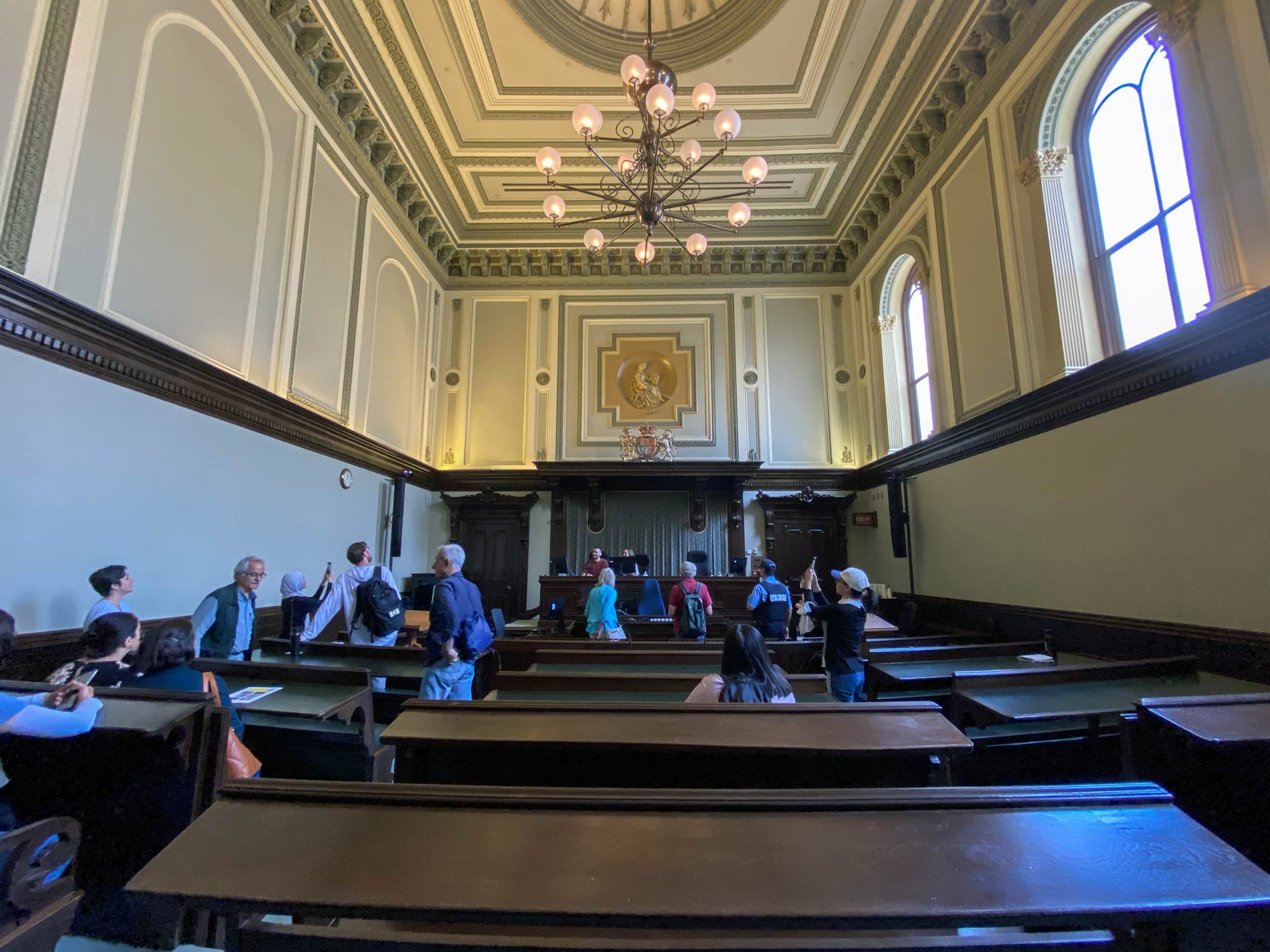
Daisy de Melker’s murder trial took place in the Johannesburg High Court and was heard by Justice Leopold Greenberg and his assistants, AA Stanford and JM Graham. In his opening statement, Crown Prosecutor Cyril Jarvis explained the Crown’s case against Daisy de Melker. He explained how death seemed to follow Daisy, recounting the deaths of her first fiancé, Bert Fuller, the deaths of her youngest children, and the deaths of her two husbands, Alfred Cowle and Robert Sproat.
He then went on to explain that Rhodes and his mother often argued and that he had become a burden to Daisy. So Daisy poisoned Rhodes’ coffee, and later fed him poisoned custard when it seemed like he was starting to get better.
Harry Morris, on the other hand, argued that Daisy wasn’t a murderer, but a “loving a dutiful wife, a housekeeper, a nurse, a hard worker.” She was no stranger to death, and already lost four of her children. All of her neighbours would testify to the care she’d shown to Alfred Cowle and Robert Sproat, how she’d immediately called for a doctor when they fell ill, and how they’d witnessed her tears when both men drew their final breaths. None of the doctors who’d attended either Alfred, Robert, or Rhodes mentioned the possibility that they’d been poisoned, and the fact that Daisy had set out to kill a cat just a week before Rhodes fell ill, was a coincidence, but not improbable.
Two of Daisy’s sisters were called to the stand, and they testified that as far as they knew, Daisy’s marriage to Alfred Cowle had been a happy one. One of her sisters, Fanny McLachlan, explained that Daisy had been grief-stricken after Alfred’s death, and told the court that she often thought that Daisy was too soft on Rhodes.
Daisy’s old neighbours all described Alfred Cowle and Robert Sproat’s deaths in detail, explaining how their backs and necks had arched when they convulsed. All of them recalled how the two men had seemed to be perfectly healthy in the days leading up to their deaths. And all of them noted how similar the two men’s symptoms were.
When Eileen de Melker was called to the stand, she explained that Daisy was a loving mother, but Rhodes was spoiled.
“He was always wanting his own way. Often when he passed the remark that he had seen something in town for his motorbike which he wanted, he would get it.”
When Rhodes didn’t get his way or Daisy told him to find a job, he’d get angry. He would start throwing things like vases or a water jug at his mother. He’d slap her or hit her with a fist, forcing her to defend herself, or threaten to take his own life if he didn’t get his way. He once destroyed his tennis racket when Eileen got invited to play tennis with some friends, but he didn’t.
And when he grew frustrated while doing some maintenance work on his bicycle, he lost his temper and chopped it up with an axe. The only person he behaved around, was Daisy’s new husband, Sid.
One Saturday, Rhodes got home late and asked Eileen to help him work on his motorcycle. When she refused, Rhodes threatened to kill himself again, but Eileen ignored him. A few minutes later, he came back and breathed into her face. She recognised the distinct smell of a poisonous liniment Daisy kept in the house, and thought that he’d taken a fatal dose. When Eileen began crying, Rhodes calmed down and told her –
“It’s all right, I haven’t taken very much.”
It was this piece of testimony that Harry Morris tried to spin to Daisy’s advantage since it made it seem entirely possible that Rhodes might have drank another liniment or bottle of medicine in the house, not knowing that it contained a fatal dose of arsenic.
Unfortunately, he couldn’t argue against the fact that Daisy had bought some arsenic a week before Rhodes fell ill. Tests done on his remains and fingernail clippings that belonged to his colleague, James Webster, all agreed that both men had been exposed to arsenic.
When the Crown’s poison expert, Professor John Watt, was called to the stand, he explained what the symptoms of strychnine and arsenic poisoning were.
People who’d been poisoned with strychnine would start showing symptoms within just 15 to 60 minutes of being poisoned. It is characterised by restlessness, painful spasms, uncontrollable arching of the back and neck, a tightness in their jaw, difficulty breathing, and dark urine when their kidneys started failing.
A lethal dose can be as small as just 1.5 to 2 grams, and a larger dose would cause respiratory failure and death within just 15 to 30 minutes. Strychnine is incredibly bitter, and it wouldn’t have been possible to mask the bitterness with beer or sweetened tea. Chemical and biological tests was able to prove the presence of strychnine in a person’s remains, but it’s quickly metabolised and doesn’t remain in the system for long.
The symptoms of arsenic poisoning can appear within 30 minutes of being exposed to high levels of arsenic. They include severe abdominal pain, nausea and vomiting, diarrhoea, chest pain, shortness of breath, sore throat, low blood pressure, arrhythmia, and a garlic odour in the mouth. A fatal dose for a young man weighing approximately 80kg would be just 1g of arsenic. Which means that Daisy had had enough arsenic in her possession to murder approximately 60 people.
Harry Morris was able to get Prof. Watt to admit that the tests for strychnine conducted on Alfred Cowle and Robert Sproat’s remains weren’t conclusive since the samples were too small to positively confirm that they’d died from strychnine poisoning. Furthermore, Prof.
Watts also had to admit that Rhodes’ symptoms on the Friday morning before his death – namely a headache and sharp pain in his neck – didn’t agree with his list of symptoms of arsenic poisoning. What’s more, it was theorized that Rhodes had to have been exposed to a higher dose than his colleague, James Webster, and yet, while Webster was sick in bed, Rhodes was off playing rugby with his friends. So isn’t it possible that James Webster just had a bout of indigestion after eating too many bananas, and Rhodes really only passed away as a result of a bad malaria attack?
When Daisy was called to the stand, she denied all the allegations against her. She explained that her marriages to Alfred Cowle and Robert Sproat had been happy ones. Alfred Cowle had kidney troubles for as long as she knew him, and Robert Sproat often suffered from indigestion. Both men preferred to dose themselves with medicines instead of going to the doctor.
Rhodes, on the other hand, had been a sickly child. He’d had ‘whooping cough, measles, German measles, diphtheria, mumps, the flu, and scarlet fever.’ He’d contracted malaria on their way to Swaziland and had two malaria attacks afterwards. She admitted to providing him with whatever he wanted, be it a new bicycle, motorcycle, or a car. She also explained that she often found him new jobs, but that he would quit after a few months because he didn’t like working.
“Sometimes he would be lively and sometimes depressed. This became more marked later in his life. Rhodes very often made dreadful threats and told me he was going to [kill himself].”
When Morris asked her about the poison she’d bought, Daisy explained that she’d bought it to kill stray cats.
“We often had them round. At night they kept us awake. When I would leave my fancy work on the verandah, I would return to find the cats sleeping on it and sleeping among the plants. They annoyed me intensely.”
Her stepdaughter, Eileen, had a female cat named Fifi, and Daisy told the court that she believed Fifi was the main reason why the cats wouldn’t leave them alone. She admitted to buying cat poison but claimed that she didn’t know that it contained arsenic. When she got home that afternoon, she locked Fifi up in Eileen’s room and then went about poisoning three stray cats by covering pieces of meat with the poison powder. She was only able to find the remains of one of them a day later, and she had disposed of it by wrapping it up in a burlap bag and tossing it in the trash.
There hadn’t been any poison left in the small box, so she’d tossed the box away. To her knowledge, there wasn’t any other sources of arsenic in the house.
Daisy denied poisoning Rhodes and explained that she’d just thought that he’d eaten too many ice creams after work, which had caused his stomach ache. When he didn’t get better, she called Dr. Mackenzie, who told her that Rhodes had the flu. She watched over him all night and checked on him the next day.
“I was in the room nearly all the time and I did all I possibly could for the boy.”
She admitted to making Rhodes some custard on Saturday morning and explained that he didn’t want to eat it, so she ate it instead. A short while later, his condition worsened, and he passed away.
When it was the Crown’s turn to question her, Daisy explained how it came to be that Robert Sproat signed a new will during his first illness. She also admitted to having the forms ready, claiming that she’d helped a friend draw up a new will a few weeks before. She admitted to having Rhodes draw up a will of his own shortly after he fell ill with malaria, explaining that she didn’t think he would die, but that she had thought that it would make it easier to sort out his estate if something did happen to him.
When the Crown asked her why she’d travelled all the way to Kenilworth to buy cat poison, she explained that Mr. Spilkin knew her, so he was more likely to agree to sell her some poison. She’d provided the name of ‘Mrs. Sproat’ and her old address ‘out of habit’, and not because she was trying to cover her tracks. Daisy also had to admit that she hadn’t told anyone of her plans to poison the stray cats, and no one could testify that they’d seen the bodies of the cats she’d poisoned.
Daisy’s testimony didn’t do her case any favours, and by the time the Crown and her defence presented their closing arguments, the public was even more convinced that Daisy was guilty of murder.
When Judge Greenberg read his judgement to the court, he explained that the State had failed to prove beyond all reasonable doubt that Daisy had murdered her two husbands. The amount of strychnine needed to make them ill – but not kill them immediately – was so minuscule that Daisy would have had to be an expert in poison to be able to measure out the correct amount. The Crown’s poison expert, Prof. Watts, wasn’t even sure how much strychnine Daisy would have had to give them, so how would Daisy have known?
And then there was the Crown’s theory that she’d supposedly used the same poison on both of her husbands. The people who’d witnessed Alfred Cowle’s death were the very same people who’d witnessed Robert Sproat’s final moments. They all reported that the men had suffered from painful convulsions before they’d died, and yet that is where the similarities in their testimonies ended. Some had explained that the two men had been foaming at the mouth, while others denied it.
Some claimed that the men had been purple in the face, or yellow, or ashen. Some said that they’d been curled up in pain, and others claimed that they’d been stretched out on the bed, stiff as a board. All of their stories seemed to be based on reports in the newspaper.
And then there is the fact that Dr. Pakes had been there when both Alfred Cowle and Robert Sproat had been ill, and yet he didn’t see any similarities between the two cases.
“These points are not conclusive, but they are points which create some doubt on the aspects of the case other than the medical.”
“In the present case there were two deaths and the cause of death is not proved independently in either … The position, therefore, with regard to the first and second counts is that the Crown evidence neither convinces nor does it convict the accused, and the accused must be found not guilty.”
On the third count, the murder of Rhodes Cowle, Judge Greenberg explained that there is no question that Rhodes’s coffee had been poisoned with arsenic. The question was, had Rhodes offed himself?
“The case is stronger against suicide than if there had been no evidence at all. If there were not suicide, did the poison get into the flask through accident on the part of Rhodes? There is nothing in the evidence to suggest that possibility. According to the evidence of the prisoner, there was no arsenic in the house. I cannot see how it could have got there accidentally.”
“I can see no escape from the conclusion that the accused put arsenic into the flask. It is unnecessary to decide whether that was the fatal dose or not. If it was, she is responsible. If it was not, and subsequent doses were given when Rhodes was ill, it is inconceivable anyone else could have done so. The only conclusion I can come to is that the accused is guilty on this charge.”
Daisy de Melker was sentenced to death by hanging for the murder of her son, and was transferred to Pretoria Central to await her execution. She was executed at 7 am on the morning of the 30th of December 1932 and was buried in Brixton cemetery, becoming the second white woman to be executed in South Africa.
Within a few months, the sensation surrounding her crimes died down. Soon the newspapers would start reporting on the growing unrest in Europe. Then came WWII, Apartheid, South Africa’s independence from the British Empire, Nelson Mandela’s arrest, the border war, and South Africa’s first democratic election. But it doesn’t mean that Daisy has been forgotten.
If a girl has a particularly bad hair day, she might be compared to Daisy de Melker. If you were naughty, your parents might threaten to have Daisy de Melker take you away. If a door slammed shut unexpectedly, it was said that it was the ghost of Daisy de Melker come to call. She’s said to haunt the Children’s Hospital where she’d worked, the Johannesburg High Court, the old police headquarters in Johannesburg, and the old women’s prison on Constitution Hill.
And just like that, South Africa’s first female serial killer became a boogeyman. Nothing more than a ghost story. And these days, she’d not nearly as famous as she once was.
Dismembered Appendices
Following Daisy’s conviction, the Sproat family managed to get Robert Sproat’s last will declared invalid. They had to be reimbursed, but Daisy’s properties were all mortgaged, and her estate was sequestrated.
Following Daisy’s death, some of her belongings were auctioned off. According to some reports, the new owner of her radio found an envelope hidden inside with the inscription “For dear old Sid”. Inside, they allegedly found another dose of arsenic.
Daisy was reportedly also under suspicion for at least three murders that took place in Rhodesia. For the duration of Daisy’s trial, police officers from Rhodesia stood guard outside the courthouse, ready to rearrest her should she be found not guilty.
It’s reported that people used to wait in queues outside the courthouse, hoping for a chance to watch Daisy’s trial in person. Some of those who were lucky enough to score a seat, then sold their tickets to the ‘show’ for 30 shillings.
Daisy started working on a book based on her story during her trial, claiming that it was going to turn her into a star. She called it “My Life, by Daisy de Melker”. It’s not known what happened to it after her death.
One of Daisy’s defence lawyers, Issie Maisel, would go on to lead the defence team during the infamous Treason Trials, during which several members of the ANC – including Nelson Mandela - were charged with treason under the Suppression of Communism Act. They were all found not guilty but would be sent to prison following the Rivonia Trial in 1964.
The original house that once stood on 67 Terrace Road no longer exists, but from what I could see on Google Maps, the stone wall that Alfred Cowle built still stands – though it definitely isn’t 10 feet tall. Some of the homes she’d lived in still exist, and the first house she’d lived in with Alfred Cowle, is still known as the “Daisy de Melker House”.
Key Takeaways
- Daisy de Melker was South Africa’s first female serial killer, executed in 1932 for poisoning her son with arsenic.
- She was acquitted of murdering two husbands due to inconclusive strychnine evidence, though their remains tested positive.
- Daisy bought arsenic from a pharmacist under a false name, claiming it was to kill stray cats.
- Her trial drew massive public attention, with courtroom seats reportedly sold for 30 shillings.
- Daisy became a cultural boogeyman in South Africa, with parents using her name to frighten children.
Dana Ortiz covers prosecutorial mechanics, evidentiary procedure, and how investigations unwind decades after the original case file went cold.
Frequently Asked Questions
Who was Daisy de Melker and why is she historically significant?
Daisy de Melker was South Africa’s first female serial killer. She was born Daisy Louisa Hancorn-Smith on June 1, 1886, and was executed on December 30, 1932, for the murder of her son Rhodes Cecil Cowle by arsenic poisoning. She was also tried for the murders of her two husbands, Alfred Cowle and Robert Sproat, by strychnine poisoning, though she was acquitted of those charges.
How did Daisy de Melker’s first fiancé Bert Fuller die?
Bert Fuller died on March 3, 1907, the day he and Daisy were supposed to be married. He was suffering from an attack of malaria that had developed into black water fever, which was destroying his red blood cells. Daisy reportedly sat by his bedside until he passed away. He left her £95 in his will.
What happened to Daisy de Melker’s children with Alfred Cowle?
Daisy and Alfred Cowle had five sons. Their first children, twin boys, were born prematurely around July 20, 1909; one was stillborn and the other died shortly after. Their third son Rhodes Cecil Cowle was born June 21, 1911. Their fourth son Lester Bereford Cowle was born June 9, 1913, and died October 17, 1917 from what was listed as ‘an abscess of the liver.’ Their fifth son Alfred Eric Cowle was born October 19, 1915, and died January 1, 1917 from convulsions. Only Rhodes survived to adulthood.
How did Daisy de Melker’s first husband Alfred Cowle die?
Alfred Cowle died on January 11, 1923, after suffering from convulsions. Daisy had given him Epsom salts earlier that morning, and he became ill shortly after. Dr. Albert Pakes suspected poisoning and asked police to examine the Epsom salts, but due to miscommunication, no poison test was conducted. The post-mortem concluded he died from Bright’s disease (inflamed kidneys). Years later, his exhumed remains were found to contain strychnine particles.
How did Daisy de Melker’s second husband Robert Sproat die?
Robert Sproat died on November 6, 1927, after suffering two episodes of illness. On October 23, 1927, he collapsed with convulsions after drinking beer with Daisy and complaining of a bitter taste. He recovered but fell ill again on November 5 after drinking another beer Daisy brought him. He suffered convulsions and died. His death certificate listed ‘cerebral haemorrhage,’ but his exhumed remains later tested positive for strychnine.
How did Daisy de Melker’s son Rhodes Cowle die?
Rhodes Cowle died on March 5, 1932, three months before his 21st birthday. On March 2, he shared coffee from a flask his mother had prepared with a coworker named James Webster. Both men became ill, though Webster recovered. Rhodes initially seemed to improve but worsened after Daisy made him custard on March 5. He suffered convulsions, trouble breathing, and died. His autopsy initially listed ‘cerebral malaria,’ but exhumed remains tested positive for arsenic.
How was Daisy de Melker caught and arrested?
William Sproat, Robert Sproat’s brother, became suspicious after Rhodes’ death due to similarities with Robert’s death and reported his suspicions to the Department of Criminal Investigation in Pretoria. On April 15, 1932, the remains of Alfred Cowle, Robert Sproat, and Rhodes Cowle were exhumed and tested for poisons. Alfred and Robert’s remains contained strychnine; Rhodes’ remains contained arsenic.
A pharmacist named Abraham Spilkin came forward after seeing Daisy’s photo in the newspaper, identifying her as the woman who bought arsenic from him on February 25, 1932, claiming it was to kill stray cats. Daisy was arrested on April 20, 1932.
What was the outcome of Daisy de Melker’s trial?
Daisy de Melker’s trial began October 17, 1932, before Justice Leopold Greenberg. She was found not guilty of murdering her two husbands Alfred Cowle and Robert Sproat, as the state failed to prove beyond reasonable doubt that they were murdered by strychnine poisoning. However, she was found guilty of murdering her son Rhodes Cowle by arsenic poisoning and sentenced to death by hanging. She was executed at 7 am on December 30, 1932, at Pretoria Central, becoming the second white woman executed in South Africa.
What was Daisy de Melker’s explanation for buying arsenic?
Daisy claimed she bought the arsenic to kill stray cats that were bothering her. She testified that cats kept her awake at night, slept on her fancy work and among her plants, and annoyed her intensely. She claimed she locked up her stepdaughter Eileen’s cat Fifi, poisoned three stray cats with meat covered in arsenic powder, found only one body which she disposed of, and threw away the empty box. She claimed she didn’t know the poison contained arsenic and that there was no other arsenic in the house.
What happened to Daisy de Melker’s estate after her execution?
Following Daisy’s conviction, the Sproat family managed to get Robert Sproat’s last will declared invalid. However, Daisy’s properties were all mortgaged, and her estate was sequestrated. Some of her belongings were auctioned off after her death, and according to some reports, the new owner of her radio found an envelope hidden inside with the inscription ‘For dear old Sid’ containing another dose of arsenic.
Sources
- Original Casual Criminalist video: Wife, Nurse, Mother, Murderer: The Crimes of Daisy de Melker
- Hero image source by Canmenwalker / openverse, by.